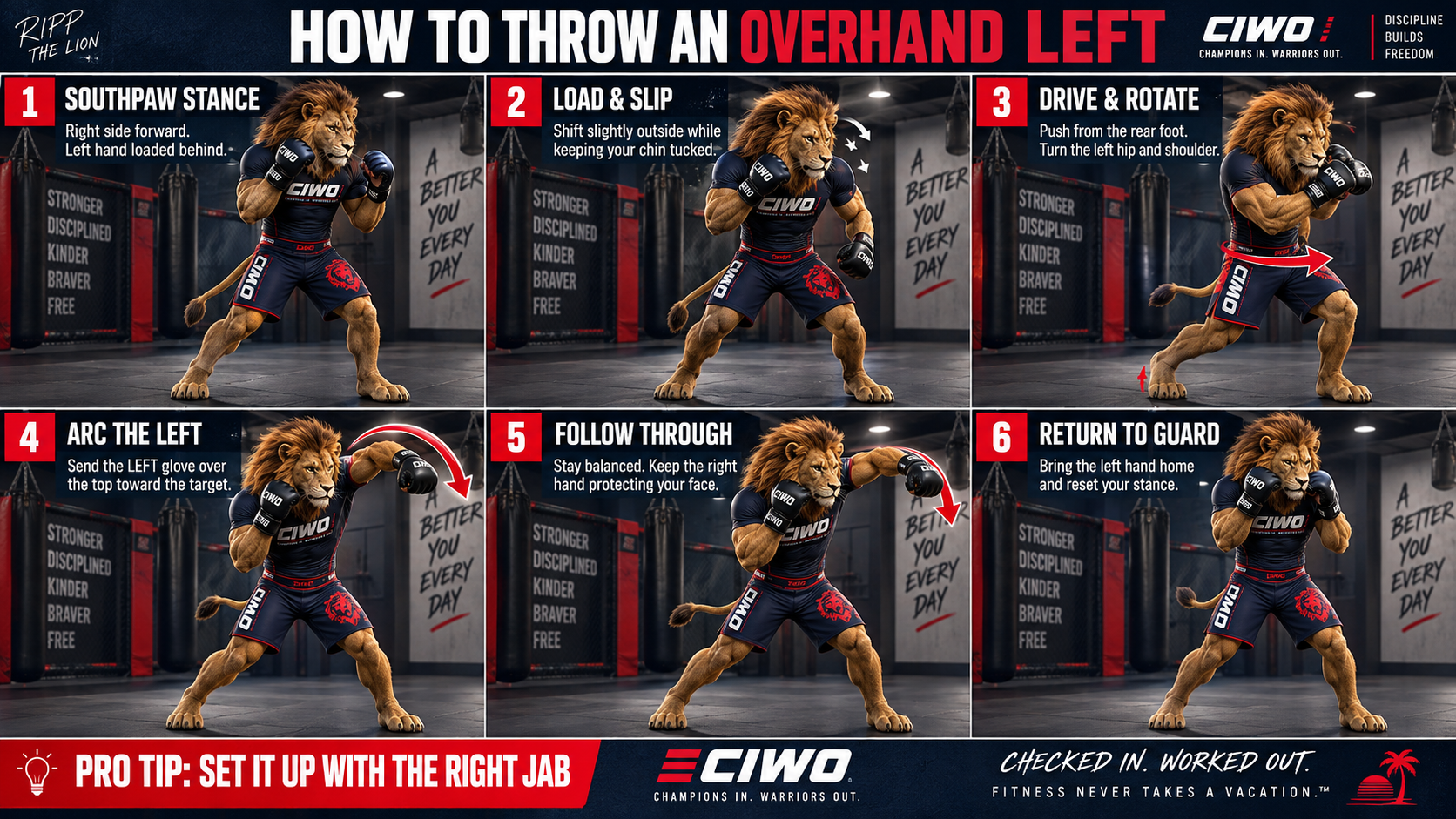

The Overhand Left is a powerful looping punch most naturally thrown as the rear hand from a southpaw stance. It travels over or around an opponent’s lead hand and can be effective when disguised behind a right jab, level change, feint or angle step.
This guide teaches the rear overhand left from southpaw: right foot and right shoulder forward, left foot and left shoulder back. If you stand orthodox, the comparable rear-hand technique is the overhand right.
Technique Overview
- Stance: Southpaw
- Striking hand: Anatomical left hand—the rear hand
- Primary targets: Opponent’s guard line or legal head target during supervised training and competition
- Main power sources: Rear-foot drive, hip rotation, torso rotation and coordinated shoulder movement
- Best setups: Right jab, right-hand feint, level-change feint, outside foot position or opponent reaching with the lead hand
- Range: Midrange
How to Throw the Overhand Left
- Southpaw stance: Place the right foot and right shoulder forward with the left side behind. Keep the knees soft, chin tucked and both gloves near your face.
- Load and slip: Use a right jab or feint, then shift your head slightly outside the opponent’s centerline without bending excessively at the waist. Do not make a large windup.
- Drive and rotate: Push through the ball of the rear left foot. Allow the left heel, hip and shoulder to rotate forward together while your core stays braced.
- Arc the left glove: Send the anatomical left glove over the top in a compact looping path. Keep a natural bend in the elbow and angle the palm inward or slightly downward near impact.
- Protect and follow through: Keep the right glove near your cheek and the right shoulder organized. Rotate through the target without falling forward or swinging past your balance.
- Return to guard: Retract the left glove immediately, recover your southpaw stance and be ready to defend, angle away or continue the combination.
Key Form Checklist
- Right foot forward and left foot back in southpaw stance.
- The anatomical left hand throws the punch.
- Chin stays tucked behind the shoulder line.
- Right glove remains close enough to protect the face.
- Rear foot, left hip and left shoulder rotate as one coordinated action.
- The punch follows a compact arc rather than a wide, visible swing.
- Eyes remain on the opponent or target.
- Finish balanced enough to retract, defend or continue the combination.
Setups and Combinations
- Right jab → Overhand left: Use the jab to occupy the guard and establish range.
- Double right jab → Overhand left: Change the rhythm before driving the rear hand over the top.
- Right jab to the body → Overhand left: Change levels and bring the punch back upstairs.
- Right-hand feint → Overhand left: Draw a defensive reaction without committing the jab.
- Outside step → Overhand left: Step the lead right foot outside an orthodox opponent’s lead foot when the position is available, then rotate without crossing your feet.
- Overhand left → Right hook: Recover balance after the left and follow with the lead hook only when range and control allow.
Common Mistakes and Fixes
- Throwing the right hand: This lesson is for the overhand left. In southpaw, keep the right side forward and punch with the rear anatomical left hand.
- Telegraphing with a large windup: Keep the left glove near its guard position and create power through the floor, hip and torso.
- Making the arc too wide: Shorten the path so the punch travels over the guard without becoming a slow looping swing.
- Dropping the right glove: Keep the non-punching hand protecting your face throughout the motion.
- Leaning beyond the lead knee: Reduce the reach and maintain a stable stance so you can defend or move after the punch.
- Using only the arm: Coordinate rear-foot pressure, heel turn, hip rotation and shoulder rotation.
- Over-rotating: Stop the turn while you still control your base; do not spin or expose your back.
- Staying in range: Retract immediately and exit on an angle, defend or continue a planned combination.
Beginner Practice Progression
- Shadowboxing: Practice the southpaw stance, left-side rotation and return to guard slowly in front of a mirror.
- Target-line drill: Visualize the left glove clearing an opponent’s lead hand while the right glove protects your face.
- Heavy bag: Use light contact first. Confirm wrist alignment, balance and recovery before adding speed or power.
- Focus mitts: Work with a qualified coach who can present a safe target and correct the punch path.
- Controlled combinations: Add the right jab or feint only after the single punch remains consistent.
Suggested Drill
Perform 3 rounds of 2 minutes at technical intensity. In round one, practice the overhand left by itself. In round two, use a right jab before every overhand left. In round three, finish by returning to guard and stepping safely out of range. Rest for approximately 60 seconds between rounds.
Quality matters more than punch count. Stop the round when fatigue causes the guard, wrist alignment, stance or balance to break down.
Defense After the Punch
- Retract the left glove directly to your cheek.
- Keep the right glove ready to block or parry.
- Move your head off the centerline only while keeping visual contact.
- Exit at an angle without crossing your feet.
- Do not admire the punch or remain extended in front of the opponent.
Safety Notes
Practice under qualified supervision and use properly fitted hand wraps, gloves, mouth protection and other equipment appropriate for the session. Begin with shadowboxing or light bag work before increasing speed and power. Never use full power on an unprepared partner. Stop if you experience sharp pain, dizziness, confusion, headache, vision changes or unusual discomfort. Suspected concussion symptoms require prompt medical evaluation and no same-day return to contact activity.
Frequently Asked Questions
Is the overhand left only for southpaw fighters?
An orthodox fighter can throw a lead-side overhand left, but this tutorial specifically teaches the more common rear overhand left from southpaw, where the left hand begins behind the right.
Should the punch be a large looping swing?
No. The path travels over the top, but it should remain compact enough to reach the target efficiently and return to guard quickly.
Where does the power come from?
Power comes from coordinated pressure against the floor, rear-foot pivot, hip and torso rotation, shoulder movement and correct timing—not from swinging the arm alone.
What is the easiest setup for a beginner?
A controlled right jab followed by the overhand left is a practical starting combination. The jab helps establish range and can move the opponent’s attention or guard.
The Bottom Line
The rear overhand left is most effective when it is set up rather than announced. Start in southpaw, keep the right hand guarding, drive from the rear left foot, rotate the left hip and shoulder, arc the anatomical left glove over the top and return immediately to a balanced guard.
Power gets attention. Discipline brings the hand home.
RIPP the Lion — Checked In. Worked Out.
Keep Training with CIWO
Looking for MMA gloves, hand wraps, heavy bags, focus mitts and training accessories? Visit the Checked In. Worked Out. Shop and explore equipment for gym, home and travel training.
Affiliate disclosure: Some shop links may be affiliate links. CIWO may earn a commission from qualifying purchases at no additional cost to you.
Training disclaimer: This content is for general educational purposes. Combat sports carry a risk of injury. Train under qualified supervision, use appropriate protective equipment and work within your experience level.
Fitness Never Takes a Vacation.™