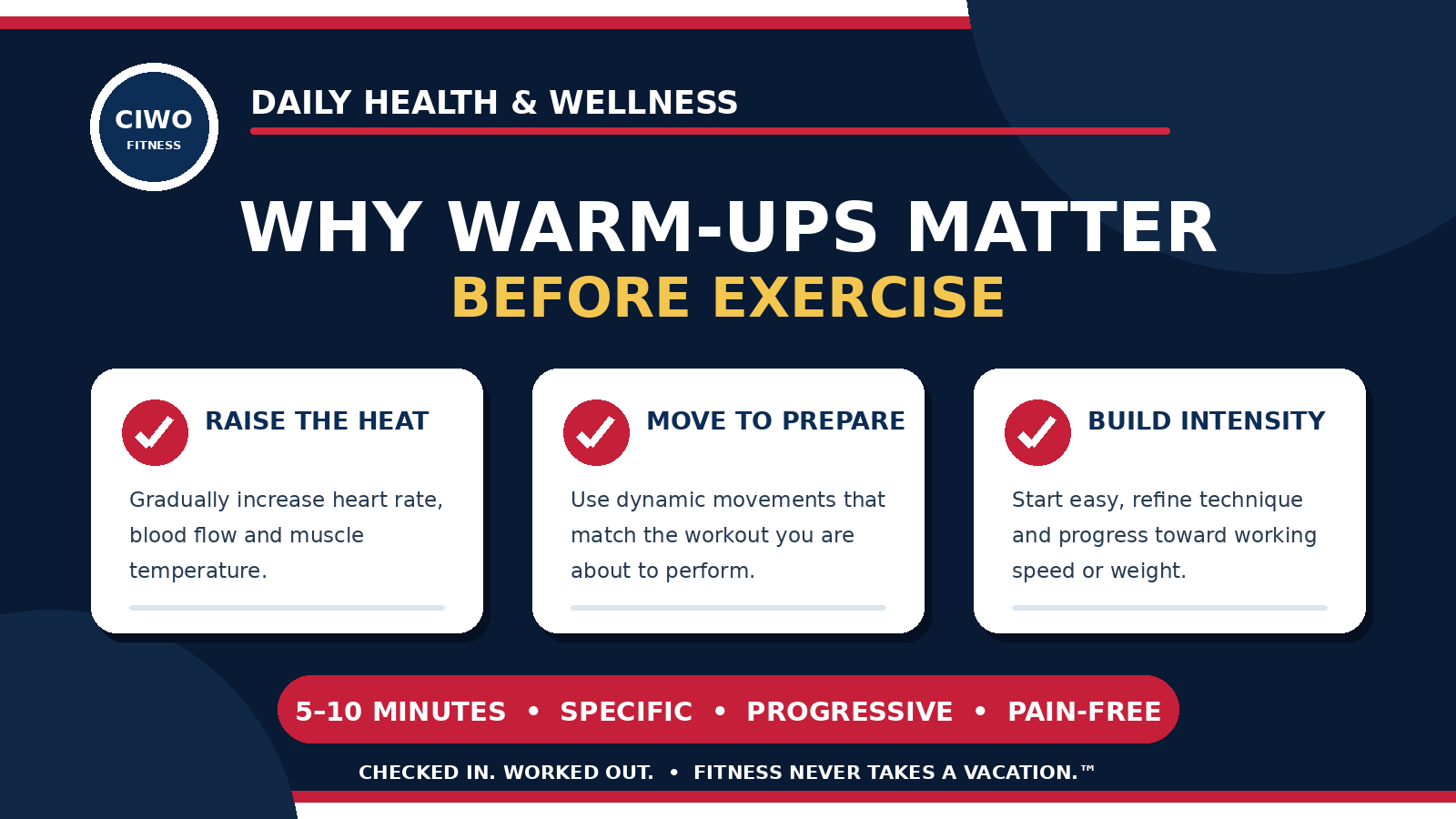

A warm-up is the bridge between rest and training. It gradually increases heart rate, breathing, circulation and muscle temperature while giving you time to rehearse the movements your workout requires. A useful warm-up does not need to exhaust you—it should leave you feeling more prepared to move.
For many workouts, approximately 5 to 10 minutes is a practical starting point. You may need longer in cold conditions, before intense exercise, after a long period of sitting or when a sport requires fast and complex movements.
What Happens During a Warm-Up?
- Your heart rate rises gradually: This helps the cardiovascular system transition from rest toward exercise instead of jumping immediately into hard work.
- Blood flow increases: Working muscles receive more oxygen-rich blood as activity builds.
- Muscle temperature increases: Warmer tissue can move more efficiently through the ranges required by the workout.
- Joints begin moving: Controlled movement rehearses the positions and ranges of motion you plan to use.
- Your nervous system practices: Sport- or lift-specific movements help coordinate technique, balance, timing and force production.
- Your mind checks in: A warm-up gives you a chance to notice unusual pain, stiffness, dizziness or fatigue before intensity increases.
The Three Parts of an Effective Warm-Up
1. Raise your temperature
Begin with easy whole-body movement such as brisk walking, light cycling, rowing or marching. Start at a comfortable pace and gradually increase the effort. You should feel warmer and breathe a little faster while still being able to talk.
2. Mobilize the areas you will use
Use controlled dynamic movements through a comfortable range. Examples include arm circles, shoulder rolls, hip hinges, leg swings, ankle rocks, bodyweight squats and walking lunges. Select movements that match the joints and muscles involved in the workout.
3. Rehearse the activity
Perform easier versions of the main exercise. A runner can progress from walking to easy jogging and short controlled pickups. A lifter can perform the movement with body weight, an empty bar or lighter sets before reaching working weight. A recreational athlete can practice footwork and skills at reduced speed before moving faster.
Simple 7-Minute General Warm-Up
- 2 minutes: Brisk walk, easy bike or march in place.
- 30 seconds: Shoulder rolls and controlled arm circles.
- 30 seconds: Hip hinges with a neutral spine.
- 1 minute: Alternating knee lifts or low-impact step jacks.
- 1 minute: Controlled bodyweight squats.
- 1 minute: Alternating reverse lunges or supported split squats.
- 1 minute: Rehearse the first exercise with low resistance and gradually increase the effort.
Modify or replace any movement that causes pain, does not match your ability or conflicts with guidance from your healthcare professional.
Warm-Up for Strength Training
A strength warm-up should prepare both the movement pattern and the load. After a few minutes of light movement, perform one or more progressively heavier preparation sets for the first major exercise. The exact number depends on the lift, your experience and how heavy the working sets will be.
- Practice the exercise with body weight, a light dumbbell or an empty bar when appropriate.
- Use controlled repetitions and confirm your setup, grip, stance and range of motion.
- Add weight in steps while reducing repetitions so preparation sets do not create unnecessary fatigue.
- Use additional specific preparation when changing to a very different movement or muscle group.
Example only: Before a working bench press, someone might perform 8 to 10 easy repetitions with a very light load, 5 repetitions at a moderate preparation load and 2 to 3 repetitions closer to the working weight. Load selection must match the individual’s strength, experience and health.
Warm-Up for Walking, Running or Cardio
Start with the same activity at a lower intensity. Before running, walk briskly and then jog easily. Before cycling, pedal with light resistance. Before using a stair machine, begin at a slower level. Gradually approach your intended pace over approximately 5 to 10 minutes rather than starting at maximum effort.
Warm-Up for Sports and Fast Movement
Sports often require acceleration, jumping, cutting, rotation and quick reactions. Begin with general movement, then add sport-specific drills in stages. Progress from predictable movements at low speed to faster movements that resemble practice or competition. Avoid making the warm-up so demanding that performance is reduced before the activity begins.
Dynamic Movement vs. Static Stretching
Dynamic movements use controlled motion and are often a practical fit immediately before activity. Static stretching involves holding a position. Flexibility work can be useful, but stretching cold muscles is not recommended. If you use static stretches before training, warm the body first and keep the approach appropriate for the activity. Longer flexibility sessions often fit better after training or in a separate session.
What a Warm-Up Cannot Do
- It cannot guarantee that an injury will never occur.
- It cannot correct unsafe technique or inappropriate exercise selection.
- It does not replace gradual training progression, rest, hydration or suitable equipment.
- It should not be used to push through sharp, worsening or unexplained pain.
Common Warm-Up Mistakes
- Starting too hard: The first minute should not feel like the final minute of the workout.
- Using the same routine for everything: A squat session, a run and a tennis match place different demands on the body.
- Turning it into a workout: Excessive volume can create fatigue before the main session.
- Moving carelessly: Use the warm-up to reinforce good technique, not rushed repetitions.
- Ignoring warning signs: Stop if you develop chest pain, severe shortness of breath, faintness, unusual weakness or sharp pain.
When You May Need a Longer or Modified Warm-Up
Consider more time or individual guidance when exercising in cold weather, preparing for high-intensity work, returning after inactivity or injury, managing stiffness, training early in the day or performing technically demanding movements. A physical therapist, qualified trainer or clinician can help adapt a warm-up for limitations or rehabilitation needs.
Frequently Asked Questions
How long should I warm up?
Approximately 5 to 10 minutes is a practical general range, but the activity, environment, intensity, age, health and how your body feels can change the amount of time needed.
Is walking enough?
Walking may be enough before an easy walk. Before strength training, running or sport, add movements and lower-intensity practice that more closely resemble the activity.
Should I warm up before every workout?
Yes, but the warm-up can be scaled to the session. A gentle mobility workout may need only a brief transition, while heavy lifting, sprinting or competitive sport generally warrants more preparation.
Does sweating mean I am warmed up?
Not necessarily. Sweat response varies with temperature, humidity, clothing, fitness and the individual. Readiness also includes comfortable movement, gradually elevated effort and successful practice of the activity.
The Bottom Line
A useful warm-up is gradual, specific, progressive and pain-free. Raise your temperature, move the joints and muscles you will use, then rehearse the workout at an easier intensity. You should finish feeling ready—not tired.
Sources
- American Heart Association: Warm Up, Cool Down
- MedlinePlus: How to Avoid Exercise Injuries
- NHS: How to Warm Up Before Exercising
Shop CIWO Fitness Picks
Looking for resistance bands, mobility tools, workout equipment and travel-ready fitness accessories? Visit the Checked In. Worked Out. Shop.
Affiliate disclosure: Some shop links may be affiliate links. CIWO may earn a commission from qualifying purchases at no additional cost to you.
Medical Disclaimer
This article provides general education and is not medical advice, diagnosis or treatment. Ask a healthcare professional whether exercise is appropriate if you have a health condition, injury, symptoms, recent surgery or other concerns. Stop exercising and seek appropriate care for chest pain, faintness, severe breathing difficulty, sudden weakness or severe pain.
Fitness Never Takes a Vacation.™