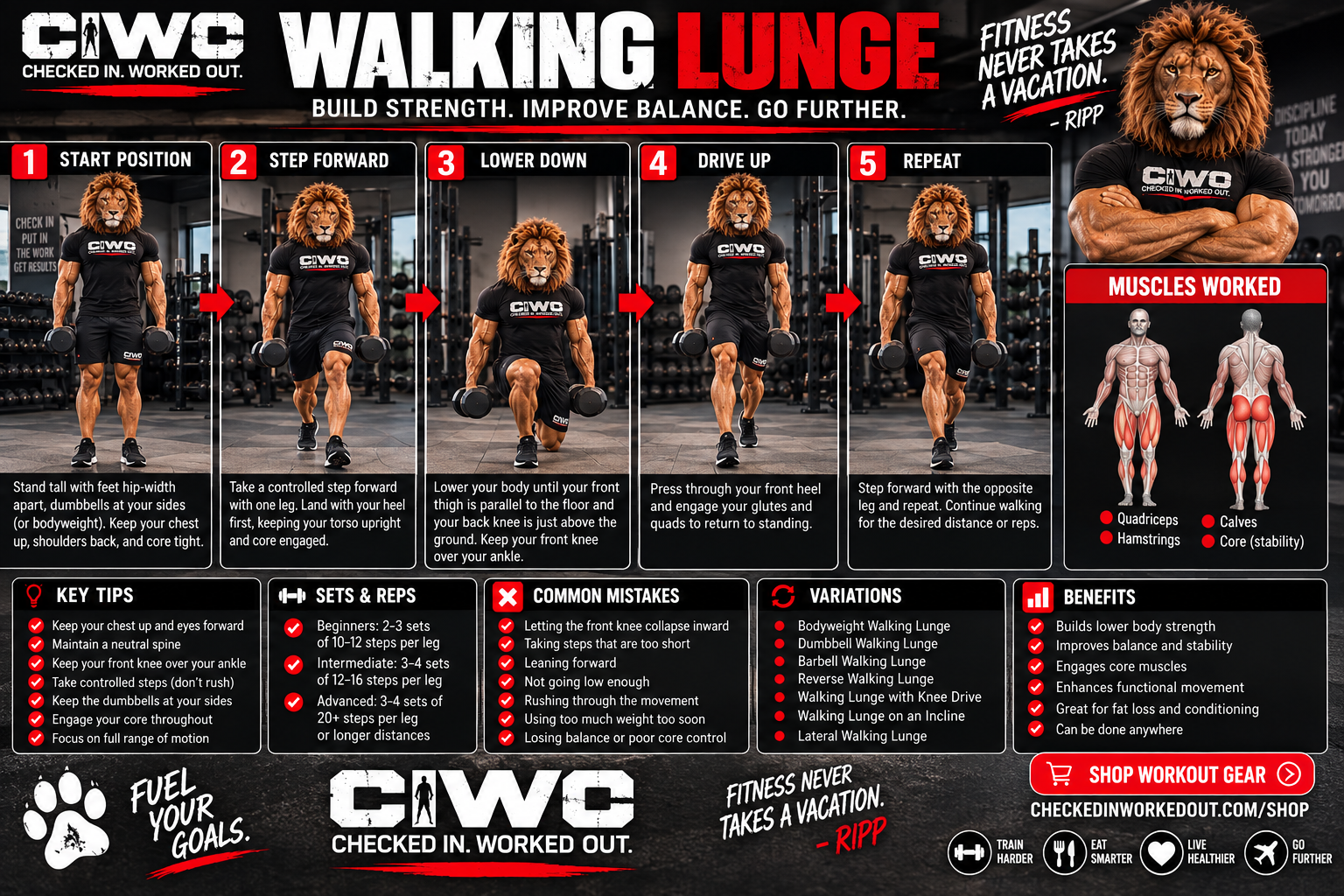

Learn the walking lunge with this CIWO step-by-step exercise guide. This lower-body movement combines a forward step with a controlled lunge to train leg strength, coordination, and balance.
What Is a Walking Lunge?
The walking lunge is a unilateral lower-body exercise in which you step forward, lower into a lunge, rise, and continue forward with the opposite leg. It trains the quadriceps, glutes, and other muscles that help stabilize your hips, knees, and trunk.
How to Perform a Walking Lunge
1. Set Your Starting Position
Stand tall with feet about hip-width apart. Brace your abdomen gently, keep your chest comfortably upright, and look ahead. Start with bodyweight until you can control each step.
2. Step Forward
Take a comfortable step forward, keeping your feet approximately hip-width apart rather than placing one foot directly in front of the other on a tightrope.
3. Lower With Control
Bend both knees and lower your body toward the floor as far as you can comfortably control. Keep your front foot planted and your front knee tracking in the same direction as your toes. Your rear knee can approach the floor without striking it.
4. Drive Up and Continue Walking
Push through your front foot to stand, bring the rear leg forward, and step directly into the next lunge. Alternate legs while keeping your torso steady and your steps deliberate.
Breathing and Tempo
Inhale as you lower and exhale as you rise. Use a controlled descent and a smooth ascent rather than rushing or bouncing off the bottom position.
Muscles Worked
Walking lunges primarily challenge the quadriceps and glutes. The hamstrings, calves, hip stabilizers, and trunk muscles assist with movement and balance.
Beginner Workout and Progressions
Begin with 2 sets of 6–8 steps per leg, resting 60–90 seconds between sets. If walking lunges feel unstable, practice supported stationary split squats or reverse lunges first. Progress to 2–3 sets of 8–12 steps per leg as control improves. Add light dumbbells only after your bodyweight technique is consistent.
Common Mistakes to Avoid
Avoid stepping on a narrow line, taking steps so short that balance or knee comfort suffers, slamming the rear knee into the floor, letting the front knee collapse inward, leaning excessively forward, and sacrificing control to cover more distance.
Safety and Modifications
Use a clear, level path and supportive footwear. Hold a stable rail or countertop when learning the movement, or substitute stationary split squats if space is limited. Work within a comfortable range of motion; stop if you feel sharp pain, dizziness, or instability. Anyone with an injury or relevant medical restriction should seek individualized guidance before loading the exercise.
Walking Lunge FAQ
Should my front knee stay behind my toes?
Not necessarily. Some forward knee travel is normal; prioritize a planted foot, controlled motion, comfortable range, and knee alignment with the toes.
Are walking lunges good for beginners?
They can be, but the moving step adds a balance challenge. Beginners may find supported or stationary lunges easier to learn first.
How many walking lunges should I do?
A practical starting point is 2 sets of 6–8 steps per leg, adjusting the volume to your current ability and recovery.
Can I do walking lunges with dumbbells?
Yes. Hold light dumbbells at your sides after you can complete the bodyweight version with steady balance and consistent technique.
CIWO reminder: Quality repetitions matter more than rushing through a set. Train consistently and progress at a pace you can control.