

The body jab is a fast lead-hand punch directed toward the opponent’s torso. It can interrupt rhythm, draw the guard downward, score at range and help set up attacks to the head. This guide teaches the body jab from an orthodox stance, using the left hand while the right hand protects the face.
A clean body jab is not simply a head jab aimed downward. Lower your entire stance with the knees, keep your eyes forward and send the lead glove straight to the target without leaning your head and chest into danger.
Body Jab at a Glance
- Stance shown: Orthodox—left foot and left hand forward
- Striking hand: Lead left hand
- Common target: Center of the torso or solar-plexus area on a pad or bag
- Main purpose: Disrupt rhythm, score at range and create openings
- Key protection: Keep the rear right glove at the cheek and move your head with your level change
How to Throw a Body Jab: Step by Step
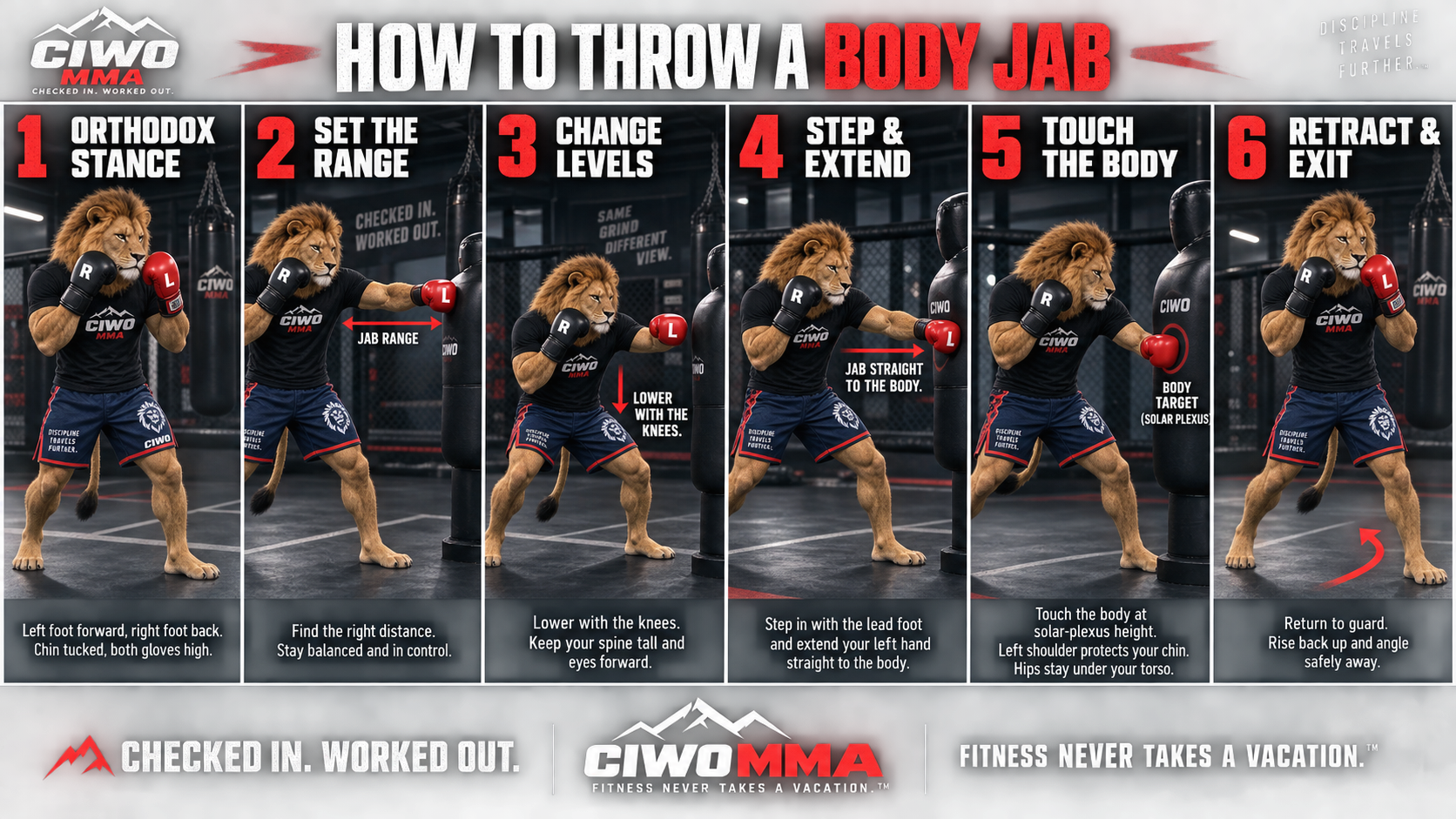
1. Establish Your Orthodox Stance
Stand with your left foot forward and right foot back. Keep your knees soft, chin tucked and both gloves near your cheeks. Stay light enough on your feet to enter range and exit without crossing your stance.
2. Set the Range
Use small steps, feints or a head-level jab to judge distance. The body jab should reach the torso without forcing you to stretch, dive forward or leave your rear foot behind.
3. Change Levels with Your Knees
Bend both knees slightly and lower your hips while keeping your spine tall and your eyes on the target. Avoid folding at the waist. The level change should be compact enough that you can move and defend immediately.
4. Step and Extend the Lead Hand
Take a short step with the lead left foot as the left glove travels straight toward the body. Let the left shoulder rise to help protect your chin. Keep the rear right glove firmly beside your face and avoid flaring the lead elbow.
5. Make Controlled Contact
Touch the target with the first two knuckles behind a straight wrist. Exhale sharply and keep your hips under your torso. Use accuracy and speed rather than falling forward in an attempt to create power.
6. Retract and Exit
Snap the left glove directly back to your cheek. Recover your stance as you rise, then angle away, step out or continue with a combination. Do not remain low and stationary after the punch.
Key Form Cues
- Lower with the knees—not the waist.
- Keep your eyes forward throughout the level change.
- Send the lead glove straight to the torso.
- Keep the rear glove protecting your cheek.
- Use a short lead-foot step instead of reaching.
- Retract immediately and leave the line of attack.
Common Mistakes and Corrections
- Bending at the waist: Lower your hips by bending the knees so you can see and defend.
- Dropping the rear hand: Keep the right glove at your cheek to reduce the opening for a counter.
- Reaching from too far away: Move your feet into range before fully extending the jab.
- Telegraphing the level change: Keep the dip small and use the same rhythm as your other attacks.
- Leading with the head: Send the glove first and keep your head from drifting beyond the lead knee.
- Staying low after contact: Retract, recover and exit immediately.
- Trying to overpower the target: Prioritize timing, placement and balance over force.
Body Jab Setups and Combinations
- Head jab → body jab: Change levels after directing attention upward.
- Double jab—head then body: Use the first jab to measure and the second to score downstairs.
- Body jab → right cross: Rise into the rear straight as the opponent reacts to the body.
- Body jab → left hook: Retract the jab and rotate into a compact lead hook.
- Body-jab feint → overhand right: Use the level-change reaction to create an opening above the guard.
- Body jab → angle out: Score, retract and step away from the opponent’s power side.
Practice Progression
- Level-change drill: Practice lowering with the knees while maintaining your guard for 2 sets of 10 repetitions.
- Shadowboxing: Perform 3 rounds of 1 minute, focusing on balance and immediate retraction.
- Heavy bag: Complete 3 sets of 8 controlled body jabs using a clearly chosen torso-height target.
- Focus mitts or body shield: Add setups and exits with a qualified coach or experienced partner.
Defense After the Body Jab
Attacking the body can expose you to hooks, uppercuts, knees or kicks if you remain in place. Keep the rear hand high, avoid dropping your eyes and recover promptly. Depending on your ruleset and position, exit at an angle, pull back to range or continue with a defensive combination.
Safety Notes
Practice with properly fitted gloves and hand wraps when using pads or a heavy bag. Begin at low speed, maintain wrist alignment and avoid hard body contact during unsupervised partner drills. Train legal targets for your sport and ruleset under qualified supervision. Stop if you experience sharp pain, dizziness or other concerning symptoms.
Frequently Asked Questions
Is a body jab thrown with the lead hand?
Yes. A jab is normally thrown with the lead hand. In an orthodox stance that is the left hand; in a southpaw stance it is the right hand.
Should I bend forward to reach the body?
No. Lower your stance primarily through the knees and hips while keeping your spine controlled and eyes forward. Use footwork when additional range is needed.
Where should the body jab land?
During training, aim at a controlled torso-height target on a heavy bag, focus mitt or body shield. Target selection in competition depends on positioning and the rules of the sport.
Does the body jab need to be powerful?
Its value often comes from speed, timing, accuracy and the reaction it creates. Stay balanced enough to defend or continue attacking immediately.
Change the level, touch the target and leave before the counter arrives.
RIPP the Lion
Keep Training with CIWO
Build your striking skills one controlled repetition at a time. Explore CIWO training gear and accessories for workouts at home, in the gym or while traveling.
Some shop links may be affiliate links. CIWO may earn a commission from qualifying purchases at no additional cost to you.
This content is for general education and is not a substitute for personalized coaching, medical advice or professional safety supervision.
Checked In. Worked Out. Fitness never takes a vacation.™
Technique Development and Drilling
How to Throw a Body Jab should first be practiced slowly enough to maintain stance, balance, guard and a controlled return to position. Speed and power are useful only when the mechanics remain repeatable.
Beginner progression
Start with shadowboxing or a cooperative technical drill. Build accuracy before adding a heavy bag, pads or live resistance. Increase speed gradually and reset after every repetition rather than allowing fatigue to turn the drill into uncontrolled movement.
Defense after the strike
Do not treat the strike as finished at contact. Recover the hand or leg, restore the guard, regain stance and be prepared to move, defend or continue the combination. That recovery is part of the technique.
Common training errors
Typical problems include overcommitting the body, dropping the opposite hand, losing the stance, telegraphing the attack and chasing power before accuracy. Record short practice rounds when possible so you can review posture and recovery.
Safety
Use appropriate gloves, wraps, pads and supervision for contact work. Technical practice should be controlled; hard sparring is not required to learn mechanics and carries substantially more injury risk.
Continue with the CIWO MMA & Combat Training hub and MMA Striking library.