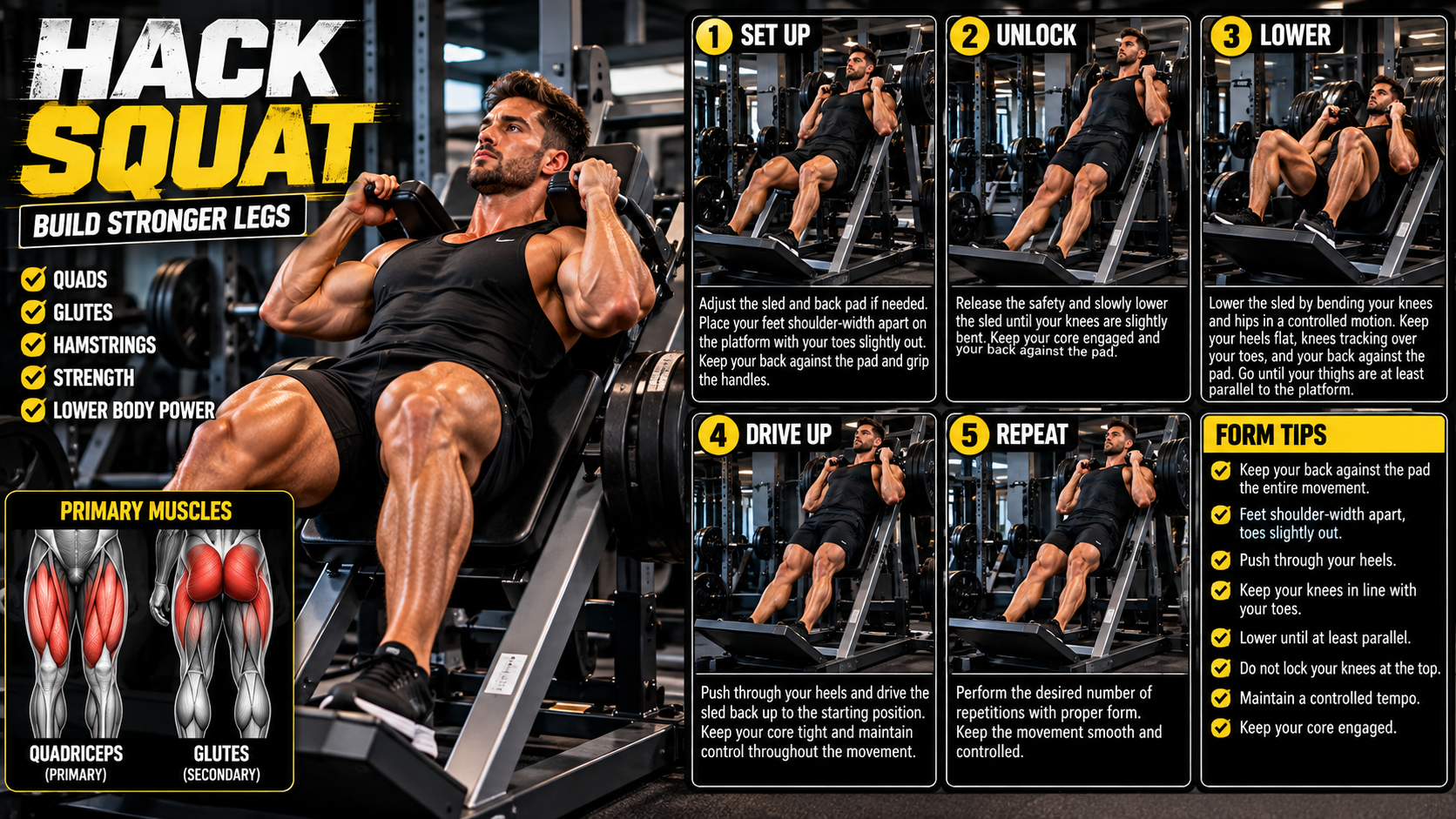

The hack squat is a machine-based lower-body exercise that primarily trains the quadriceps while also involving the glutes and other muscles that extend and stabilize the hips and knees. Because the machine guides the sled and supports the torso, it can be a useful squat variation for building lower-body strength while concentrating on controlled leg movement.
Muscles Worked
- Quadriceps: primary knee extensors.
- Glutes: contribute to hip extension.
- Hamstrings and adductors: assist movement and stabilization.
- Core: helps maintain a stable supported position.
Hack Squat: Step-by-Step
1. Set Up
Step onto the platform with your shoulders beneath the pads and your back and hips supported. Start with your feet around shoulder-width apart in a comfortable position. Machine geometry and individual anatomy vary, so use a stance that allows natural knee tracking.
2. Brace and Release the Safety
Grip the handles, brace your trunk and extend your legs enough to unload the safety stops. Release the machine’s safety mechanism according to its instructions.
3. Lower Under Control
Bend your knees and hips to allow the sled to descend smoothly. Keep your feet planted and your knees tracking generally in the same direction as your toes. Lower only as far as you can comfortably maintain control, stable foot contact and a supported torso.
4. Drive Up
Press firmly through your feet and extend your knees and hips to move the sled upward. Keep your back against the pad and avoid bouncing out of the bottom. Finish in a strong position without forcefully snapping the knees into hyperextension.
5. Repeat and Re-Rack
Continue for the planned repetitions with a controlled tempo. When finished, fully engage the safety stops before relaxing or stepping away.
Form Tips
- Keep your back and hips supported against the pad.
- Maintain stable full-foot contact with the platform.
- Let your knees track naturally with your feet.
- Control the descent rather than dropping rapidly.
- Use a range of motion you can control comfortably.
- Start with a manageable load while learning the machine.
Common Mistakes
Too much weight: excessive resistance can shorten your range or reduce control. Heels lifting: adjust stance, load or depth if you cannot maintain stable foot contact. Knees collapsing inward: aim for a stable knee path. Bouncing: reverse direction under muscular control. Forcing depth: mobility, proportions and machine design differ, so there is no single depth every athlete must reach.
Sets and Reps
A practical starting approach for many healthy adults learning the exercise is 2–3 sets with a load that permits controlled technique. Rep ranges can vary with strength, muscular-development and general resistance-training goals. Technique should remain consistent as resistance increases.
Hack Squat vs. Leg Press
Both train the lower body, but their body positions and machine mechanics differ. The hack squat usually supports the torso on an angled pad while the athlete stands on a platform beneath a moving sled. The leg press usually places the athlete seated or reclined while pressing a platform away. Equipment, comfort and programming goals can guide your choice.
Safety
Inspect the machine and understand its safety stops before using substantial resistance. Stop if you experience sharp or unusual pain. If you have an existing knee, hip, back or other musculoskeletal condition, are returning from injury, or have exercise restrictions, consider guidance from a qualified healthcare or exercise professional.
Frequently Asked Questions
Is the hack squat only for quadriceps?
No. The quadriceps are heavily involved, but the glutes and other lower-body muscles also contribute.
How deep should I go?
Use a depth that lets you maintain control, stable foot contact and a comfortable supported position. Anatomy, mobility and machine design affect appropriate depth.
Should my knees go past my toes?
Some forward knee travel can naturally occur and varies with stance, limb proportions, depth and machine geometry. Focus on controlled movement, stable feet and comfortable knee tracking rather than treating the toes as an absolute boundary.
Can beginners use a hack squat?
It can be appropriate for many beginners when setup is correct and resistance is manageable. Learn the safety mechanism and movement pattern before progressing the load.
Checked In. Worked Out.
Fitness Never Takes a Vacation.