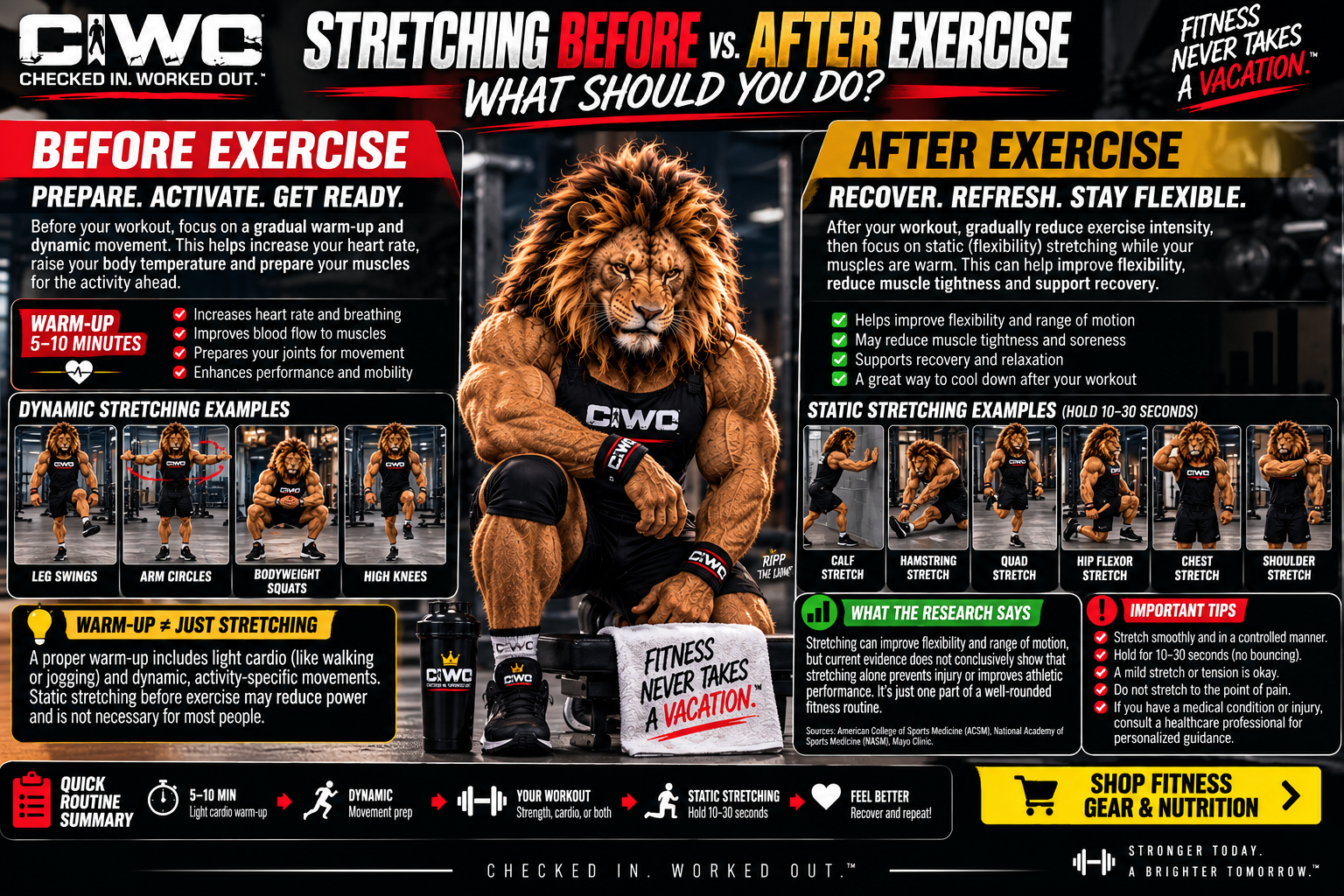

Should you stretch before exercise, after exercise, or both? The answer depends on what kind of stretching you are doing and what you want it to accomplish. A warm-up and a flexibility session are related, but they are not the same thing. Before training, the priority is generally to prepare your body progressively for the activity ahead. Afterward, when your muscles are already warm, static flexibility work can be a convenient option.
First: Stretching and Warming Up Are Not the Same Thing
A good warm-up gradually raises heart rate and breathing and introduces movements similar to the workout you are about to perform. For example, a runner might begin with easy walking or jogging before progressing toward normal training pace. A lifter can use general movement followed by lighter, exercise-specific sets.
Stretching can be included in a warm-up, but simply holding a few stretches is not a complete replacement for gradually preparing for exercise.
Before Exercise: Think Dynamic and Activity-Specific
For many workouts, dynamic movement is a practical way to prepare. Dynamic stretching moves joints and muscles through controlled ranges rather than holding one position for an extended period.
Examples of Pre-Workout Dynamic Movement
- Leg swings
- Arm circles
- Controlled bodyweight squats
- Walking lunges
- High knees at an appropriate pace
- Hip and shoulder mobility movements
- Light, exercise-specific practice sets
The exact warm-up should match the activity. A heavy squat session does not require exactly the same preparation as a jog, cycling workout or upper-body training session.
What About Static Stretching Before Exercise?
Static stretching means moving into a stretch and holding the position. It can improve range of motion, but long or intensive static stretching immediately before activities requiring maximal strength, power or speed may not be the best way to prepare for peak performance. Research on the size and practical importance of acute performance effects is nuanced, and not every brief static stretch causes a meaningful decline.
If you enjoy static stretching before exercise or need additional range of motion for a particular activity, it does not automatically need to be eliminated. Keep it comfortable and consider following it with dynamic, activity-specific movement before demanding exercise.
After Exercise: Static Stretching Can Fit Well
After training, gradually reduce exercise intensity rather than stopping abruptly after demanding cardiovascular work. Once you have transitioned into your cool-down, static stretching can be used to work on flexibility while the muscles are warm.
Simple Post-Workout Approach
- Gradually reduce exercise intensity.
- Select the major muscle groups you want to work on.
- Move slowly into each stretch.
- Hold a comfortable stretch for roughly 10–30 seconds.
- Breathe normally rather than holding your breath.
- Avoid bouncing and stop if the stretch becomes painful.
Does Stretching Prevent Soreness or Injury?
This is where stretching is often oversold. Stretching can improve flexibility and range of motion, but evidence does not establish that stretching by itself reliably prevents exercise injuries or eliminates delayed-onset muscle soreness. Warm-up quality, progressive training, workload management, technique, recovery and the demands of the activity all matter.
Stretch because flexibility or comfortable movement is useful to you—not because you expect a few stretches to guarantee that you will never become sore or injured.
A Practical Before-and-After Routine
Before Your Workout
- Begin with about 5–10 minutes of gradually increasing activity when appropriate for the workout.
- Add dynamic movements that resemble the ranges and patterns you will use.
- For strength training, progressively practice the exercise with manageable warm-up resistance before challenging working sets.
After Your Workout
- Gradually decrease intensity, particularly after cardiovascular exercise.
- Once breathing and effort begin settling, perform optional static stretches for areas you want to improve or maintain.
- Use smooth, comfortable stretches rather than forcing additional range.
When Should Flexibility Be Trained Separately?
If improving flexibility is an important goal, you do not have to squeeze all of your stretching into the minutes surrounding a workout. A separate flexibility or mobility session can allow you to focus on range of motion without rushing. If you stretch when you are otherwise cold, begin with several minutes of easy movement first.
Important Stretching Safety Tips
- A mild pulling sensation can be normal; sharp, stabbing or joint pain is not a goal.
- Move smoothly and avoid forcing a joint beyond a comfortable range.
- Do not bounce aggressively into a stretch.
- Individual anatomy, previous injuries and mobility differ, so not everyone needs identical ranges.
- If you have an injury, significant pain, a medical condition or activity restrictions, get individualized guidance from an appropriate health professional.
Frequently Asked Questions
Should I stretch before lifting weights?
You can, but your pre-lifting preparation should also include movement and exercise-specific warm-up sets. For many lifters, dynamic preparation followed by progressively heavier practice sets is more specific to the task than relying only on prolonged static stretches.
Is dynamic stretching always better than static stretching?
No. They serve different purposes. Dynamic movement is often useful when preparing for activity, while static stretching is a straightforward way to work on flexibility. Context matters more than declaring one universally superior.
Do I have to stretch after every workout?
No. Stretching can be useful for maintaining or improving flexibility, but there is no rule that every exercise session must end with a specific stretching routine. Your needs depend on your goals and activities.
How long should I hold a static stretch?
A practical general range is about 10–30 seconds per stretch. Keep the position controlled and comfortable rather than forcing greater range.
The Bottom Line
Before exercise: prioritize a gradual warm-up and dynamic, activity-specific preparation. After exercise: cool down gradually when appropriate, and use static stretching if you want to work on flexibility while your muscles are warm. Stretching is a useful fitness tool, but it is only one part of a well-rounded training and recovery routine.