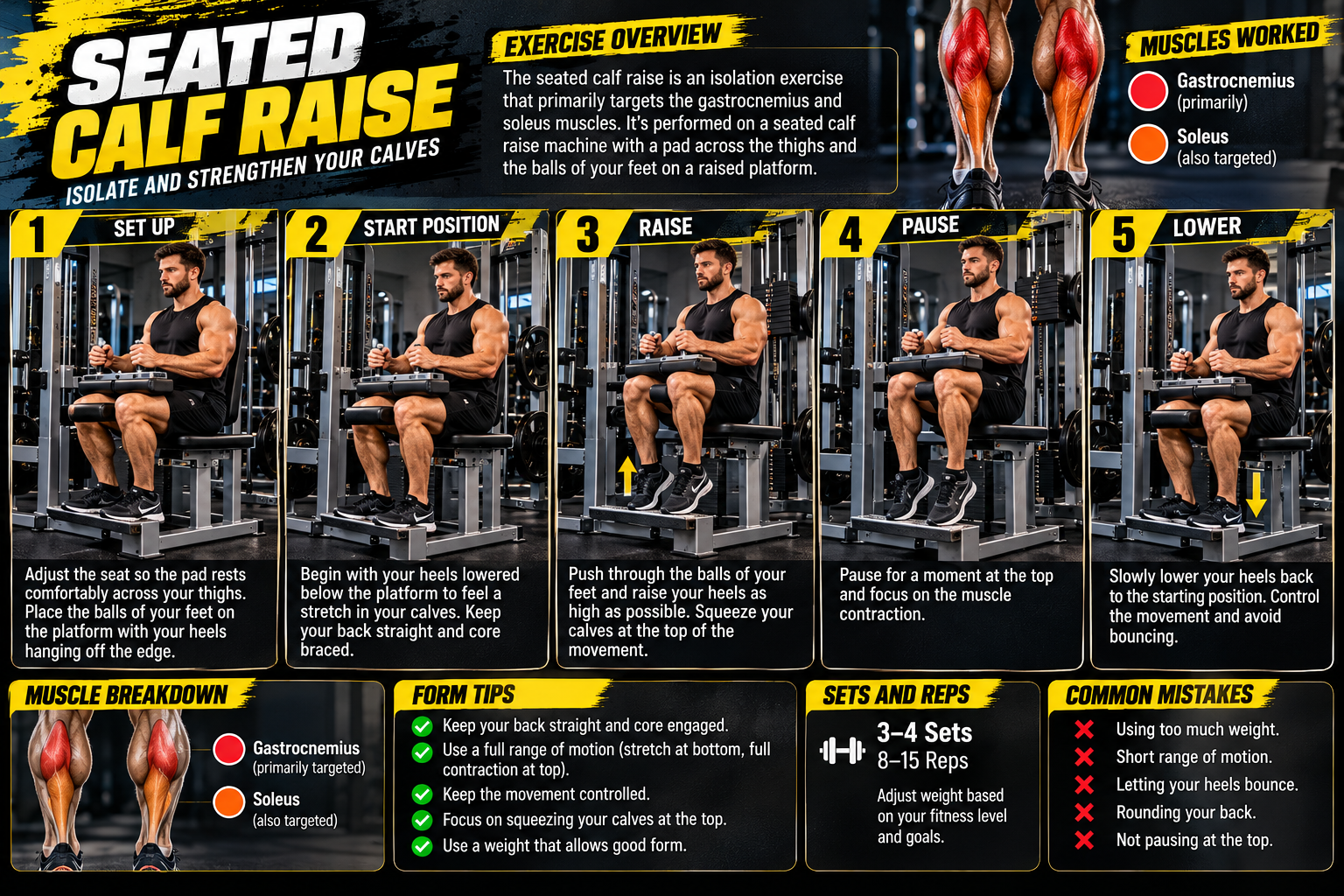

The seated calf raise is a lower-leg strength exercise performed with the knees bent. This position places substantial emphasis on the soleus while the gastrocnemius also contributes. Controlled repetitions through a comfortable range of motion are more important than simply moving the heaviest possible load.
Seated Calf Raise: Step-by-Step
Step 1: Set Up the Machine
Adjust the thigh pad so it rests securely above your knees without uncomfortable pressure. Place the balls of your feet on the platform with your heels free to move. Learn the machine’s release and safety mechanism before adding challenging resistance.
Step 2: Establish the Start Position
Keep your feet stable and torso comfortable. Lower your heels under control until you feel a comfortable calf stretch. Do not force the ankle into a painful range.
Step 3: Raise Your Heels
Press through the balls of your feet and raise your heels as high as you can comfortably control. Keep the movement at the ankles rather than bouncing your knees or body.
Step 4: Control the Top
Briefly control the top position. A deliberate pause can help prevent momentum from taking over, but there is no need to force an exaggerated contraction.
Step 5: Lower Slowly
Lower your heels smoothly to your comfortable starting depth. Avoid dropping the resistance or bouncing out of the bottom. Reset and repeat.
Muscles Worked
The calf complex includes the soleus and gastrocnemius. Both help plantar-flex the ankle. Because the gastrocnemius crosses the knee, bending the knee reduces its contribution compared with straight-knee calf-raise variations, giving the seated variation greater relative emphasis on the soleus.
Form Tips
- Keep the balls of your feet securely supported.
- Use controlled motion rather than bouncing.
- Let the ankles track naturally.
- Choose resistance that allows consistent repetitions.
- Use a comfortable stretch at the bottom.
- Keep the thigh pad securely positioned.
Common Mistakes
- Using so much weight that range of motion becomes very short.
- Bouncing at the bottom.
- Dropping the heels instead of controlling the lowering phase.
- Allowing the feet to slide.
- Forcing an uncomfortable stretch.
- Rushing repetitions.
Foot Position
A neutral, comfortable foot position is a good starting point. Extreme toe-in or toe-out positions are unnecessary. Prioritize stable foot contact and comfortable ankle tracking.
Sets and Reps
For general resistance training, 2–4 working sets of approximately 8–15 controlled repetitions can be a practical starting range. Other repetition ranges can also be useful depending on your program. Select resistance that allows good technique and gradual progression.
Seated vs. Standing Calf Raises
Seated calf raises use bent knees and give greater relative emphasis to the soleus. Standing calf raises keep the knees straighter, allowing the gastrocnemius to contribute more strongly. Either or both variations can be included depending on goals and equipment.
Safety
Start with manageable resistance and learn the machine before challenging sets. Avoid forcing painful ankle motion or allowing the resistance to drop suddenly. Stop for sharp or unusual pain and seek individualized guidance when an existing condition affects safe exercise.
The CIWO Takeaway
Set up securely, move through a comfortable range, raise and lower the heels under control, and increase resistance only when you can maintain consistent technique.