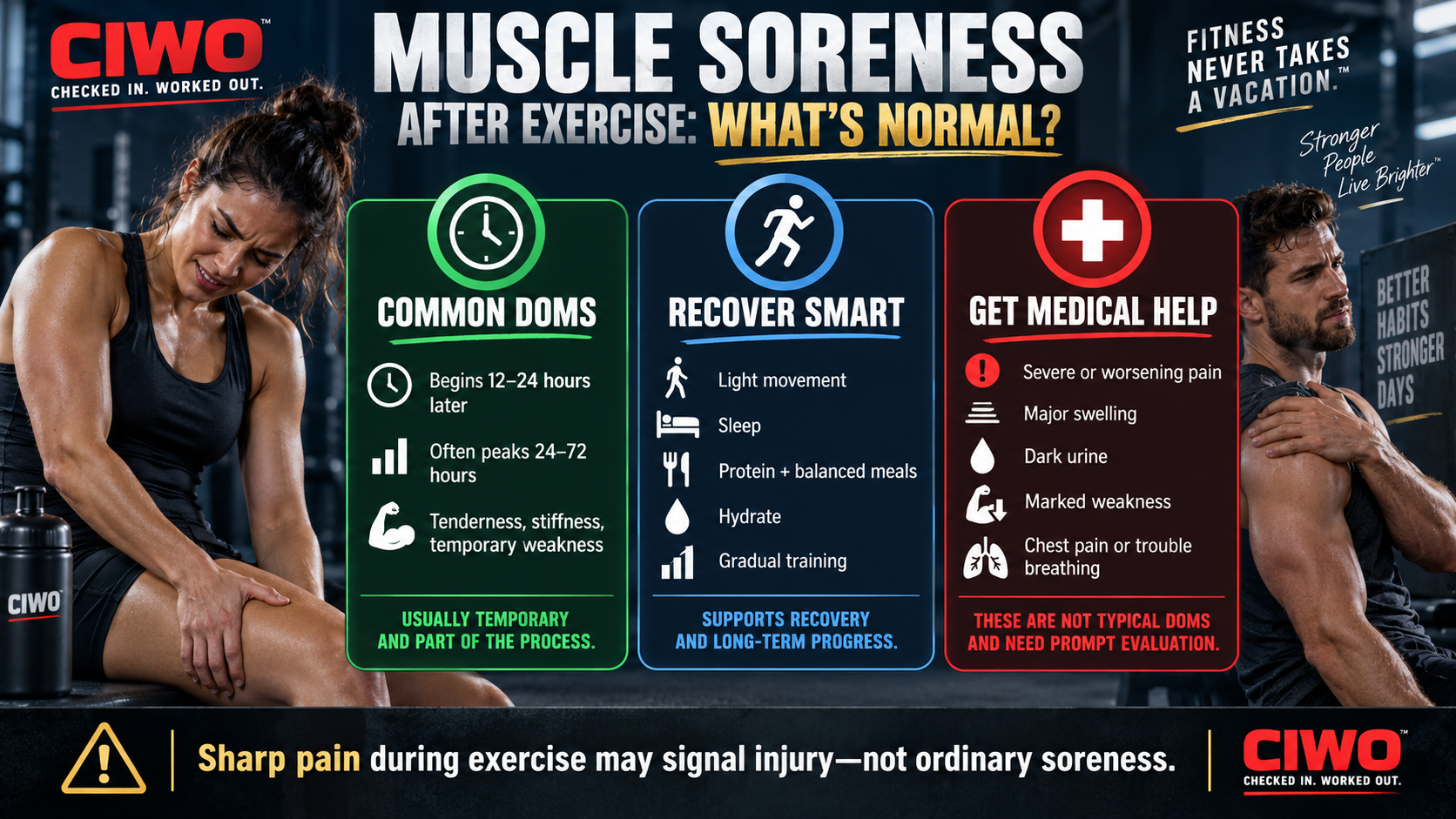

Muscle soreness after a challenging or unfamiliar workout is common, but not every pain should be dismissed as normal. Delayed-onset muscle soreness—usually called DOMS—often develops after your muscles perform work they are not accustomed to, especially exercises that emphasize controlled lengthening under load.
Knowing the usual timing and symptoms of DOMS can help you recover sensibly and recognize when pain deserves medical attention.
What Is Delayed-Onset Muscle Soreness?
DOMS is the soreness, tenderness and stiffness that can follow an unfamiliar or unusually demanding workout. It is associated with microscopic muscle damage and the body’s repair response. It is not caused simply by lactic acid remaining in the muscles.
Activities with a strong eccentric component—when a working muscle lengthens under tension—commonly trigger it. Examples include lowering a weight, walking downhill, descending stairs, lowering into a squat or returning slowly from a curl.
The Typical DOMS Timeline
- During exercise: Ordinary DOMS is usually not a sudden sharp pain during the movement.
- About 12–24 hours later: Soreness and stiffness may begin.
- About 24–72 hours later: Symptoms are often most noticeable.
- Over the next several days: Soreness should gradually improve as the muscle recovers.
The exact pattern varies with the exercise, training history, intensity and individual response. Soreness that continues without improvement, repeatedly worsens or lasts around a week deserves closer attention.
What Normal Post-Workout Soreness Often Feels Like
- A dull, achy or tender feeling in the muscles you trained
- Stiffness after sitting or when beginning to move
- Mild swelling or a temporary decrease in comfortable range of motion
- Temporary muscle fatigue or weakness
- Discomfort on both sides after bilateral exercise, although one side may feel more worked
- Symptoms that ease gradually rather than becoming more intense each day
Soreness vs. a Possible Injury
DOMS is generally diffuse and delayed. An injury is more likely when pain is sudden, sharp or localized; begins during a specific repetition; causes instability; is accompanied by substantial bruising or swelling; or prevents normal use of a joint or limb.
- More consistent with DOMS: delayed muscle tenderness, stiffness and gradual improvement.
- More concerning for injury: a pop or tearing sensation, sharp joint pain, major swelling, visible deformity, loss of function, numbness or pain that keeps worsening.
Stop the aggravating activity and seek evaluation when you suspect a significant injury. Do not try to “push through” sharp or disabling pain.
Warning Signs That Need Prompt Medical Care
Severe muscle damage can rarely lead to exertional rhabdomyolysis, which can harm the kidneys. Seek immediate medical care for muscle pain or cramping that is much worse than expected—especially when combined with marked weakness, major swelling, reduced urine output or tea- or cola-colored urine. Stop exercising while seeking care.
Emergency symptoms also include chest pain, fainting, severe shortness of breath, confusion, a visibly deformed limb or rapidly increasing swelling. Dark urine after hard exercise is not a normal sign of a productive workout.
How to Recover From Ordinary Soreness
- Use light movement: Easy walking, cycling or mobility work may reduce stiffness temporarily. Keep the effort comfortable.
- Allow recovery time: Avoid another hard session for the same severely sore muscles until movement and performance are reasonably comfortable.
- Sleep consistently: Adequate sleep supports recovery and training readiness.
- Eat balanced meals: Include sufficient total calories and protein along with carbohydrate-rich foods, fruits, vegetables and healthy fats.
- Hydrate normally: Replace fluids lost through sweat. More water is not a cure for DOMS, and excessive intake can also be unsafe.
- Try gentle self-massage or foam rolling: These may provide temporary relief for some people. Avoid aggressive pressure on an acutely injured area.
- Use heat or cold for comfort: Either may feel helpful, but neither substitutes for medical assessment when warning signs are present.
Stretching may feel good and support mobility, but research has not shown that post-exercise stretching reliably prevents DOMS. Keep stretches gentle and never force a painful range.
Should You Exercise While Sore?
Mild soreness does not always require complete rest. You may choose easy activity, train a different muscle group or reduce the load, volume and range of motion. Your movement should remain controlled and your technique should not change to protect the sore area.
Take additional recovery time when soreness is severe, normal movement is limited, strength is substantially reduced or technique deteriorates. Training hard through those signs can increase compensations and reduce workout quality.
How to Reduce Excessive Soreness Next Time
- Increase weights, repetitions, sets or workout duration gradually rather than changing everything at once.
- Begin unfamiliar exercises with conservative volume and practice the technique first.
- Return gradually after illness, travel or a long break from training.
- Use a warm-up that raises body temperature and rehearses the movements you plan to perform.
- Schedule hard sessions so the same muscles have reasonable time to recover.
- Track how your body responds instead of copying another person’s training volume.
You Do Not Need to Be Sore to Make Progress
Soreness is not a scorecard for workout quality. As your body adapts to a program, the same effective training may create less soreness. Progress is better assessed through consistent technique, gradual increases in training capacity, improved performance and results over time.
Frequently Asked Questions
Is soreness the day after exercise normal?
It can be. DOMS commonly begins after the workout rather than during it, especially after unfamiliar or more demanding exercise. It should trend toward improvement over the following days.
Does soreness mean the workout worked?
Not necessarily. Soreness reflects a response to unfamiliar or demanding stress, not a direct measurement of muscle growth, calorie burn or workout quality.
Can I take pain medicine for soreness?
Medicines have risks, contraindications and possible interactions. Ask a pharmacist or healthcare professional what is appropriate for you, especially if you have kidney, liver, stomach, bleeding, cardiovascular or medication concerns.
When should I contact a healthcare professional?
Seek guidance for pain that is severe, worsening, persistent, recurring in the same location or interfering with normal activity. Seek urgent care for dark urine, major swelling, marked weakness or other emergency warning signs.
The Bottom Line
Ordinary DOMS is delayed, affects the muscles you trained and improves gradually. Recover with sensible movement, sleep, balanced nutrition and appropriate training adjustments. Sudden sharp pain, loss of function, severe swelling, extreme weakness or dark urine should never be written off as routine soreness.
Sources
- American College of Sports Medicine: Delayed-Onset Muscle Soreness
- CDC/NIOSH: Heat-Related Illnesses and Rhabdomyolysis
- MedlinePlus: Sports Injuries
Shop CIWO Fitness & Recovery Picks
Looking for mobility tools, foam rollers, hydration gear, resistance equipment and other training essentials? Visit the Checked In. Worked Out. Shop and explore products selected to support an active lifestyle.
Affiliate disclosure: Some shop links may be affiliate links. CIWO may earn a commission from qualifying purchases at no additional cost to you.
Medical Disclaimer
This article provides general education and is not medical advice, diagnosis or treatment. Symptoms and recovery needs vary. Consult a qualified healthcare professional for persistent or concerning pain and seek urgent care for emergency warning signs.
Fitness Never Takes a Vacation.™