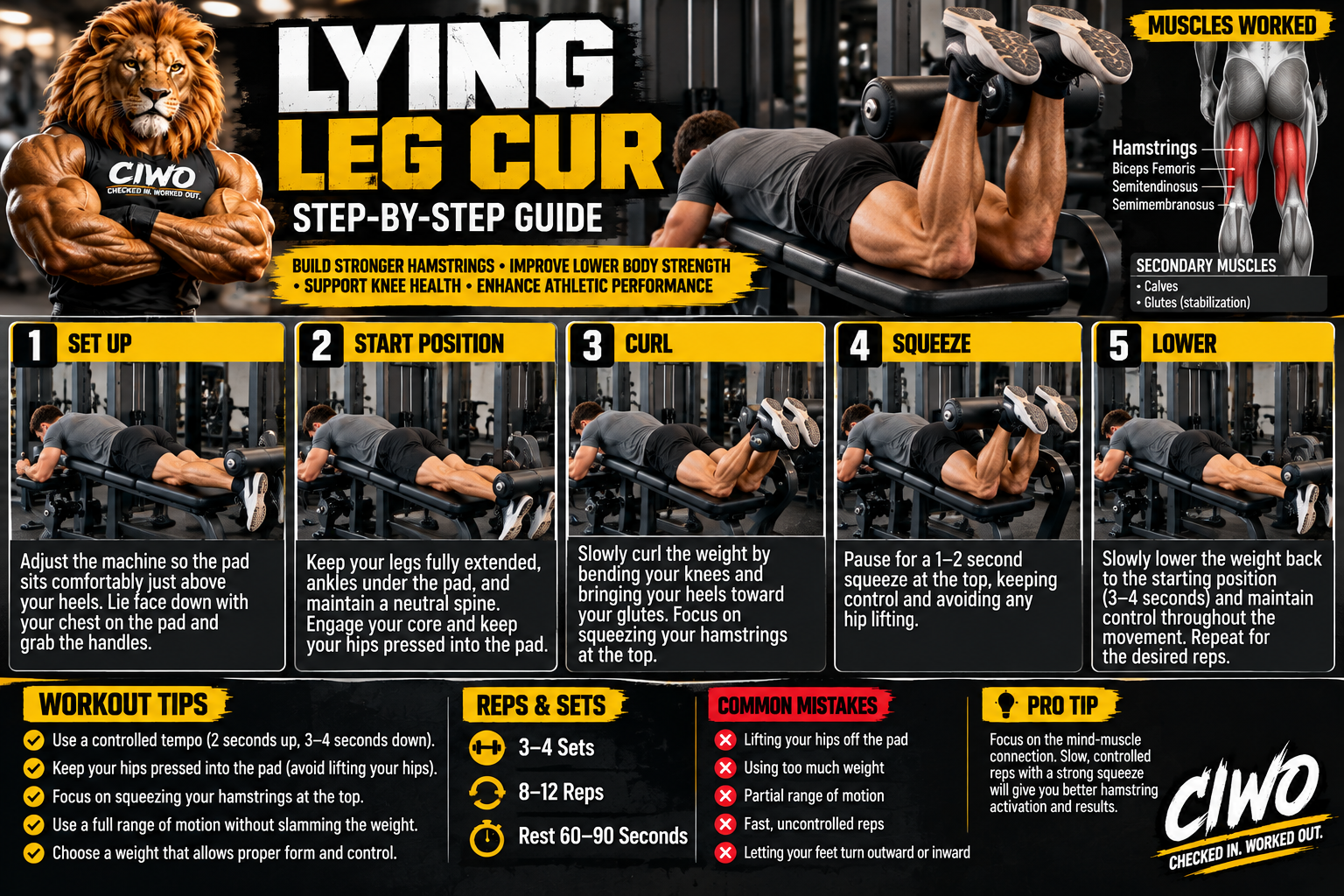

The lying leg curl, also called the prone leg curl, is a machine-based isolation exercise that trains the hamstrings through knee flexion. The machine supports the torso while the lower legs move against resistance, making it useful for controlled direct hamstring training.
Equipment and Muscles Worked
Equipment: Lying or prone leg curl machine. Primary muscles: hamstrings, including the biceps femoris, semitendinosus, and semimembranosus. The calf muscles can assist with knee flexion, while the glutes and trunk help stabilize the hips and torso.
How to Perform the Lying Leg Curl
- Adjust the machine: Position yourself face down so your knees align closely with the machine’s pivot point. Set the roller pad just above the heels on the lower calves.
- Set the start position: Keep your hips and torso supported by the pad, legs comfortably extended, and hands on the handles if provided.
- Curl the weight: Contract your hamstrings and bend your knees, bringing your heels toward your glutes through a comfortable range of motion.
- Pause under control: Briefly hold the top position without lifting your hips or forcing your knees beyond a comfortable range.
- Lower slowly: Extend your knees and return the roller toward the starting position under control. Do not let the weight stack slam.
- Repeat: Continue for the planned repetitions while keeping your hips stable and the movement smooth.
Lying Leg Curl Form Tips
- Align your knees with the machine pivot as closely as the equipment allows.
- Keep the roller pad above the heels rather than high on the calves.
- Keep your hips against the pad instead of arching the lower back or lifting the pelvis.
- Use a smooth curl rather than kicking the pad upward.
- Work through a comfortable range of motion you can control.
- Slow the lowering phase instead of letting the machine pull your legs down.
Common Mistakes
- Using too much resistance: Reduce the load if you need momentum or your hips repeatedly lift from the pad.
- Poor machine setup: Incorrect knee alignment or roller placement can make the exercise awkward.
- Arching the lower back: Keep the torso supported and avoid turning the curl into a whole-body movement.
- Dropping the weight: Control the return instead of allowing the stack to fall.
- Forcing range of motion: Stop the curl where you can maintain comfortable, stable technique.
Sets and Repetitions
For general resistance training, a practical starting point is 2–3 sets of 10–15 controlled repetitions. More experienced trainees may use approximately 3–4 sets of 8–15 repetitions depending on their program. Rest about 60–90 seconds between moderate sets, or longer when needed to maintain good technique.
Where Lying Leg Curls Fit in a Workout
Lying leg curls can be used after larger lower-body movements such as squats, Romanian deadlifts, leg presses, or lunges, or earlier in a session when direct hamstring work is a priority. Combining knee-flexion exercises such as leg curls with hip-hinge exercises gives the hamstrings different training demands.
Frequently Asked Questions
What does the lying leg curl work? It primarily trains the hamstrings on the back of the thighs. How close should my heels come to my glutes? Curl only as far as you can while keeping your hips stable and the movement comfortable. How heavy should I go? Choose resistance that challenges the hamstrings without requiring jerking, hip lifting, or an uncontrolled return. What if I feel knee or lower-back pain? Stop if you experience sharp or worsening pain. Recheck setup, resistance, and range of motion, and seek qualified guidance when appropriate.
Training Safety
Lying leg curl machines vary, so follow the manufacturer’s setup instructions when available. Start conservatively when learning the movement. Muscular effort is expected, but sharp pain, joint pain, numbness, or unusual discomfort is a reason to stop and reassess.
Shop official CIWO apparel and represent Checked In. Worked Out. in and out of the gym.
Fitness never takes a vacation. Set the machine to your body, keep the movement controlled, and progress resistance gradually.