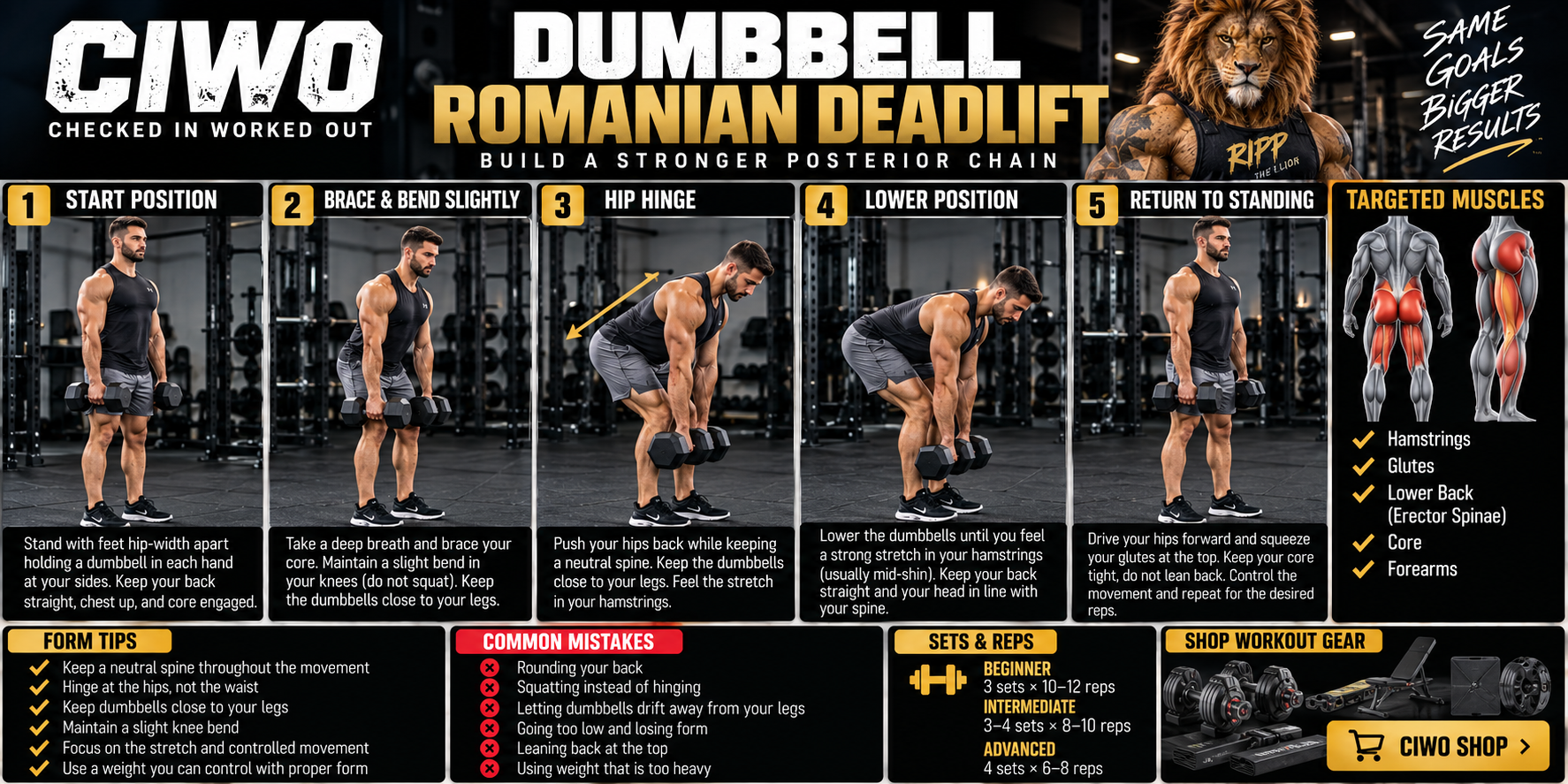

The dumbbell Romanian deadlift (RDL) is a hip-hinge exercise that trains the hamstrings and glutes while challenging your back and core to stabilize your torso. Unlike a conventional deadlift, you begin standing and lower the weight only as far as you can maintain a controlled hinge and neutral, comfortable spine.
Equipment and Muscles Worked
Use two dumbbells. The hamstrings and glutes are the primary movers; the spinal erectors, upper back, grip and abdominal muscles help stabilize the position.
Dumbbell Romanian Deadlift: Step-by-Step
- Set up: Stand with feet about hip-width apart and hold one dumbbell in each hand at your sides. Keep your knees softly bent, shoulders relaxed and ribs stacked over your pelvis.
- Push your hips back: Move your hips toward the wall behind you while maintaining approximately the same slight knee bend. Let your torso incline forward as your hips move backward.
- Lower the weights: Keep the dumbbells close to your legs. Lower slowly until you feel a comfortable hamstring stretch or reach the limit of your controlled range. The weights do not need to touch the floor.
- Stand up: Press your feet into the floor and drive your hips forward to return to standing. Finish tall without leaning backward or forcefully squeezing your lower back.
- Repeat: Reset your balance and breathing before the next controlled repetition.
Key Form Cues
Think “hips back” rather than “bend over.” Keep the weight close, knees soft and neck aligned with your torso. Your depth depends on your mobility and ability to maintain control; stopping around the knees or mid-shins is completely acceptable. Avoid forcing the weights lower by rounding your back.
Common Mistakes
- Squatting the weight down: Excessively bending the knees shifts the exercise away from a hip hinge.
- Letting the weight drift forward: Keep it close to the thighs and shins rather than reaching out in front.
- Chasing the floor: Stop when the hips can no longer move back without losing your comfortable spinal position.
- Jerking the weight up: Use a smooth ascent without bouncing or hyperextending at the top.
- Starting too heavy: Reduce the load until every repetition looks and feels controlled.
Beginner Modification and Progressions
Practice the hip hinge without weights while facing away from a wall, gently moving your hips back to touch it. Progress to light dumbbells, then increase resistance gradually. Progress to heavier dumbbells only after you can maintain a controlled hip hinge.
Suggested Workout
Begin with 2–3 sets of 8–12 controlled repetitions using a manageable load, resting 60–120 seconds as needed. Start with fewer repetitions if fatigue affects your form. Increase weight only when you can complete the planned range without losing control.
Safety
Warm up with easy movement and unloaded hinges. Stop if you experience sharp pain, numbness or radiating symptoms. If you have a current back or hamstring injury, seek individualized guidance from a qualified clinician or exercise professional before trying loaded hinges.
Frequently Asked Questions
How low should I lower the weights?
Only as low as you can maintain a comfortable, controlled hip hinge. The floor is not the goal; many people stop near the knees or mid-shins.
Should my knees be locked?
No. Maintain a soft, consistent knee bend rather than locking your knees or turning the movement into a squat.
Should I feel it in my lower back?
Your back muscles work to stabilize you, but sharp or increasing back pain is not the intended sensation. Reduce the load and check your hinge mechanics.
Where should the dumbbells travel?
Keep one dumbbell beside each leg, close to the thighs and shins as you hinge.