

Dumbbell Bench Press: Step-by-Step Exercise Guide
The Dumbbell Bench Press, also commonly called the dumbbell chest press, is a classic upper-body strength exercise that targets the chest while also training the triceps and front shoulders. Compared with a barbell bench press, dumbbells allow each arm to work independently and can provide a comfortable range of motion for many lifters.
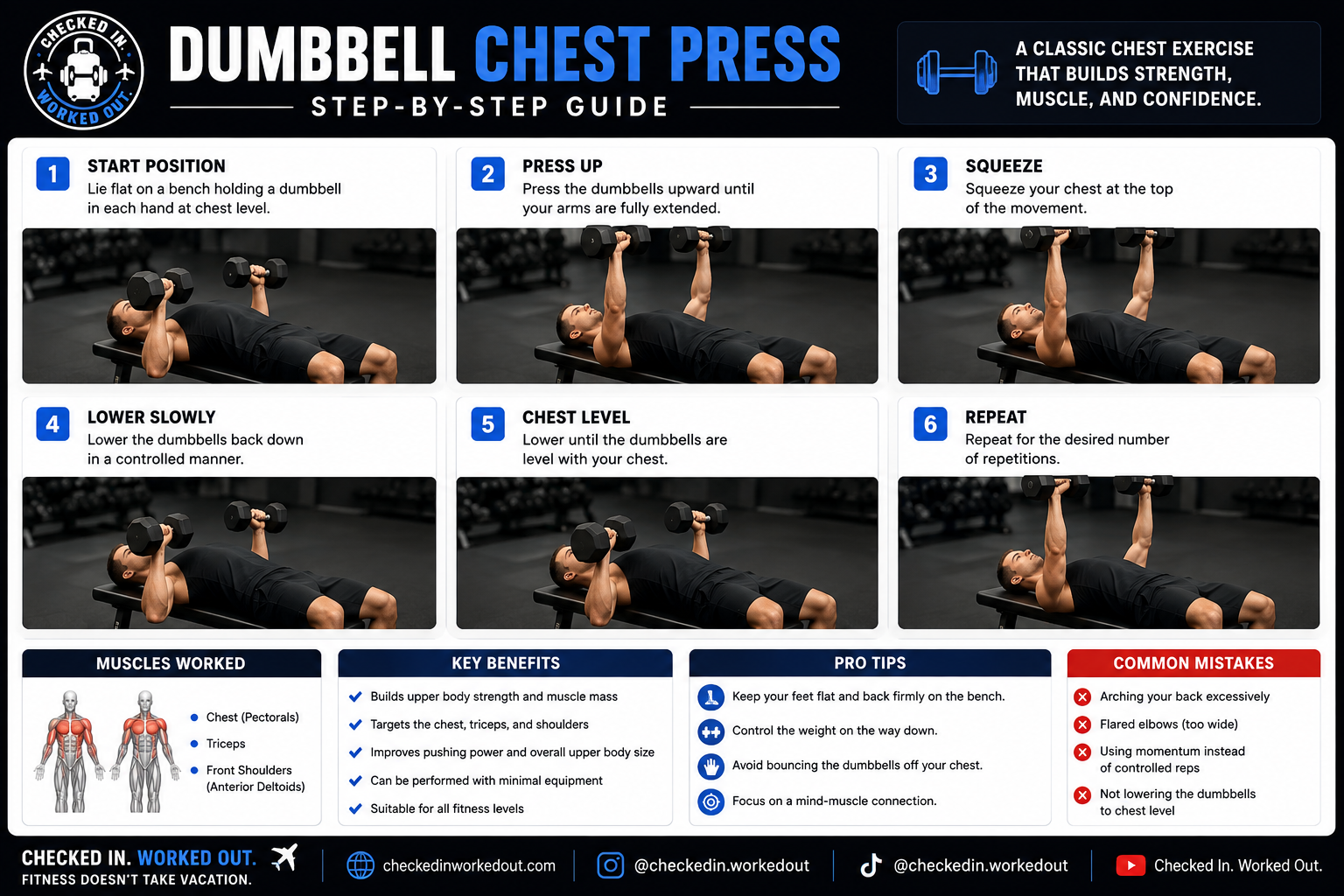
Muscles Worked
- Primary: Chest (pectoralis major)
- Secondary: Triceps
- Secondary: Front shoulders (anterior deltoids)
- Stabilizers: Upper back, rotator cuff, forearms and core
How to Perform the Dumbbell Bench Press
- Start position: Sit on a flat bench with one dumbbell resting on each thigh. Lie back carefully and bring the dumbbells to chest level.
- Set your body: Keep your feet planted, shoulder blades pulled gently back and down, and wrists stacked over the forearms.
- Press: Drive the dumbbells upward until your arms are extended without aggressively locking the elbows.
- Squeeze: Briefly contract the chest at the top while keeping the dumbbells controlled.
- Lower slowly: Bring the dumbbells down in a controlled arc until they are approximately level with the chest or until you reach a comfortable shoulder range.
- Repeat: Maintain the same controlled path for the desired number of repetitions.
Suggested Dumbbell Bench Press Routine
- Beginner: 3 sets of 8–10 reps
- Muscle building: 3–4 sets of 8–12 reps
- Strength focus: 4 sets of 6–8 controlled reps with appropriate weight
- Rest: 60–120 seconds between sets depending on training goal
Key Benefits
- Builds chest, triceps and shoulder strength.
- Allows each arm to work independently.
- Helps expose and improve left-to-right strength imbalances.
- Provides a useful alternative to barbell pressing.
- Works well in strength, hypertrophy and general-fitness programs.
Form Tips
- Keep your feet firmly planted throughout the set.
- Keep the shoulder blades stable against the bench.
- Control the lowering phase rather than dropping the dumbbells.
- Keep the wrists relatively straight and stacked above the forearms.
- Use a load that allows a smooth, pain-free range of motion.
Common Mistakes
- Using momentum instead of controlled repetitions.
- Flaring the elbows excessively.
- Allowing the shoulders to roll forward at the bottom.
- Using more weight than can be controlled safely.
- Lowering the dumbbells too deep when shoulder mobility does not support that range.
- Arching the lower back excessively or lifting the feet from the floor.
Dumbbell Bench Press vs. Barbell Bench Press
Both exercises can build upper-body strength and muscle. Dumbbells require each arm to stabilize its own load and may offer a greater comfortable range of motion, while the barbell bench press often allows heavier total loading. Rotating both movements through a training program can provide useful exercise variety.
CIWO Training Tip
Progress gradually. Before adding weight, make sure you can complete every repetition with consistent control, stable shoulders and a repeatable dumbbell path.
Checked In. Worked Out. Fitness on the go or wherever life takes you. Fitness never takes a vacation!
Programming Dumbbell Bench Press
Use Dumbbell Bench Press as part of a complete program rather than judging it in isolation. Start with a resistance that allows repeatable technique and stop a set when range of motion or body position begins to deteriorate.
Sets, repetitions and progression
For general muscle development, two to four working sets in a moderate repetition range are a practical starting point. When you can reach the top of your planned range across your sets with controlled form, increase resistance by a small amount. Progress can also come from better control, more quality repetitions or an improved usable range of motion.
Tempo and breathing
Control the lowering phase instead of letting gravity or momentum take over. Brace before the demanding portion of the repetition, exhale through the working phase without losing torso position and reset your breath as needed between repetitions.
When to modify the movement
Muscular fatigue is expected, but sharp joint pain is not the objective. Reduce resistance, adjust the range or choose a comparable variation if the exercise cannot be performed comfortably. Persistent pain or a return from injury warrants individualized guidance from an appropriate professional.
Track what actually improves
Record load, repetitions and technique notes. Small, repeatable improvements are more useful than adding weight while shortening the range or relying on momentum.
See more CIWO exercise guides and use the Workout Calendar to organize training.
Quality Repetitions Before More Weight
A useful progression standard is whether the final repetitions still resemble the first. If added load changes the intended joint path, shortens the range dramatically or requires momentum, the resistance has probably increased faster than technique. Keep a simple training log and progress in small steps.
Exercise selection should also account for the rest of the session. If the same muscles have already accumulated substantial fatigue, use a conservative load or move this exercise earlier in the workout when it is a priority.