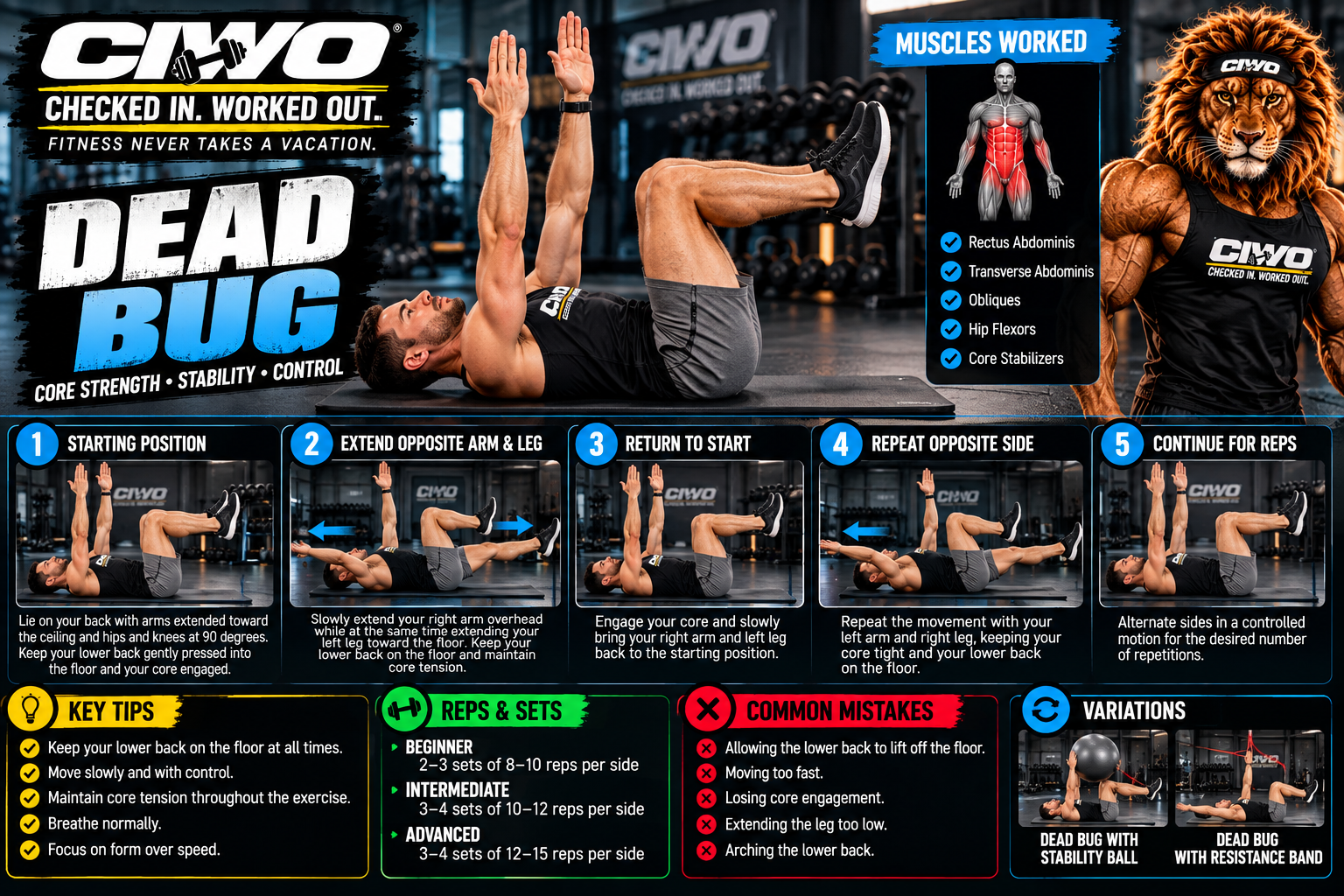

The Dead Bug is a floor-based core exercise that trains controlled arm and leg movement while maintaining a stable trunk. It requires no machine and can be scaled by changing the range of motion.
How to Perform the Dead Bug
1. Starting Position
Lie on your back. Bring your hips and knees to roughly 90 degrees with the lower legs approximately parallel to the floor. Extend your arms toward the ceiling and gently brace your abdominal muscles.
2. Extend Opposite Arm and Leg
Slowly reach one arm overhead while extending the opposite leg. Only travel as far as you can while keeping your trunk controlled and avoiding excessive lower-back arching.
3. Return Under Control
Bring the arm and leg back to the starting position without using momentum.
4. Switch Sides
Repeat with the opposite arm and leg. Maintain steady breathing and abdominal tension.
5. Continue for Repetitions
Alternate sides for the desired repetitions. End the set when you can no longer maintain consistent trunk control.
Muscles Worked
The dead bug challenges the abdominal wall and deeper trunk musculature to resist unwanted movement. Muscles involved can include the rectus abdominis, transverse abdominis, obliques and other trunk stabilizers. The hip flexors also participate in positioning and moving the legs.
Key Form Tips
- Move slowly and maintain control.
- Keep the ribs and pelvis controlled rather than repeatedly arching the torso.
- Extend only as far as your current control allows.
- Breathe normally instead of holding your breath throughout the set.
- Prioritize trunk stability over touching the heel or hand to the floor.
Common Mistakes
- Extending the leg farther than you can control.
- Moving too quickly and relying on momentum.
- Holding your breath.
- Allowing excessive lower-back arching.
- Focusing on repetition speed instead of trunk stability.
Sets and Reps
A practical starting point is 2–3 sets of 5–10 controlled repetitions per side. More experienced trainees can gradually add repetitions, pauses or appropriately progressed variations. Stop before technique deteriorates.
Make It Easier
- Move one arm at a time while keeping the legs stationary.
- Perform heel taps with the arms stationary.
- Shorten the leg-extension range.
- Keep the knee more bent during the extension.
Progressions
Once the standard movement is controlled consistently, options can include longer limb extensions, pauses, light resistance bands or a stability-ball dead bug. Add difficulty only when you can preserve controlled trunk positioning.
Where It Fits in Your Workout
Use the dead bug during a warm-up, dedicated core session, between compatible strength exercises or near the end of a workout. Its emphasis on control rather than maximal loading allows it to fit many training programs.
Safety and Comfort
The exercise should feel like controlled muscular work rather than sharp or unusual pain. Reduce the range or use an easier variation if needed. People managing an injury, recent surgery or a condition affecting exercise should follow individualized professional guidance.
The CIWO Takeaway
The dead bug looks simple, but its value comes from precision. Brace, move the opposite arm and leg slowly, maintain trunk control and use only the range you can own. Improve control before adding difficulty.