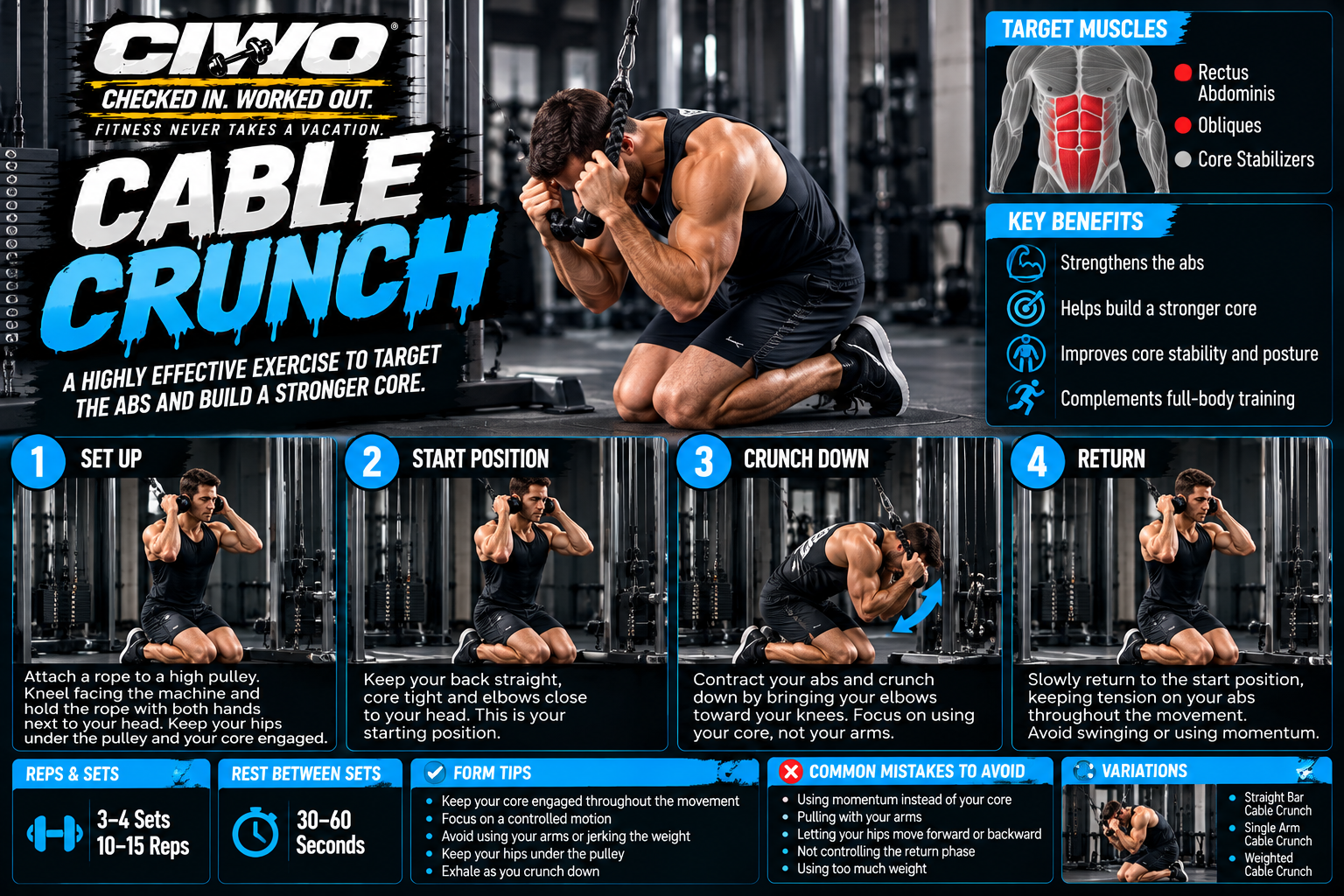

The cable crunch is a loaded abdominal exercise that uses a cable stack to provide resistance through spinal flexion. When performed with control, it gives you a practical way to progressively train the abdominal muscles without turning the movement into an arm pull or hip hinge.
Muscles Worked
The primary target is the rectus abdominis. The obliques and other trunk muscles contribute to stabilization and control. The goal is not to pull the rope down with the arms; the trunk should create the crunching motion.
Cable Crunch: Step-by-Step
1. Set Up the Cable
Attach a rope to a high cable pulley. Select a manageable resistance that allows controlled repetitions. Kneel a comfortable distance from the stack and hold the rope near the sides of your head or upper shoulders.
2. Establish the Start Position
Keep the hips relatively stable and brace your trunk. Avoid aggressively pulling the rope downward with your hands. The cable should provide resistance while your abdominal muscles control the movement.
3. Crunch Down
Exhale and contract the abdominal muscles as you flex your trunk, bringing the rib cage toward the pelvis. Think about shortening the distance between your ribs and pelvis rather than simply trying to bring your elbows toward the floor.
4. Pause Under Control
At the bottom, briefly maintain abdominal tension without collapsing or using momentum. Your exact range will depend on your mobility, proportions and ability to maintain control.
5. Return Slowly
Reverse the motion under control and allow the trunk to extend back toward the starting position. Maintain tension instead of letting the weight stack pull you upward abruptly.
Programming
A practical starting range for many lifters is 2–4 sets of 8–15 controlled repetitions. The appropriate load, repetitions and rest depend on your training experience and goals. Add resistance only when you can maintain the intended abdominal movement without compensating.
Form Tips
- Keep the rope near your head rather than repeatedly pulling it with your arms.
- Focus on moving the rib cage toward the pelvis.
- Keep the hips relatively stable instead of sitting back toward the heels on every repetition.
- Use a controlled tempo through both the crunch and return.
- Choose a load that allows a meaningful range of trunk flexion.
- Keep your neck comfortable rather than aggressively tucking the chin.
Common Mistakes
- Using too much weight: excessive resistance often turns the exercise into a whole-body pull.
- Pulling with the arms: the hands hold the rope, but the abdominal muscles should create the primary motion.
- Hinging primarily at the hips: sitting backward and forward can reduce the intended trunk movement.
- Rushing the return: control the resistance instead of allowing the stack to pull you back up.
- Chasing elbow-to-knee contact: contact is not required; focus on controlled spinal flexion.
Progression and Modification
Begin with a lighter load while learning the movement. Progress by adding small amounts of resistance while preserving technique, or by improving control through a comfortable range. If kneeling is uncomfortable, another cable or machine-based abdominal exercise may be more appropriate.
Safety Considerations
Loaded spinal flexion is not appropriate for every person or every condition. Use a comfortable range and avoid forcing the movement. If you have an existing back condition, recent injury, significant pain or exercise restrictions, follow guidance from an appropriate healthcare or rehabilitation professional. Stop if the exercise causes sharp, radiating or unusual pain.
The CIWO Takeaway
The cable crunch is most effective when resistance is matched to your ability to actually crunch the trunk. Keep the arms relatively quiet, stabilize the hips, contract the abs to bring the ribs toward the pelvis and control the return. Quality repetitions are more useful than simply moving a heavy weight stack.