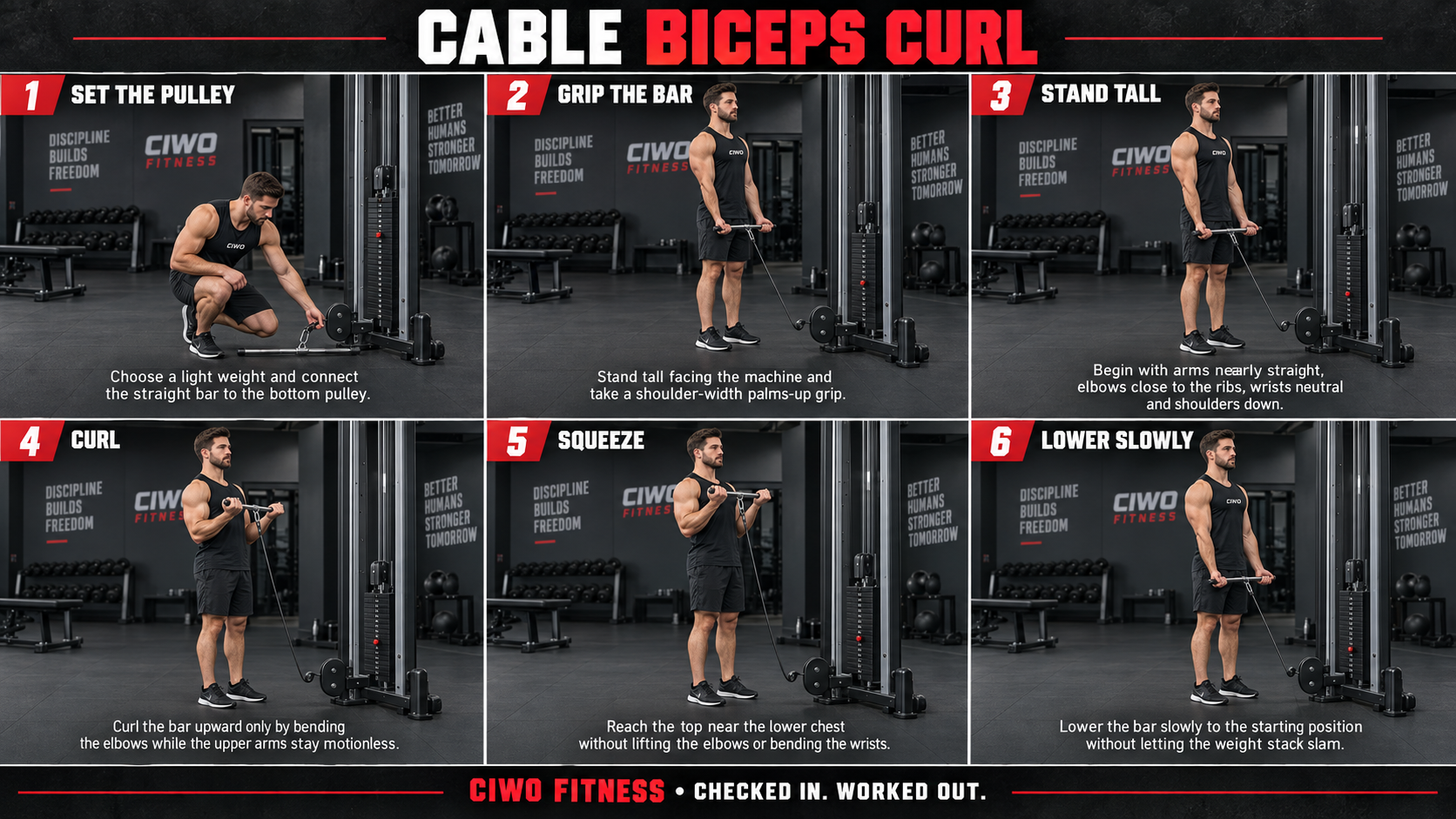

The Cable Biceps Curl is a standing arm exercise performed with a bar attached to a low cable pulley. Unlike a free weight that is pulled primarily by gravity, the cable keeps tension directed through the attachment throughout the repetition. Good technique depends on a stable torso, neutral wrists, upper arms held close to the body and controlled elbow flexion.
Set the machine before lifting, begin with a manageable resistance and use a range of motion you can control without leaning backward, driving the elbows forward or allowing the weight stack to slam.
Exercise Overview
- Primary muscles: Biceps brachii
- Secondary muscles: Brachialis and brachioradialis
- Movement: Elbow flexion
- Equipment: Cable station, low pulley and straight-bar attachment
- Grip: Supinated, with palms facing upward
- Level: Beginner to intermediate
Benefits of the Cable Biceps Curl
- Directly trains elbow flexion and the biceps.
- Maintains cable resistance through the lifting and lowering phases.
- Allows small resistance adjustments on selectorized machines.
- Provides a stable alternative to dumbbell and barbell curls.
- Works well in upper-body, pull-day and dedicated arm workouts.
- Can be performed one arm at a time or with different attachments when appropriate.
Equipment and Setup
- Inspect the cable, carabiner, attachment and weight selector before beginning.
- Move the pulley to its lowest position and connect a straight bar securely.
- Select a light starting resistance and insert the weight pin completely.
- Stand facing the machine and hold the bar with a closed, palms-up grip approximately shoulder width.
- Step back only far enough to create tension without pulling the body forward.
- Stand tall with feet about hip- to shoulder-width apart, knees softly bent and core braced.
- Keep the shoulders down, chest comfortably lifted and elbows close to the ribs.
How to Perform the Cable Biceps Curl
- Set the pulley: Attach the straight bar to the low cable and confirm that all connections are secure.
- Grip the bar: Use a shoulder-width palms-up grip with the thumbs wrapped around the bar and wrists aligned with the forearms.
- Establish the starting position: Stand upright with the bar near the front of the thighs, arms nearly straight and elbows close to the body. Avoid forcefully locking the elbows.
- Brace and curl: Exhale as you bend the elbows and raise the bar toward the lower chest. Keep the torso, shoulders and upper arms quiet.
- Control the top: Stop when you reach your strongest controlled contraction—before the elbows drift forward or the wrists fold.
- Lower slowly: Inhale as you extend the elbows and return the bar toward the thighs over approximately two to three seconds.
- Reset: Maintain cable tension at the bottom, confirm your posture and begin the next repetition without bouncing.
Key Form Checklist
- Face the low pulley and stand tall.
- Keep both feet planted and knees slightly relaxed.
- Use a closed, palms-up grip approximately shoulder width.
- Keep the wrists neutral instead of bending them backward.
- Hold the elbows close to the sides.
- Move primarily at the elbows while keeping the upper arms still.
- Avoid shrugging, leaning or rocking the torso.
- Lower the resistance under control.
- Keep the weight plates from crashing together between repetitions.
Tempo and Breathing
- Exhale during the controlled upward curl.
- Pause briefly at the top without relaxing the posture.
- Inhale while lowering the bar over approximately two to three seconds.
- Avoid holding your breath unnecessarily.
- Use a smooth rhythm rather than accelerating the bar with body momentum.
Suggested Sets and Repetitions
- Technique practice: 2–3 sets of 10–15 light, controlled repetitions
- Muscle building: 3–4 sets of 8–15 repetitions
- Muscular endurance: 2–3 sets of 15–20 repetitions
- Rest: Approximately 45–90 seconds between sets
- Frequency: Commonly one to three times weekly depending on total pulling and arm-training volume
Choose a resistance that allows every repetition to look similar. End the set when maintaining wrist, elbow and torso position would require swinging or shortening the intended range. Increase the resistance gradually only after completing the target repetitions with consistent control.
Common Mistakes and Corrections
- Leaning backward: Reduce the resistance, brace the trunk and keep the ribs stacked over the pelvis.
- Swinging the bar: Slow the repetition and eliminate movement from the hips and knees.
- Elbows traveling forward: Keep the upper arms beside the torso and stop the curl before shoulder flexion takes over.
- Wrists bending backward: Lower the load and keep the knuckles aligned with the forearms.
- Shoulders shrugging: Relax the neck and keep the shoulder blades gently down.
- Partial lowering: Extend the elbows through a comfortable controlled range instead of performing only the top half.
- Weight stack slamming: Control the lowering phase and stop just before the plates crash together.
- Standing too far away: Move closer so the cable does not pull the shoulders excessively forward.
- Using too much resistance: Select a load that lets the elbows—not body momentum—produce the movement.
Variations and Alternatives
- EZ-bar cable curl for a different wrist angle
- Rope hammer cable curl with a neutral grip
- Single-arm cable curl for side-to-side focus
- Bayesian cable curl with the arm positioned behind the body
- High-cable curl with both upper arms raised
- Barbell biceps curl
- Standing dumbbell curl
- Preacher curl
- Incline dumbbell curl
Safety Notes
Inspect the cable station and make sure the attachment and selector pin are fully secured. Keep fingers away from the weight stack and pulley. Do not release a loaded attachment abruptly. Use a controlled resistance and stop if you experience sharp pain, numbness, tingling or unusual discomfort in the hands, wrists, elbows or shoulders. People returning from injury or managing a medical condition should seek appropriate professional guidance.
Frequently Asked Questions
Should the elbows move during a cable curl?
The elbows bend, but the upper arms should remain relatively still beside the torso. If the elbows travel far forward, the shoulders begin contributing more to the movement.
How high should I curl the bar?
Curl until you reach a strong biceps contraction while the wrists remain neutral and the upper arms stay controlled. The bar does not need to touch the shoulders or chest.
Should I lock my elbows at the bottom?
Lower through a comfortable full range, but avoid forcefully snapping the elbow joints into lockout. Maintain muscular control and cable tension.
Are cable curls better than dumbbell curls?
Neither is universally better. Cable curls provide a different resistance direction and easy load adjustments, while dumbbells allow independent arm movement and greater equipment flexibility. Both can support a well-designed strength program.
Bottom Line
The Cable Biceps Curl is most effective when the pulley is set low, the palms face upward, the wrists stay neutral, the upper arms remain close to the body and both phases of every repetition are controlled. Use enough resistance to challenge the biceps without turning the curl into a full-body movement.
Sources and Further Reading
Shop CIWO Fitness Gear
Explore cable attachments, lifting accessories and other training essentials in the Checked In. Worked Out. Shop.
Affiliate disclosure: Some shop links may be affiliate links. CIWO may earn a commission from qualifying purchases at no additional cost to you.
Exercise disclaimer: This content is for general educational purposes and is not medical advice. Exercise carries risk. Use appropriate equipment and technique, work within your abilities and consult a qualified professional when needed.
Fitness Never Takes a Vacation.™