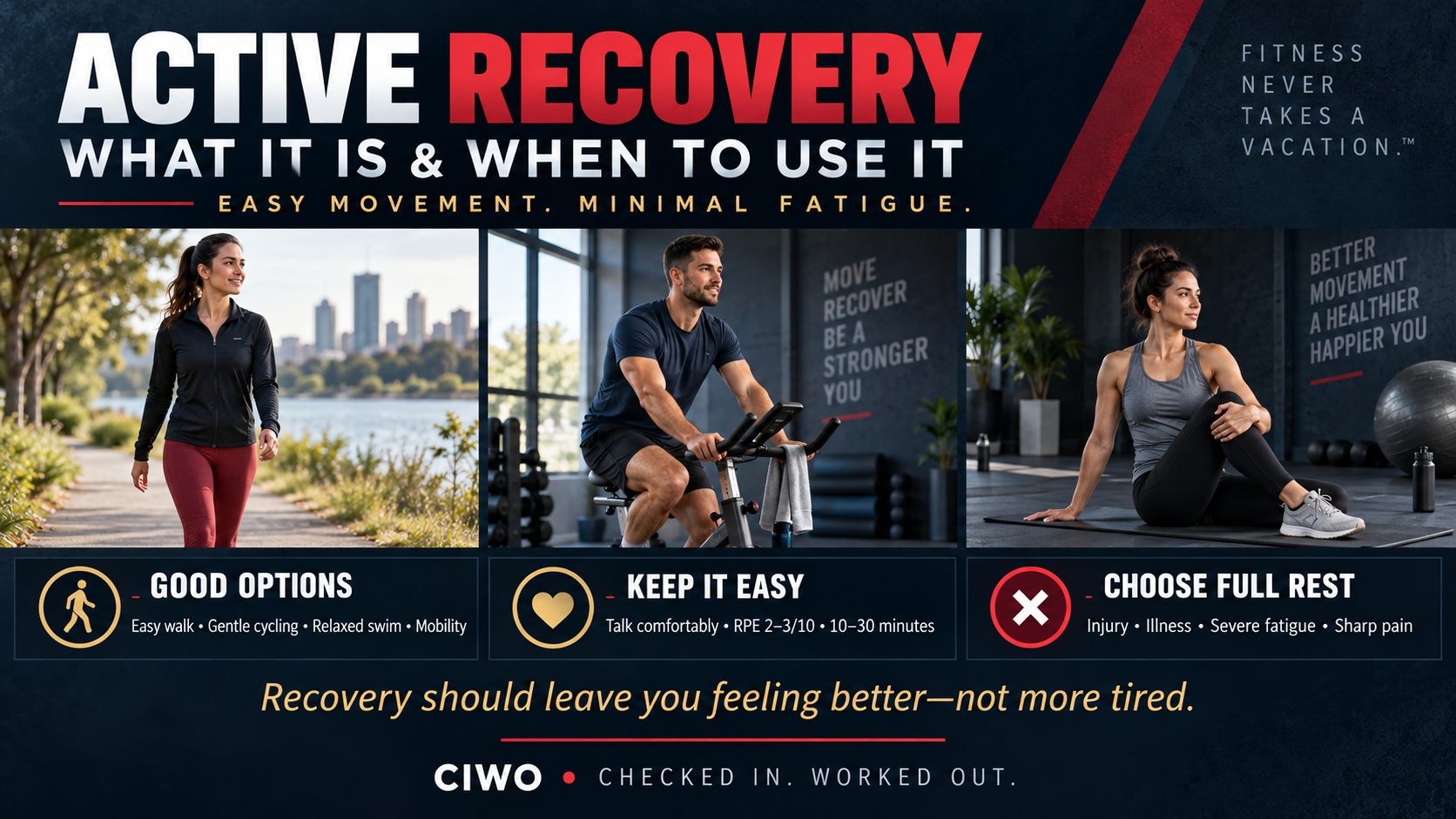

Recovery does not always mean doing nothing. Active recovery uses easy, low-stress movement between demanding workouts—or immediately after one—to keep the body moving without creating meaningful new fatigue. The goal is not to improve speed, strength or calorie burn during the recovery session. The goal is to finish feeling as good as or better than when you started.
Examples include a comfortable walk, gentle cycling, relaxed swimming, easy mobility work or another familiar activity performed well below normal training intensity. Active recovery can be useful when you feel mildly stiff or mentally restless, but it is optional—not a requirement for progress.
What Is Active Recovery?
Active recovery is intentionally light physical activity performed during a recovery period. It can appear in three common places:
- After a workout: a brief, gradual cool-down such as easy walking or pedaling.
- Between hard intervals: slow movement instead of standing completely still.
- On a recovery day: a short, easy session between harder training days.
This article focuses mainly on recovery-day activity. A true active-recovery session should feel easier than a normal workout, use movements you already tolerate well and avoid adding significant muscle damage, joint stress or exhaustion.
Potential Benefits
Gentle movement may reduce the feeling of stiffness
Easy movement increases circulation and takes joints and muscles through a comfortable range of motion. Many people report feeling looser after a walk or a short mobility session. That subjective improvement can make everyday movement feel better even when it does not shorten the biological recovery process.
It can support a consistent activity habit
A recovery day can still include ordinary physical activity. Walking, light household tasks and gentle recreation can reduce long periods of sitting while preserving the purpose of the day. This may help people maintain a routine without treating every day as a high-intensity training day.
It may help you mentally reset
Low-pressure movement can provide fresh air, relaxation and a change of pace. An easy session can satisfy the desire to move without the performance targets attached to a regular workout.
It can maintain comfortable movement practice
Gentle mobility and technique work may help you explore pain-free ranges of motion. Keep the activity familiar and avoid forcing stretches or rehearsing a movement that caused pain.
What Active Recovery Cannot Promise
Active recovery is often marketed as a way to “flush toxins,” eliminate soreness or guarantee faster muscle repair. Those claims go beyond the evidence. Light activity can accelerate the decline of blood lactate immediately after intense exercise, but lactate is not the cause of delayed-onset muscle soreness. Research on active cool-downs has not consistently shown meaningful improvements in next-day performance, injury prevention or long-term training adaptation.
Use active recovery because it feels helpful and fits your training—not because you believe complete rest is harmful. Sleep, adequate food, hydration, sensible programming and time remain the foundation of recovery.
How Hard Should Active Recovery Feel?
- Effort: approximately 2–3 on a 10-point rating of perceived exertion scale
- Talk test: you should be able to speak comfortably in complete sentences
- Breathing: relaxed and controlled rather than labored
- Duration: often 10–30 minutes is enough; shorter is fine
- Resistance: light enough that muscles do not burn or approach failure
- Afterward: you should feel refreshed, looser or unchanged—not depleted
Heart-rate zones are individual and wearable estimates can be imperfect. The talk test and perceived effort are often more practical. If the session starts feeling like cardio training, leg day or a personal challenge, reduce the pace, resistance or duration.
Good Active-Recovery Options
- Easy outdoor or treadmill walking
- Gentle stationary cycling with low resistance
- Relaxed swimming or easy water walking
- Comfortable mobility drills
- Light yoga that does not force end ranges
- Easy elliptical movement
- A relaxed hike on uncomplicated terrain
- Casual recreational movement such as an easy bike ride
Choose an activity that does not heavily reload the muscles you trained. After a demanding leg session, a flat walk or very easy bike ride may work better than hills, stair climbing or a long run. After an upper-body session, walking or relaxed lower-body movement may be more comfortable than swimming.
A Simple 20-Minute Active-Recovery Session
- Minutes 0–5: walk slowly and allow your breathing to settle.
- Minutes 5–15: continue at an easy conversational pace.
- Minutes 15–18: perform gentle ankle, hip, shoulder and upper-back movements in pain-free ranges.
- Minutes 18–20: slow down, breathe comfortably and check how your body feels.
This is a flexible example, not a prescription. Five or ten minutes may be appropriate when you are new to exercise, short on time or unusually tired. Stop if movement makes symptoms worse.
When to Use Active Recovery
- You have mild, symmetrical muscle soreness after a familiar workout.
- You feel a little stiff but normal daily movement is comfortable.
- You want gentle movement between demanding training days.
- You completed a hard workout and want a gradual cool-down.
- You are reducing training load during a deload week.
- You feel mentally better with a short, low-pressure activity.
When Complete Rest Is the Better Choice
- Sharp, sudden, localized or worsening pain
- A suspected sprain, strain, fracture or other injury
- Illness, fever, vomiting, diarrhea or significant dehydration
- Severe fatigue, dizziness, faintness or unusual shortness of breath
- Soreness so intense that normal movement or technique is altered
- Persistently declining performance, disturbed sleep or loss of motivation
- A clinician has instructed you to rest or limit activity
Chest pain, severe breathing difficulty, fainting, confusion, profound weakness or dark urine after strenuous exercise requires prompt medical evaluation. Do not attempt to “walk off” warning signs.
Active Recovery vs. a Deload
An active-recovery day is a single easy day or session. A deload is a planned period—often several days or a week—in which overall training stress is reduced by lowering weight, volume, intensity, frequency or a combination of those variables. You can include active recovery during a deload, but the terms are not interchangeable.
Common Mistakes
- Turning it into another workout: pace, resistance and duration gradually creep upward.
- Chasing calorie burn: recovery becomes a way to compensate for food rather than manage fatigue.
- Testing sore muscles: repeated heavy sets are used to see whether soreness is gone.
- Forcing mobility: aggressive stretching creates more discomfort.
- Ignoring warning signs: injury pain is mislabeled as normal soreness.
- Skipping basic recovery: movement is prioritized while sleep and nutrition are neglected.
Frequently Asked Questions
Does active recovery count as a workout?
It counts as physical activity, but its purpose and intensity differ from training. Do not use it to replace the progressive aerobic and strength work required for fitness improvements.
Can I do active recovery when I am sore?
Gentle movement may feel helpful with mild, typical soreness. Avoid loading a sore area hard, and stop if pain worsens or changes your movement. Sharp or highly localized pain may indicate injury rather than ordinary soreness.
Is stretching active recovery?
Gentle mobility or relaxed stretching can be included, but stretching should not be painful or forced. Easy walking or cycling can also be used without stretching.
Should I take a full rest day every week?
There is no universal schedule. Recovery needs depend on training age, exercise selection, intensity, total volume, sleep, nutrition, stress, health and individual response. Many people benefit from at least one low-stress day each week, whether it is complete rest or active recovery.
Will active recovery remove lactic acid?
Easy movement can help blood lactate decline shortly after intense exercise, but lactate is normally cleared relatively quickly and does not cause soreness that develops one or two days later. Active recovery should not be sold as a toxin-cleansing treatment.
The Bottom Line
Active recovery is easy movement used to support—not challenge—your recovery. Keep the effort conversational, select familiar low-impact activities and stop before fatigue builds. Use it when mild stiffness improves with movement. Choose complete rest or medical guidance when illness, injury, severe fatigue or warning signs are present.
Sources
- U.S. Department of Health and Human Services: Physical Activity Guidelines for Americans, Second Edition
- Van Hooren and Peake: Do We Need a Cool-Down After Exercise? A Narrative Review
- Dupuy and colleagues: An Evidence-Based Approach for Choosing Post-exercise Recovery Techniques
- Centers for Disease Control and Prevention: About Physical Activity
Shop CIWO Fitness Picks
Looking for mobility tools, walking gear, hydration products and equipment that can support recovery and training? Visit the Checked In. Worked Out. Shop to explore CIWO fitness picks.
Affiliate disclosure: Some shop links may be affiliate links. CIWO may earn a commission from qualifying purchases at no additional cost to you.
Medical Disclaimer
This article provides general education and is not medical advice, diagnosis or treatment. Exercise and recovery needs vary. Consult a qualified healthcare professional before starting or changing an exercise program if you have an injury, medical condition, concerning symptoms or clinician-directed activity restrictions.
Fitness Never Takes a Vacation.™