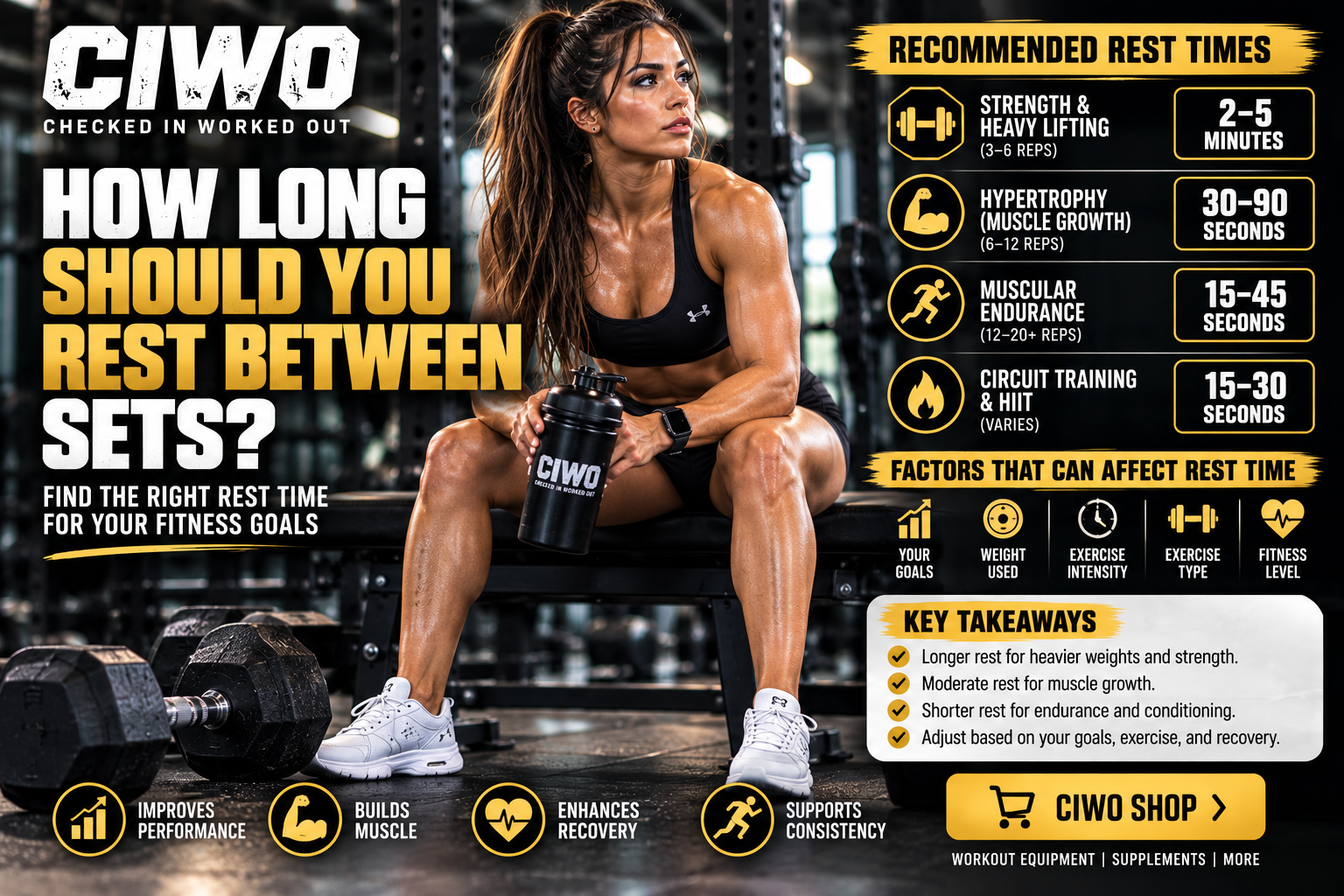

Rest between sets is the time you allow yourself to recover before repeating an exercise. The right interval depends on your training goal, the load, how close you trained to failure, and how ready you feel to repeat the movement with good technique.
Quick Guide: Rest Between Sets
- Heavy strength training: Approximately 2–5 minutes between challenging sets; demanding compound lifts may need longer.
- Muscle growth (hypertrophy): Start around 1–3 minutes; use 2–3 minutes or more for hard compound sets when shorter breaks reduce your repetitions or technique.
- Muscular endurance: Often 30–90 seconds for lighter, higher-repetition work; extend the break when needed to maintain safe form.
- Circuits and conditioning: Breaks vary with exercise difficulty, intensity and your fitness level; short rests are optional, not a requirement.
Important: These are flexible starting points, not strict rules. Very short rest periods are not required for muscle growth, and longer rests can help you sustain training quality and total repetitions.
How to Choose Your Rest Time
- Goal: Prioritize longer breaks when lifting heavy or aiming to repeat high-quality sets.
- Exercise: Squats, deadlifts and other demanding multi-joint exercises often require more recovery than light isolation movements.
- Effort: A set taken close to muscular failure typically requires more recovery than an easy warm-up set.
- Readiness: Begin the next set when your breathing has settled enough to brace, your technique is reliable, and you can meet the planned repetitions safely.
Practical Gym Examples
- Heavy squat, 4 sets of 4: Try 3 minutes; extend toward 5 minutes if the next set suffers.
- Dumbbell bench press, 3 sets of 10: Start with 2 minutes and adjust to maintain controlled reps.
- Cable biceps curl, 3 sets of 12: Start with 60–90 seconds; rest longer if grip or form is still fatigued.
- Light conditioning circuit: Choose a break that lets you resume with safe movement and appropriate breathing.
Five Signs You May Need More Rest
- Your next set starts with noticeably poor technique.
- Your repetitions fall sharply despite unchanged weight and effort.
- You cannot brace or breathe comfortably enough to perform the exercise.
- Your grip or stabilizing muscles have not recovered.
- You feel dizzy, faint or unwell: stop exercising rather than simply shortening or timing the break.
Common Rest-Period Mistakes
- Using the same fixed interval for every exercise regardless of difficulty.
- Rushing into heavy sets while still unable to maintain good form.
- Assuming shorter breaks automatically produce greater muscle growth.
- Taking long, unplanned breaks that make the workout difficult to complete; use a timer if helpful.
- Ignoring sleep, hydration, training load and overall recovery.
Bottom Line
For most lifters, a practical approach is to rest long enough to repeat the planned work with good technique. Start with roughly 2–5 minutes for heavy strength sets, 1–3 minutes for many muscle-building sets, and 30–90 seconds for lighter endurance work, then adjust to the exercise and your recovery. If a longer break preserves your performance, take it.
Explore CIWO
Find more workout guides and wellness education at Checked In Worked Out. Browse training gear and recovery essentials in the CIWO Shop.
Educational content only. If you experience chest pain, severe breathlessness, dizziness or faintness during exercise, stop and seek appropriate medical evaluation.