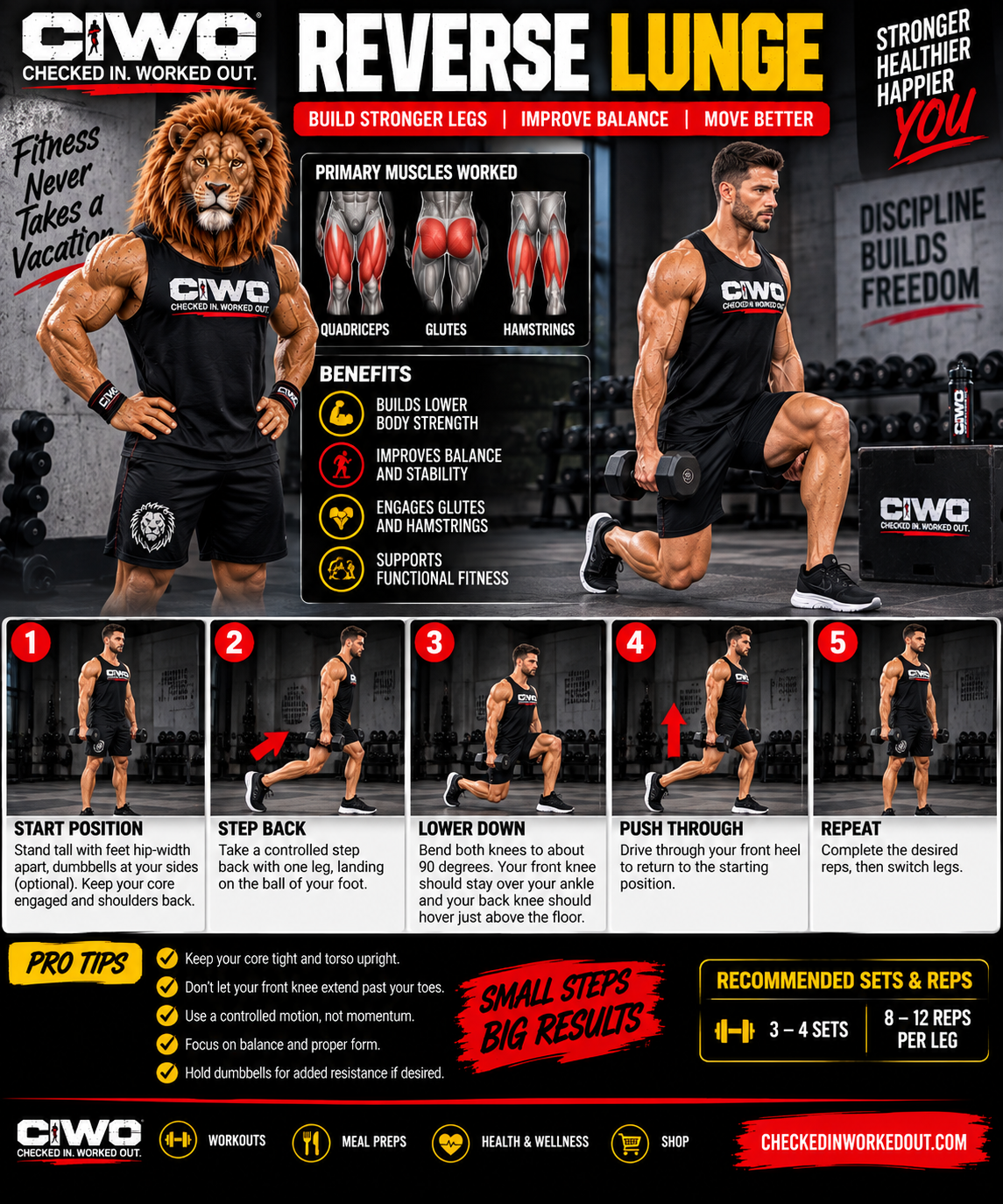

The reverse lunge is a unilateral lower-body exercise that trains the quadriceps, glutes and hamstrings while challenging balance and trunk control. Step backward instead of forward, then return to your starting stance. Begin with body weight and add dumbbells only after you can repeat the movement with control.
Muscles Worked
The quadriceps and glutes help extend the front leg as you stand. Hamstrings and calf muscles assist, while your core and hip stabilizers help keep you steady.
Reverse Lunge: Step-by-Step
- Set up: Stand tall with feet about hip-width apart. Keep your gaze forward, ribs stacked over your pelvis and hands at your sides or in front of your chest.
- Step back: Move one foot straight backward far enough to create a comfortable split stance. Land on the ball of the rear foot and keep your front foot flat.
- Lower with control: Bend both knees and lower your hips vertically. Allow the front knee to travel naturally in line with the toes; avoid letting it collapse inward. The rear knee approaches the floor without striking it.
- Stand up: Press through your entire front foot, especially the midfoot and heel, and bring the rear foot forward to return to standing.
- Repeat: Complete the planned repetitions, then switch legs. You can alternate legs or finish one side at a time.
Form Cues
Keep your front heel down, maintain a comfortable stride length, and move slowly enough to control the descent and ascent. A slight forward torso lean can be natural; avoid rounding your back. Your front knee may move past your toes depending on your proportions and ankle mobility—prioritize comfort, control and knee alignment rather than forcing an arbitrary knee position.
Beginner and Advanced Options
Beginner: Hold a sturdy support, shorten the depth, or perform a stationary split squat before trying a full step-back lunge. Progression: Hold a dumbbell in each hand, increase repetitions, or add a brief pause near the bottom while maintaining form.
Suggested Workout
Start with 2–3 sets of 6–10 controlled repetitions per leg, resting as needed. Choose a range of motion and load that allow consistent technique. Increase the challenge gradually as strength and balance improve.
Common Mistakes
- Stepping directly behind the front foot and losing side-to-side balance.
- Letting the front knee collapse inward.
- Rushing the lowering phase or pushing off excessively with the rear foot.
- Taking such a short or long step that the movement feels unstable.
- Adding dumbbells before body-weight repetitions are controlled.
Safety and Frequently Asked Questions
Should my back knee touch the floor?
No. Lower only as far as you can comfortably control; the rear knee can hover above the floor.
Can my front knee pass my toes?
Yes, that can occur naturally. Focus on keeping the whole front foot planted and the knee tracking in line with the toes without pain.
What if reverse lunges hurt my knees?
Stop if you feel sharp or worsening pain. Try a smaller range of motion or a supported variation; consult a qualified healthcare professional if pain persists.
Are dumbbells required?
No. Body-weight reverse lunges are an effective starting point; dumbbells add resistance when you are ready.
CIWO training tip: Train both sides with control rather than chasing speed. Fitness Never Takes a Vacation.