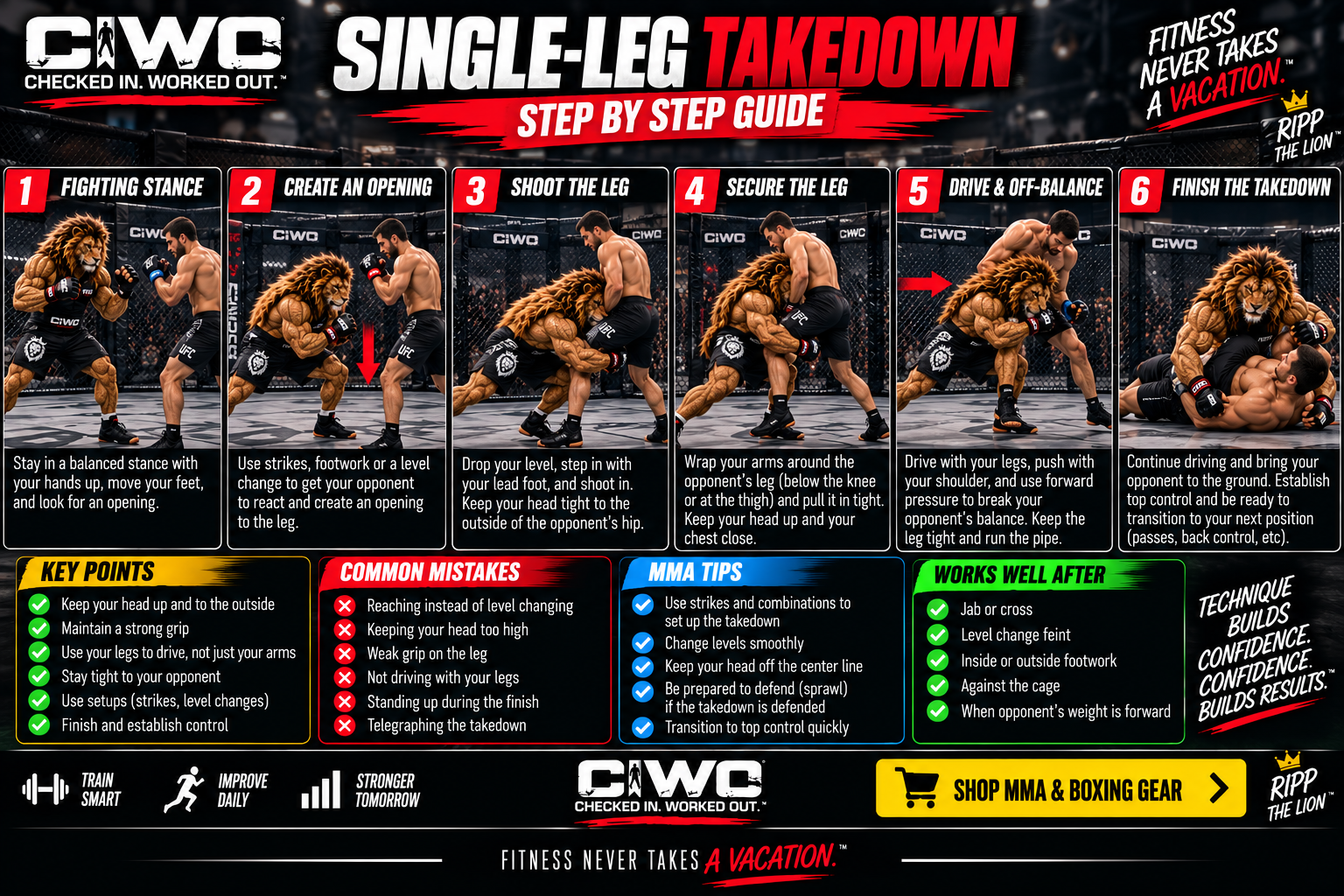

The single-leg takedown is one of the fundamental wrestling attacks used in MMA. Instead of trying to overpower an opponent, the technique combines stance, timing, a level change, close leg control and positional pressure to remove one of the opponent’s bases of support.
In MMA, the setup matters as much as the takedown itself. Striking, feints and footwork can create the opening, while good posture and tight control help reduce your exposure to counters as you enter.
What Is a Single-Leg Takedown?
A single-leg takedown is a grappling technique in which you secure one of your opponent’s legs and use controlled pressure, positioning and balance disruption to bring the opponent to the mat. There are many finishes and variations, so this guide focuses on a basic MMA-oriented progression rather than presenting one finish as the only correct method.
Step 1: Start From a Balanced Fighting Stance
Begin in a stable MMA stance with your hands available to protect yourself and your weight balanced enough to move in any direction. Avoid standing excessively tall or planting your feet so heavily that you cannot change levels quickly.
Step 2: Create the Opening
Do not simply reach for the leg from too far away. Use appropriate footwork, feints, hand fighting or a striking setup during supervised training to draw a reaction and shorten the distance. The goal is to enter when the leg is accessible rather than diving from outside range.
Step 3: Change Levels
Lower your level primarily by bending through the knees and hips while maintaining useful posture. Keep your eyes oriented toward the opponent and avoid folding excessively at the waist. A controlled level change helps position your body to penetrate toward the leg.
Step 4: Enter and Secure the Leg
Step or penetrate into close range and connect your arms around the targeted leg. Keep your body close rather than leaving a large gap between yourself and your opponent. Your exact hand configuration can vary by wrestling style, position and intended finish.
Step 5: Establish Strong Leg Control
Bring the captured leg under control and keep it close to your body. Maintain posture and a stable base while using your upper body to limit the opponent’s ability to freely pull the leg away. Avoid relying only on arm strength.
Step 6: Break the Opponent’s Balance
Once the leg is controlled, use coordinated footwork and pressure to compromise the opponent’s remaining base. Depending on the position, this may involve driving, changing direction, turning the corner or transitioning to another legal wrestling finish taught by your coach.
Step 7: Finish and Establish Control
Complete the takedown under control rather than treating impact as the objective. As the opponent reaches the mat, follow into a stable top position and establish control. In MMA, completing the takedown without controlling the resulting position can allow an opponent to immediately scramble back to their feet.
Key Single-Leg Takedown Principles
- Setup before entry: create an opening instead of reaching from long distance.
- Change levels: lower your body while maintaining useful posture.
- Stay connected: excessive space makes it easier for the opponent to defend.
- Control the leg: secure the position before rushing the finish.
- Use your whole body: effective wrestling combines legs, hips, posture, grip and footwork.
- Finish into control: the takedown is only part of the MMA exchange.
Common Mistakes
Reaching From Too Far Away
Extending your arms toward the leg without closing distance can expose your posture and make the attack easier to read.
Bending Only at the Waist
Collapsing forward can weaken posture. Practice a controlled level change and entry instead.
Leaving Space After the Entry
Loose positioning gives the defending athlete room to create frames, pull the leg away or begin a scramble.
Trying to Finish With Arm Strength Alone
A single-leg is a whole-body wrestling technique. Position, footwork and balance disruption are generally more important than simply squeezing or pulling harder.
Stopping After the Opponent Hits the Mat
In MMA, expect transitions. Establish top control and be prepared for the opponent to scramble or attempt to stand.
Single-Leg Takedown in MMA vs. Wrestling
The core wrestling mechanics carry over, but MMA changes the environment. Strikes, the cage, submission threats and different stances affect when and how entries occur. MMA athletes therefore need to connect wrestling technique with striking defense, cage awareness and positional grappling.
How to Practice the Single-Leg Safely
Learn takedowns with a qualified wrestling, MMA or grappling coach and a cooperative training partner before increasing speed or resistance. Begin with positional drilling and controlled repetitions. Use appropriate mats, communicate with your partner and avoid intentionally driving someone into the floor with unnecessary force.
Because takedowns involve falling body weight, balance changes and joint loading, stop if either partner experiences sharp pain or loses the ability to participate safely. Competition rules also vary, so learn which finishes are legal for your sport and ruleset.
Frequently Asked Questions
Which leg should I attack?
The best target depends on stance, distance, reactions and your setup. Rather than choosing a leg automatically, learn to recognize which leg becomes available as your opponent moves.
Do I need to put my knee on the mat?
Not always. Single-leg entries can be performed with different penetration steps and positions. MMA fighters may also use more upright entries in some situations because of striking and submission considerations.
What if the opponent defends the first finish?
Wrestling is transitional. Maintain safe positional control and use techniques taught by your coach to transition between appropriate finishes instead of forcing a failed position.
Is the single-leg useful against the cage?
Yes. Single-leg positions are commonly integrated with cage wrestling, although the wall changes balance, posture and available finishes. Cage-specific technique should be practiced separately with qualified instruction.
The Bottom Line
A reliable single-leg takedown is built from more than grabbing a leg. Setup, level change, close connection, leg control, balance disruption and positional follow-through all work together. Develop each part slowly, then connect the pieces through supervised drilling before adding realistic resistance.