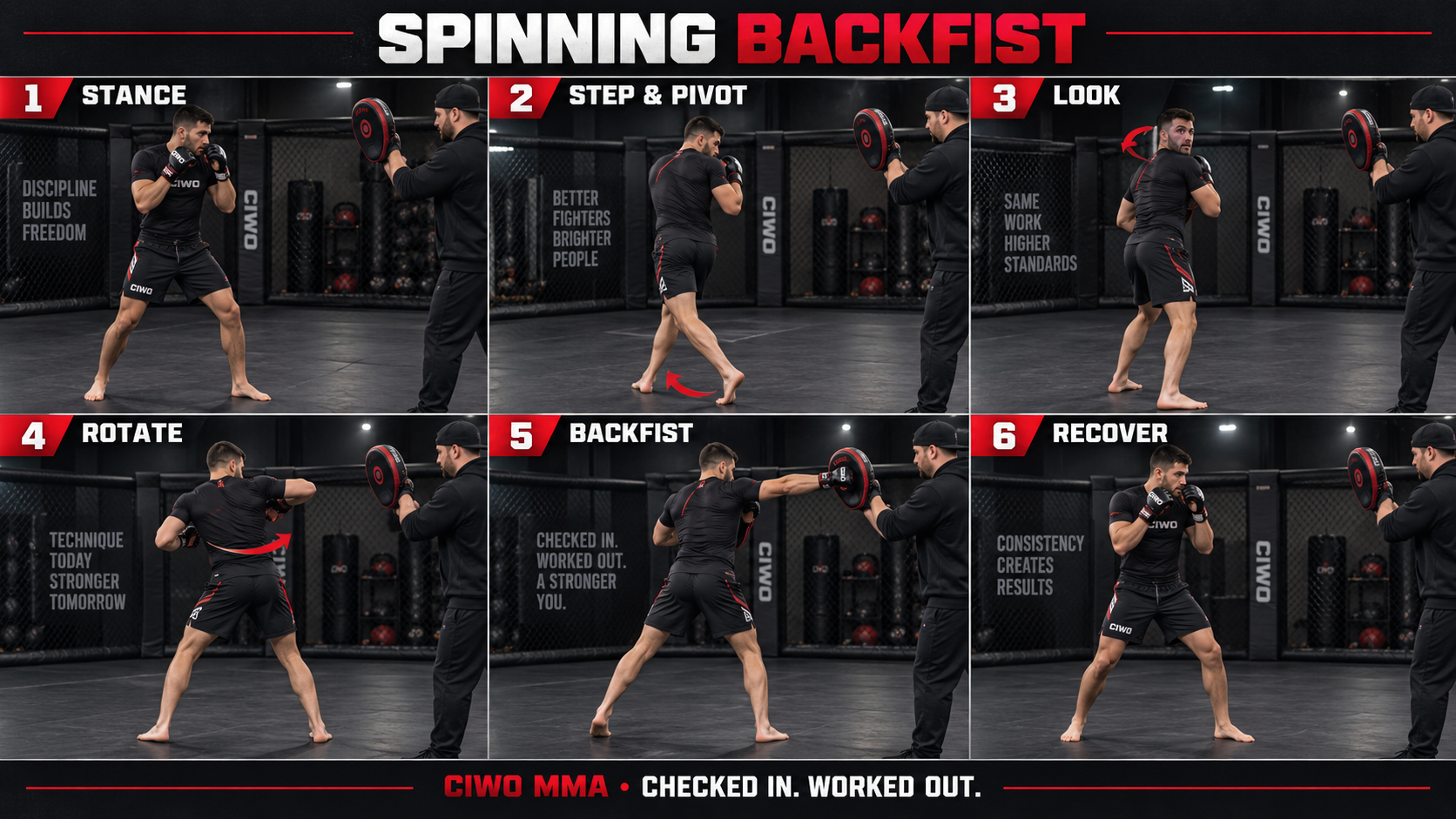

The spinning backfist is a dynamic MMA strike that uses footwork, head movement and whole-body rotation to send the back of a gloved fist toward the target. It can cover an unexpected angle, but the spin briefly changes what you can see—making timing, balance and a disciplined return to guard essential.
This is an advanced technique. Learn it slowly with a qualified coach, drill it on pads before attempting controlled partner work and follow the rules of your gym or competition. The objective is not to spin as fast as possible; it is to rotate without losing sight of the target, posture or defensive responsibility.
Technique Overview
- Category: MMA striking
- Type: Rotational hand strike
- Typical range: Mid-range
- Primary striking surface: Back of the properly gloved fist, subject to the ruleset
- Main power sources: Foot pivot, hip rotation, torso rotation and a compact arm path
- Difficulty: Intermediate to advanced
- Best first training tools: Shadowboxing, heavy bag and coach-held focus mitts
Why Fighters Use It
- Attacks from an angle that can be difficult to read.
- Uses rotational momentum rather than relying only on the arm.
- Can follow a missed kick, turning attack or opponent circling into the strike.
- Creates opportunities to vary rhythm after establishing straight punches and kicks.
- Develops coordination, pivoting, balance and visual reacquisition when trained responsibly.
How to Throw a Spinning Backfist
- Begin in a balanced stance: Keep your chin down, hands high, knees soft and weight distributed so you can move without crossing your feet.
- Create the angle: Step the lead foot slightly across your centerline and turn it in the direction of the spin. Use a small, purposeful step rather than an exaggerated crossover.
- Turn your head first: Look over the turning shoulder and find the target again before committing the strike. Do not swing blindly.
- Pivot and rotate: Turn on the balls of the feet while the hips and shoulders rotate together. Stay tall through the torso instead of bending at the waist.
- Send the backfist on a compact arc: Let the elbow lead around and keep the arm controlled. The back of the gloved fist travels toward the pad; avoid turning it into a wide, uncontrolled swing.
- Protect during the rotation: Keep the opposite hand close to the head and the shoulders raised enough to reduce unnecessary openings.
- Make controlled pad contact: Aim accurately and allow the body rotation to deliver the strike. Do not hyperextend the elbow or intentionally strike with the forearm or elbow when drilling a backfist.
- Recover immediately: Complete the turn under control, bring both hands back to guard and establish a stable stance before continuing the combination or exiting.
Form Checklist
- Start and finish in a stance you can defend from.
- Use a short step and smooth pivot instead of crossing the legs excessively.
- Turn the head early and reacquire the target.
- Rotate the hips and shoulders as one coordinated action.
- Keep the striking path compact and approximately horizontal.
- Use the back of the gloved fist—not an open hand or uncontrolled elbow.
- Keep the opposite hand protecting the head.
- Recover the guard before admiring the strike or launching another attack.
Common Mistakes and Corrections
- Spinning without looking: Lead with the eyes and head so you locate the target before the hand arrives.
- Taking an oversized step: Shorten the entry to preserve balance and reduce the time your back is exposed.
- Swinging only the arm: Coordinate the feet, hips and shoulders so the arm does not have to manufacture all the force.
- Dropping both hands: Keep the non-striking glove near the face and return the striking hand promptly.
- Leaning or falling through: Slow down, reduce power and practice stopping the rotation in a stable stance.
- Using the wrong strike: A spinning backfist uses the back of the fist; it should not accidentally become a spinning elbow, hammerfist or straight punch.
- Telegraphing the spin: Avoid a dramatic windup. Build the movement from normal footwork or a believable setup.
- Training for power too soon: Establish accurate foot placement, vision and recovery before increasing speed or force.
Beginner Progression Drills
- Quarter-turn drill: Practice the lead-foot step and partial pivot without striking.
- Spot-the-target drill: Turn slowly and pause as soon as your eyes locate the pad.
- Shadowboxing repetitions: Perform the full motion at low speed, stopping in guard after every repetition.
- Heavy-bag touch drill: Make light, precise contact and prevent the arm from wrapping around the bag.
- Focus-mitt drill: Have a qualified coach present a stable target and control the pace, distance and power.
- Setup-and-recovery drill: Add a simple setup, throw the backfist and finish with an angle exit or defensive guard.
Practical Setups
- Jab, rear straight, spinning backfist
- Lead hook, opponent circles away, spinning backfist
- Low-kick feint, step and spinning backfist
- Controlled recovery after a missed round kick
- Exit from close range, reset, then re-enter behind the spin
These are training concepts—not guarantees. Distance, stance matchup, opponent reactions and the ruleset all affect whether a setup is appropriate. Practice combinations first on pads with a qualified coach.
Suggested Practice
- Footwork only: 2–3 sets of 5 slow turns per side
- Shadowboxing: 2–3 sets of 5 controlled repetitions per side
- Focus mitts: 3–4 sets of 3–5 accurate repetitions
- Heavy bag: 2–3 sets of 5 light-to-moderate contacts after technique is consistent
- Rest: Reset fully between repetitions; quality matters more than fatigue
Safety and Rules
Rotational strikes can generate substantial force and may injure the striker, pad holder or training partner when performed carelessly. Warm up, use appropriate gloves and pads, inspect your training space and learn under qualified supervision. Never throw a hard spinning backfist during casual technical sparring unless the drill and contact level have been clearly agreed upon. Stop for pain, dizziness, loss of balance or unusual joint discomfort. Competition rules differ, so confirm the permitted target areas and striking surfaces with your coach and the applicable organization.
Frequently Asked Questions
Which part of the hand makes contact?
The intended surface is the back of the properly gloved fist. Rules and coaching standards vary, so confirm what is legal and safe in your training environment.
Should I fully extend my arm?
Do not force the elbow into a hard lockout. Use a compact, controlled arc and keep enough structure to protect the elbow and recover the arm.
Can a beginner practice this strike?
A beginner can learn the footwork and visual sequence slowly under qualified instruction, but contact, speed and power should wait until balance and recovery are reliable.
What is the most important cue?
Look before you strike. Reacquiring the target helps accuracy, control and awareness during a movement that temporarily turns your body away.
Bottom Line
A useful spinning backfist is built from a controlled step, early visual contact, coordinated rotation, a compact back-of-the-fist strike and an immediate return to guard. Train it deliberately before trying to make it fast or powerful.
Sources and Further Viewing
Train With the Right Gear
Explore gloves, hand wraps, focus mitts, heavy bags and other training essentials in the Checked In. Worked Out. Shop.
Affiliate disclosure: Some shop links may be affiliate links. CIWO may earn a commission from qualifying purchases at no additional cost to you.
Training disclaimer: This guide is for general education and does not replace instruction from a qualified combat-sports coach. Martial arts and contact training carry risk. Train responsibly, use appropriate protective equipment and follow your gym and competition rules.
Checked In. Worked Out. • Fitness Never Takes a Vacation.™