

The rear uppercut is a compact power punch used at close to mid range in boxing, kickboxing and MMA striking. For an orthodox fighter, the rear hand is the right hand. The punch gets its power from the floor, legs, hips and torso rather than simply lifting the arm.
What Is a Rear Uppercut?
A rear uppercut travels upward on a tight path from the rear side of your stance. It can be practiced in controlled pad work, bag work and coached striking drills, and it combines naturally with punches such as the jab, cross and lead hook.
Starting Position
- Stand in a balanced fighting stance.
- For orthodox stance, keep the left hand and foot forward and the right hand to the rear.
- Keep both hands high, elbows controlled and chin tucked.
- Stay relaxed enough to rotate without losing balance.
How to Throw a Rear Uppercut: Step by Step
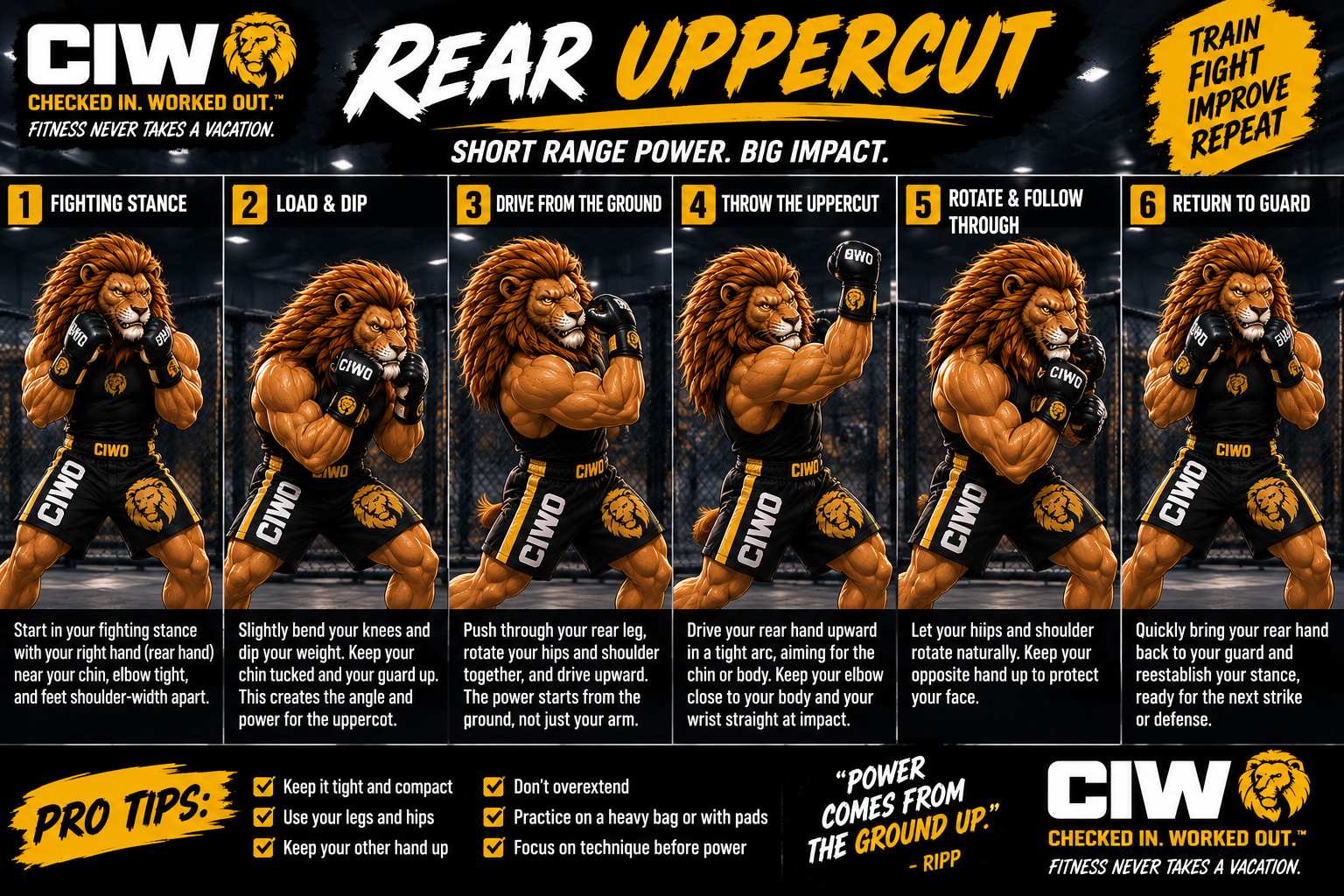
1. Establish Your Fighting Stance
Begin with a stable base and your rear hand close to your chin. Keep your opposite hand ready to protect your face.
2. Load with a Small Level Change
Bend the knees slightly and make a compact dip. Avoid dropping your hand or making a large crouch.
3. Drive from the Ground
Push through the floor and rotate the rear hip and shoulder forward. Generate the movement with the whole body instead of the arm alone.
4. Send the Rear Hand Upward
Drive the rear fist upward on a short, tight arc while keeping the elbow relatively close to the body and the wrist aligned.
5. Rotate without Overextending
Allow the hips and shoulder to rotate naturally. Keep your lead hand up and remain centered instead of leaning excessively into the strike.
6. Retract and Reset
Bring the rear hand directly back to guard, recover your balanced stance and be ready to move, defend or continue a combination.
Key Coaching Cues
- Power starts with the legs and hips.
- Keep the punch compact.
- Keep the opposite hand protecting your face.
- Maintain a supported wrist.
- Stay balanced throughout the punch.
- Return the rear hand to guard immediately.
Common Rear Uppercut Mistakes
- Dropping the rear hand: This telegraphs the strike and opens your guard.
- Using only the arm: The legs, hips and torso should contribute.
- Making the punch too wide: Keep a compact upward path.
- Leaning too far forward: Overreaching compromises balance.
- Dropping the lead hand: Keep the non-punching hand protecting your face.
- Failing to reset: Bring the rear hand back to guard.
Beginner Rear Uppercut Drill
Practice slowly in front of a mirror or with a qualified coach. Focus on the small level change, hip rotation, tight upward path and fast return to guard. Once consistent, practice on appropriate pads or a heavy bag while gradually increasing speed. Technique should come before power.
Using the Rear Uppercut in MMA
The rear uppercut can fit into short boxing combinations and close-range striking sequences. A simple training combination is jab–cross–lead hook–rear uppercut. MMA stance and distance can change because of kicks and takedowns, so practice combinations with a qualified combat-sports coach.
Safety & Training Tips
- Use appropriate gloves, hand wraps and training equipment.
- Learn technique at controlled speed before adding power.
- Use pads or bags designed for striking practice.
- Train partner drills only in a controlled environment with appropriate protective equipment and supervision.
- Stop if you experience pain in the hand, wrist, elbow or shoulder.
CIWO Takeaway
A strong rear uppercut is short, balanced and driven from the ground up. Build the movement slowly, keep your guard disciplined and focus on clean mechanics before speed or power.
Shop CIWO Fitness & Training Picks
Looking for boxing gloves, hand wraps, punching bags, training pads and other fitness equipment? Visit the Checked In. Worked Out. Shop.
Checked In. Worked Out. — Fitness Never Takes a Vacation.™
Technique Development and Drilling
Rear Uppercut should first be practiced slowly enough to maintain stance, balance, guard and a controlled return to position. Speed and power are useful only when the mechanics remain repeatable.
Beginner progression
Start with shadowboxing or a cooperative technical drill. Build accuracy before adding a heavy bag, pads or live resistance. Increase speed gradually and reset after every repetition rather than allowing fatigue to turn the drill into uncontrolled movement.
Defense after the strike
Do not treat the strike as finished at contact. Recover the hand or leg, restore the guard, regain stance and be prepared to move, defend or continue the combination. That recovery is part of the technique.
Common training errors
Typical problems include overcommitting the body, dropping the opposite hand, losing the stance, telegraphing the attack and chasing power before accuracy. Record short practice rounds when possible so you can review posture and recovery.
Safety
Use appropriate gloves, wraps, pads and supervision for contact work. Technical practice should be controlled; hard sparring is not required to learn mechanics and carries substantially more injury risk.
Continue with the CIWO MMA & Combat Training hub and MMA Striking library.