

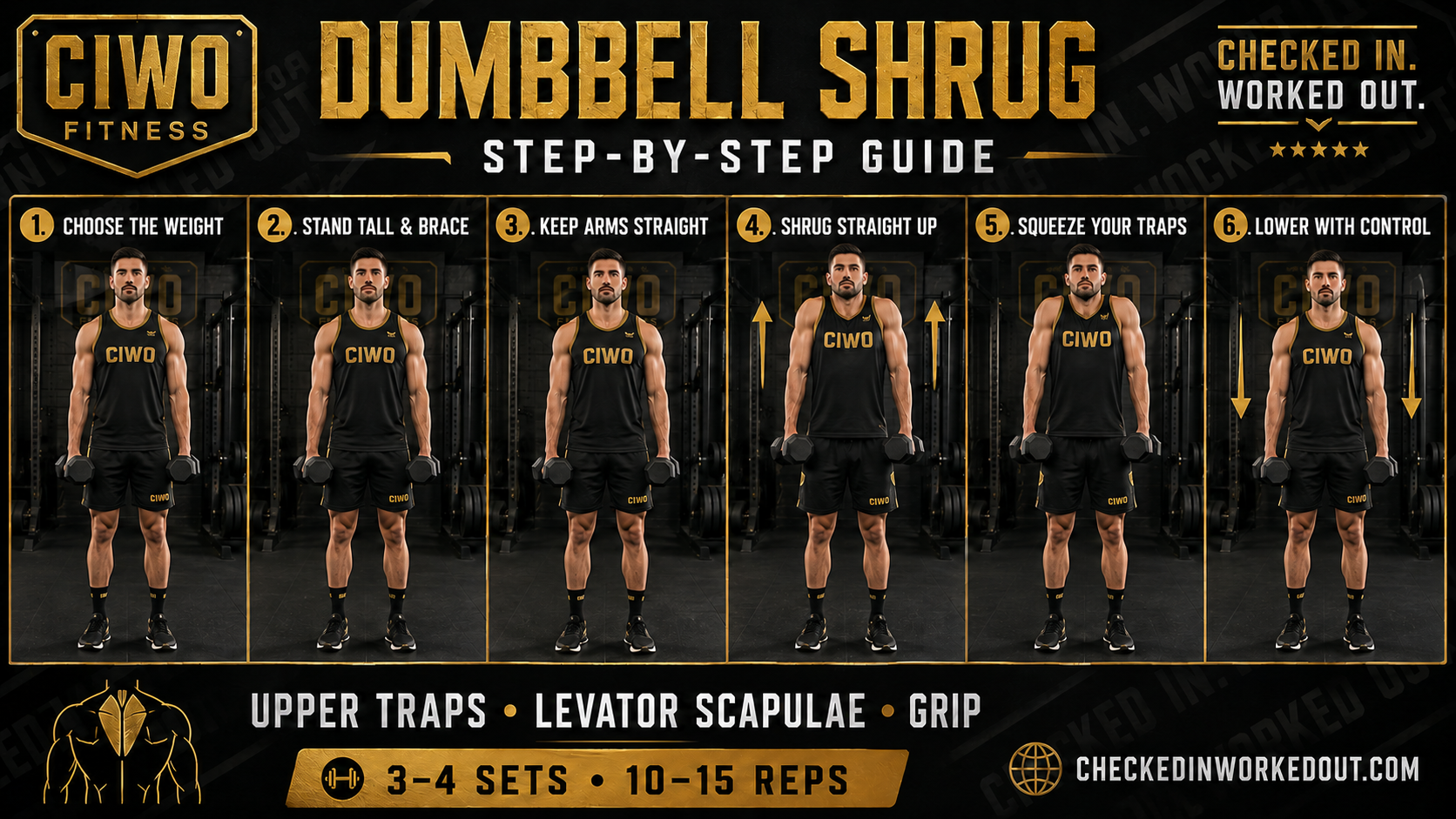
The Dumbbell Shrug is a straightforward exercise for strengthening the upper trapezius and developing grip endurance. The movement should come from lifting the shoulders straight upward—not rolling them—and lowering them slowly while the arms remain extended.
Muscles Worked
- Primary: Upper trapezius
- Secondary: Levator scapulae and middle trapezius
- Stabilizers: Forearms, grip, core and upper-back postural muscles
Equipment Needed
- Two dumbbells
- Clear standing space
Step-by-Step Instructions
1. Choose the Weight
Select dumbbells that you can hold securely without leaning, bouncing or bending your elbows. Use a lighter load while learning the movement.
2. Stand Tall and Brace
Stand with your feet approximately hip-width apart and your knees softly unlocked. Brace your core, keep your ribs stacked over your hips and look straight ahead.
3. Keep Your Arms Straight
Hold one dumbbell at each side with your palms facing inward. Let your arms hang fully extended without locking the elbows aggressively. Keep your wrists neutral.
4. Shrug Straight Up
Lift both shoulders vertically toward your ears. Keep your arms long, torso still and head neutral. Do not rotate or roll the shoulders forward or backward.
5. Squeeze Your Traps
Pause briefly at the highest comfortable position and contract the upper trapezius. Avoid pushing your head forward or tilting your chin upward.
6. Lower with Control
Slowly lower your shoulders straight down until you return to the starting position. Allow the traps to lengthen without letting the dumbbells pull your posture out of alignment.
Suggested Sets and Repetitions
- Beginner: 2–3 sets of 10–12 repetitions
- Muscle building: 3–4 sets of 10–15 repetitions
- Muscular endurance: 2–3 sets of 15–20 repetitions
Form Tips
- Move the shoulders straight upward and downward.
- Keep the elbows extended and avoid turning the shrug into a curl.
- Maintain a tall posture without leaning backward or forward.
- Keep your head neutral and avoid jutting your chin forward.
- Pause briefly at the top without forcing an uncomfortable range.
- Lower more slowly than you lift to maintain control.
Common Mistakes
- Rolling the shoulders: Use a straight vertical path instead of making circles.
- Bending the elbows: Keep the arms long so the traps drive the movement.
- Using excessive weight: Reduce the load if you must bounce, lean or shorten the range.
- Jutting the head forward: Keep your ears aligned over your shoulders.
- Dropping the dumbbells: Control the lowering phase instead of letting the weights pull your shoulders down.
- Rushing repetitions: Pause briefly at the top and maintain a steady tempo.
Variations
- Seated dumbbell shrug: Sit upright on a bench to reduce lower-body movement.
- Single-arm dumbbell shrug: Train one side at a time while keeping the torso level.
- Barbell shrug: Hold a barbell in front of your thighs and use the same vertical shoulder path.
- Trap-bar shrug: Use a neutral grip with the load positioned beside your body.
- Smith-machine shrug: Use the guided bar path while maintaining tall posture.
Safety Note
Use a comfortable range of motion and manageable resistance. Stop if you experience sharp neck, shoulder, elbow, wrist or back pain. People with existing neck or shoulder concerns should consult a qualified healthcare or fitness professional before adding this exercise.
Shop Fitness Gear Recommended by CIWO
Upgrade your workouts, meal prep and recovery routine with fitness gear selected by Checked In. Worked Out. Visit the CIWO Shop to explore equipment, accessories, nutrition products and other fitness essentials.
Affiliate disclosure: Some shop links may be affiliate links. CIWO may earn a commission from qualifying purchases at no additional cost to you.
Fitness on the go or wherever life takes you. Fitness never takes a vacation!
Programming Dumbbell Shrug
Use Dumbbell Shrug as part of a complete program rather than judging it in isolation. Start with a resistance that allows repeatable technique and stop a set when range of motion or body position begins to deteriorate.
Sets, repetitions and progression
For general muscle development, two to four working sets in a moderate repetition range are a practical starting point. When you can reach the top of your planned range across your sets with controlled form, increase resistance by a small amount. Progress can also come from better control, more quality repetitions or an improved usable range of motion.
Tempo and breathing
Control the lowering phase instead of letting gravity or momentum take over. Brace before the demanding portion of the repetition, exhale through the working phase without losing torso position and reset your breath as needed between repetitions.
When to modify the movement
Muscular fatigue is expected, but sharp joint pain is not the objective. Reduce resistance, adjust the range or choose a comparable variation if the exercise cannot be performed comfortably. Persistent pain or a return from injury warrants individualized guidance from an appropriate professional.
Track what actually improves
Record load, repetitions and technique notes. Small, repeatable improvements are more useful than adding weight while shortening the range or relying on momentum.
See more CIWO exercise guides and use the Workout Calendar to organize training.