

The Reverse Pec Deck is a machine-based upper-body exercise that targets the rear deltoids and upper-back muscles. The supported seated position makes it easier to focus on controlled shoulder movement without relying heavily on momentum.
Muscles Worked
- Primary: Rear deltoids
- Secondary: Rhomboids and middle trapezius
- Supporting: Rotator-cuff and shoulder-stabilizing muscles
Equipment Needed
A pec deck or rear-delt fly machine with handles that can be positioned for the reverse movement.
Shop the latest fitness products, supplements for your home gym or travel needs.
Step-by-Step Instructions
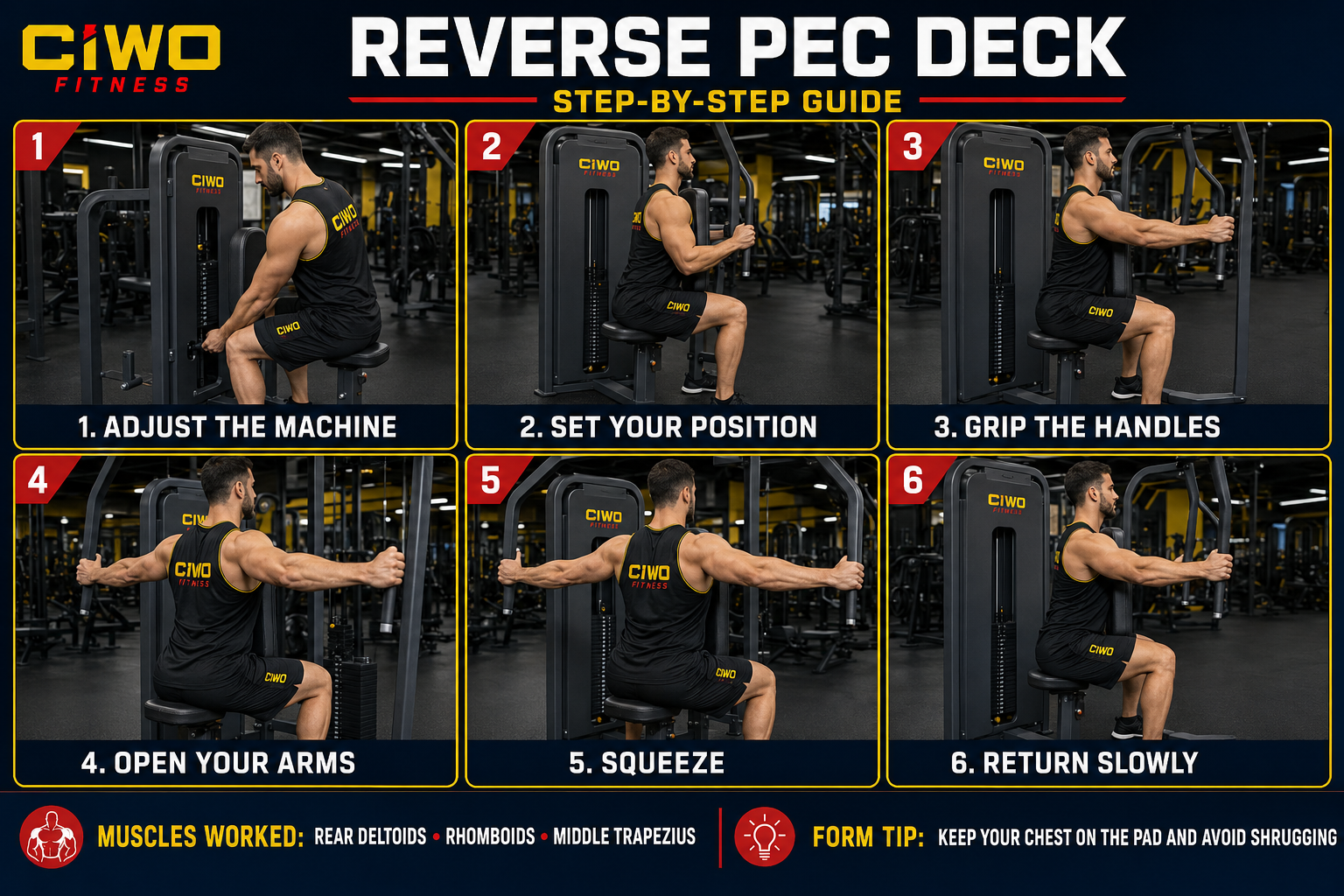
1. Adjust the Machine
Set the seat height so the handles align approximately with your shoulders. Position the machine arms for the reverse-fly movement and select a manageable weight.
2. Set Your Position
Sit facing the machine with your chest firmly against the pad. Place your feet flat on the floor, brace your core and maintain a neutral spine.
3. Grip the Handles
Grip both handles with your arms comfortably extended and your elbows slightly bent. Keep your shoulders down and away from your ears.
4. Open Your Arms
Lead with your elbows and move the handles outward and backward in a wide, controlled arc. Keep your chest against the pad and avoid arching your lower back.
5. Squeeze at the Back
Stop when your arms reach approximately the line of your torso or your strongest comfortable range. Briefly squeeze your rear shoulders and upper back without forcing excessive range.
6. Return Slowly
Control the handles forward until you return to the starting position. Do not allow the weight stack to slam, and reset your posture before the next repetition.
Suggested Sets and Repetitions
- Beginner: 2–3 sets of 12–15 repetitions
- Muscle building: 3–4 sets of 8–12 repetitions
- Muscular endurance: 3 sets of 15–20 controlled repetitions
Common Mistakes to Avoid
- Using too much weight and shortening the range of motion
- Pulling with momentum instead of controlling the machine
- Shrugging the shoulders toward the ears
- Allowing the chest to lift away from the support pad
- Locking the elbows or changing the elbow bend during the movement
- Pulling too far behind the torso and stressing the shoulder joint
Form Tips
- Keep your chest supported throughout every repetition.
- Think about moving your elbows outward rather than pulling with your hands.
- Use a slow return to keep tension on the rear deltoids.
- Choose a weight that allows a smooth, controlled range of motion.
- Stop if the movement causes sharp shoulder pain.
Where to Use It in Your Workout
Use the Reverse Pec Deck during a shoulder, upper-body, pull or back workout. It commonly works well after heavier compound pulling movements such as rows or pulldowns, when the goal is to focus more directly on the rear deltoids and upper back.
Fitness on the go or wherever life takes you. Fitness never takes a vacation!
Programming Reverse Pec Deck
Use Reverse Pec Deck as part of a complete program rather than judging it in isolation. Start with a resistance that allows repeatable technique and stop a set when range of motion or body position begins to deteriorate.
Sets, repetitions and progression
For general muscle development, two to four working sets in a moderate repetition range are a practical starting point. When you can reach the top of your planned range across your sets with controlled form, increase resistance by a small amount. Progress can also come from better control, more quality repetitions or an improved usable range of motion.
Tempo and breathing
Control the lowering phase instead of letting gravity or momentum take over. Brace before the demanding portion of the repetition, exhale through the working phase without losing torso position and reset your breath as needed between repetitions.
When to modify the movement
Muscular fatigue is expected, but sharp joint pain is not the objective. Reduce resistance, adjust the range or choose a comparable variation if the exercise cannot be performed comfortably. Persistent pain or a return from injury warrants individualized guidance from an appropriate professional.
Track what actually improves
Record load, repetitions and technique notes. Small, repeatable improvements are more useful than adding weight while shortening the range or relying on momentum.
See more CIWO exercise guides and use the Workout Calendar to organize training.
Quality Repetitions Before More Weight
A useful progression standard is whether the final repetitions still resemble the first. If added load changes the intended joint path, shortens the range dramatically or requires momentum, the resistance has probably increased faster than technique. Keep a simple training log and progress in small steps.
Exercise selection should also account for the rest of the session. If the same muscles have already accumulated substantial fatigue, use a conservative load or move this exercise earlier in the workout when it is a priority.