

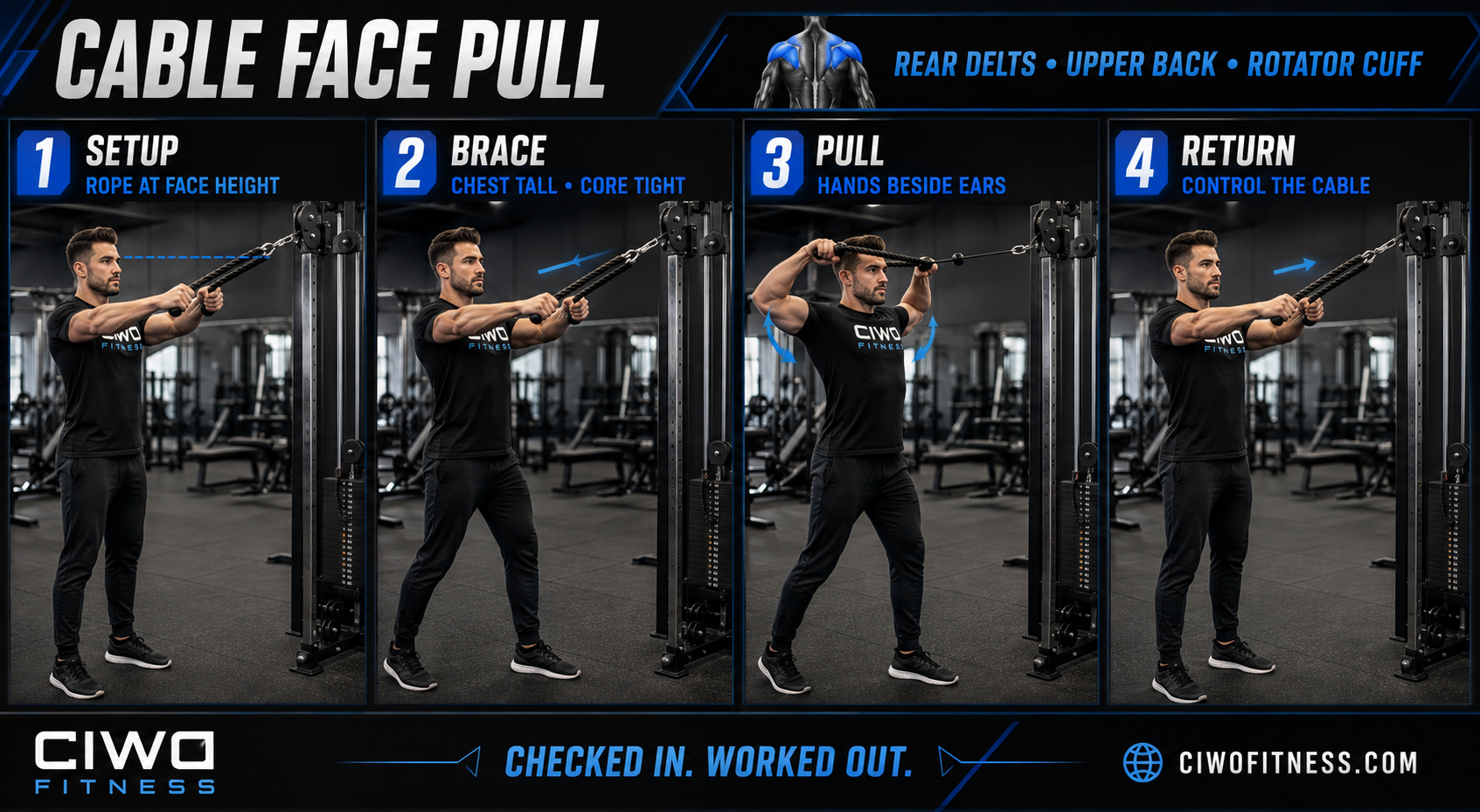
The cable face pull is an upper-body pulling exercise that targets the rear shoulders and upper back while reinforcing controlled shoulder movement. Using a rope attachment allows the hands to separate as the rope approaches the face, encouraging external rotation and a strong contraction through the rear delts and upper back.
Muscles Worked
- Primary: Rear deltoids and middle trapezius
- Secondary: Rhomboids, lower trapezius and rotator cuff muscles
- Stabilizers: Core, forearms and upper-arm muscles
Equipment Needed
- Adjustable cable machine
- Rope attachment
- Clear space to step back and maintain cable tension
Cable Face Pull: Step-by-Step
1. Set the Pulley
Attach the rope to a cable pulley positioned around upper-face or forehead height. Select a manageable resistance that allows you to move through the full range without leaning backward or shrugging.
2. Grip the Rope and Step Back
Face the machine and hold one end of the rope in each hand with a neutral grip. Step backward until your arms are extended and the cable is taut. Use an athletic or staggered stance with soft knees.
3. Brace Your Body
Keep your chest tall, ribs controlled and core engaged. Allow the shoulder blades to reach forward slightly at the start while keeping the shoulders away from the ears. Maintain an upright torso throughout the repetition.
4. Pull Toward Your Face
Lead with the elbows and pull the rope toward your forehead or upper face. As the rope approaches, separate the ends so your hands finish beside your ears. Keep the elbows outward near shoulder height and avoid turning the movement into a low row.
5. Squeeze the Upper Back
Pause briefly with the rope near your face. Squeeze the rear delts and upper-back muscles while keeping the neck relaxed and the wrists neutral.
6. Return with Control
Slowly extend your arms and allow the shoulder blades to move forward under control. Keep tension on the cable and begin the next repetition without letting the weight stack slam down.
Key Form Cues
- Pull the rope toward the forehead—not the chest.
- Finish with the hands beside the ears.
- Keep the elbows outward rather than tucked against the ribs.
- Maintain a tall torso without excessive backward lean.
- Use a smooth tempo and control the return.
- Keep the shoulders down instead of shrugging toward the ears.
Common Mistakes
- Using too much weight: Heavy resistance often causes leaning, shortened range of motion and poor shoulder positioning.
- Pulling too low: Pulling toward the chest turns the exercise into more of a cable row.
- Keeping the hands together: Separate the rope ends to allow the shoulders to externally rotate.
- Shrugging: Keep space between the shoulders and ears.
- Flaring the ribs: Brace the core and avoid arching the lower back.
- Releasing the weight quickly: The controlled return is an important part of the repetition.
Suggested Sets and Repetitions
- Beginner: 2–3 sets of 12–15 repetitions
- Muscle development: 3–4 sets of 10–15 repetitions
- Warm-up or technique work: 2–3 light sets of 15–20 controlled repetitions
Choose a resistance that lets you complete every repetition with the same upright posture and finishing position. Stop the set when you can no longer separate the rope ends or control the return.
Programming Tips
- Perform face pulls after compound pulling or pressing exercises.
- Use them as part of an upper-body warm-up with light resistance.
- Include them on back, shoulder or full-body training days.
- Pair them with presses or lateral raises for a balanced shoulder session.
- Prioritize control and positioning over load progression.
Modifications
- Half-kneeling face pull: Reduces the temptation to lean backward and increases the stability demand.
- Seated face pull: Provides a stable base when controlling torso movement is difficult.
- Resistance-band face pull: Offers a portable alternative when a cable machine is unavailable.
Safety Note
Use a comfortable range of motion and avoid forcing the elbows or hands behind the body. Stop if you experience sharp shoulder, neck or elbow pain. Anyone with an existing shoulder condition should seek guidance from a qualified healthcare or fitness professional before adding this movement.
Fitness on the go or wherever life takes you. Fitness never takes a vacation!
Programming Cable Face Pull
Use Cable Face Pull as part of a complete program rather than judging it in isolation. Start with a resistance that allows repeatable technique and stop a set when range of motion or body position begins to deteriorate.
Sets, repetitions and progression
For general muscle development, two to four working sets in a moderate repetition range are a practical starting point. When you can reach the top of your planned range across your sets with controlled form, increase resistance by a small amount. Progress can also come from better control, more quality repetitions or an improved usable range of motion.
Tempo and breathing
Control the lowering phase instead of letting gravity or momentum take over. Brace before the demanding portion of the repetition, exhale through the working phase without losing torso position and reset your breath as needed between repetitions.
When to modify the movement
Muscular fatigue is expected, but sharp joint pain is not the objective. Reduce resistance, adjust the range or choose a comparable variation if the exercise cannot be performed comfortably. Persistent pain or a return from injury warrants individualized guidance from an appropriate professional.
Track what actually improves
Record load, repetitions and technique notes. Small, repeatable improvements are more useful than adding weight while shortening the range or relying on momentum.
See more CIWO exercise guides and use the Workout Calendar to organize training.