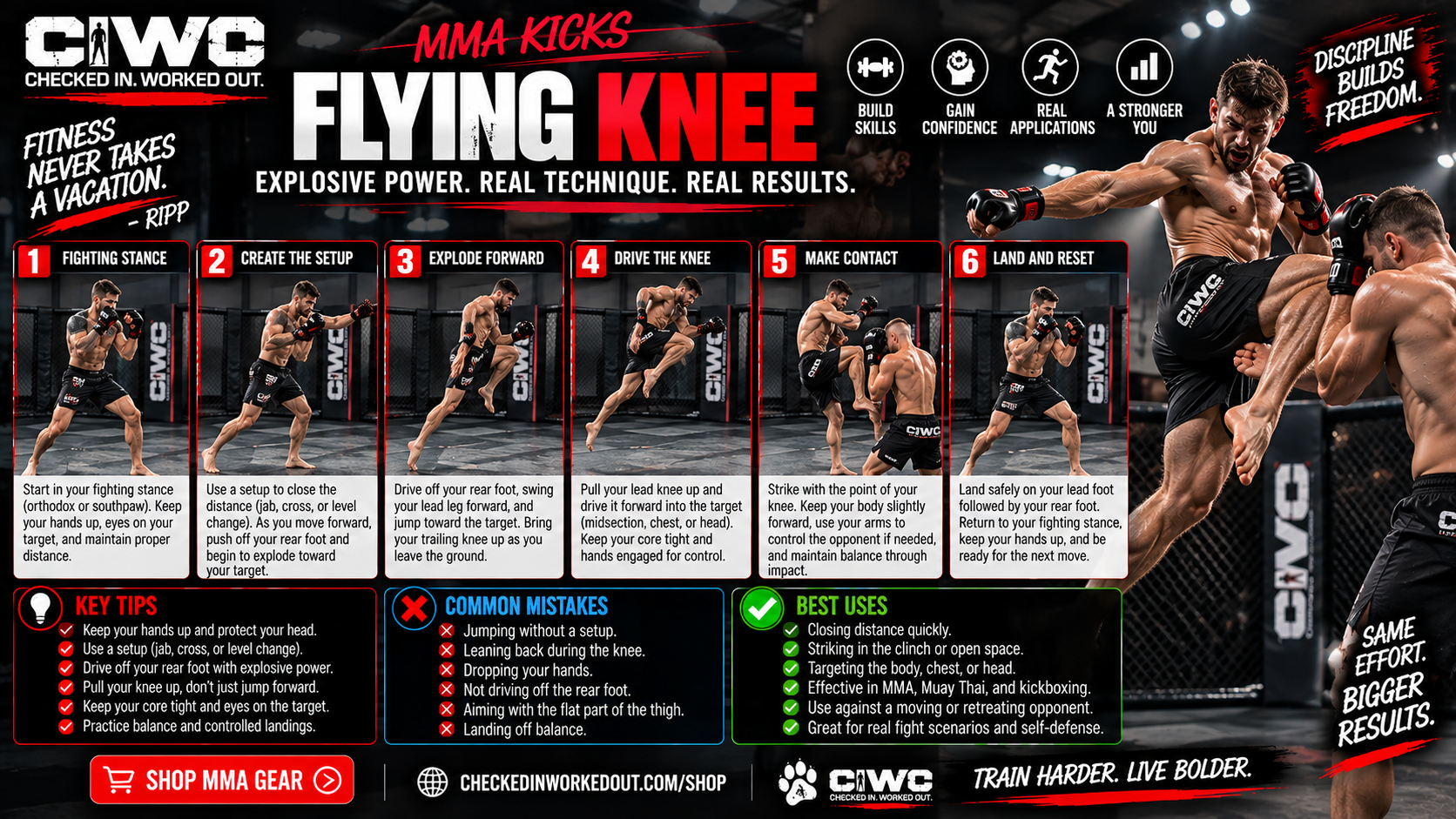

The flying knee is an advanced jumping knee strike used in MMA and Muay Thai. It requires timing, balance, coordination, and a controlled landing. This guide explains the movement for supervised pad training—not for unsupervised contact practice.
Flying Knee: Step-by-Step MMA Technique
Study the featured six-panel athlete demonstration, then rehearse the movement slowly without a partner before progressing to a coach-held pad. The panels show the sequence from stance through takeoff, knee drive, and landing; they are a visual overview rather than a substitute for hands-on coaching.
1. Establish a balanced stance
Stand with feet staggered, knees soft, chin tucked, and hands near your face. Keep enough space around you to jump and land safely.
2. Prepare the movement
Shift your weight under control and take a small, measured approach step if appropriate for your drill. Avoid rushing into a jump before you have established balance.
3. Drive upward
Push through the floor with your supporting leg to generate upward motion. Keep your torso organized and your eyes forward. Practice a modest jump first rather than chasing height.
4. Lift the striking knee
Bring one knee upward while keeping the other leg positioned for a stable return to the floor. Keep your hands in a protective position and avoid excessive backward leaning.
5. Practice on a supervised pad
When a qualified coach determines you are ready, rehearse controlled contact against an appropriately held striking pad. Begin at low intensity and prioritize positioning and balance over force. Never attempt the movement on an unprepared training partner.
6. Land and reset
Land softly with knees slightly bent, regain your stance, and check your balance before the next repetition. Stop if your landing becomes uncontrolled.
Training Progression
- Foundation: Practice knee raises, controlled marching, balance drills, and basic footwork.
- Low-impact rehearsal: Coordinate a small hop with the knee lift, focusing on a stable landing.
- Pad practice: Work with a qualified coach and appropriate protective equipment before adding speed or intensity.
- Recovery: Rest between attempts so fatigue does not compromise your landing mechanics.
Common Mistakes
- Jumping higher than you can safely land.
- Dropping both hands or leaning far backward.
- Approaching too quickly and losing control of your position.
- Practicing close to other athletes or obstacles.
- Attempting contact drills without coaching or suitable pads.
Safety and Coaching Notes
Flying knees are high-impact, advanced skills with a risk of falls and injury to both participants. Train in a clear, padded area with a qualified MMA or Muay Thai coach. Do not practice on another person’s head or neck. If you have knee, ankle, hip, or balance concerns, ask an appropriate clinician or coach about modifications before attempting jumping strikes. This article is for sport-specific education and does not guarantee performance or personal safety.
Frequently Asked Questions
Is a flying knee suitable for beginners?
It is an advanced technique. Beginners should first develop stable footwork, basic knee-strike mechanics, coordination, and controlled landings under coaching.
How high should I jump?
Only as high as you can control while maintaining a safe landing. More height is not a substitute for good timing and mechanics.
Can I learn it from an image alone?
No. The step-by-step image illustrates the general sequence, but a qualified coach can correct individual mechanics and supervise safe pad work.
Keep Building Your MMA Fundamentals
Developing a flying knee begins with controlled movement, sound footwork, and consistent practice. Explore more CIWO MMA striking tutorials and progress at a pace that allows you to maintain balance and technique.