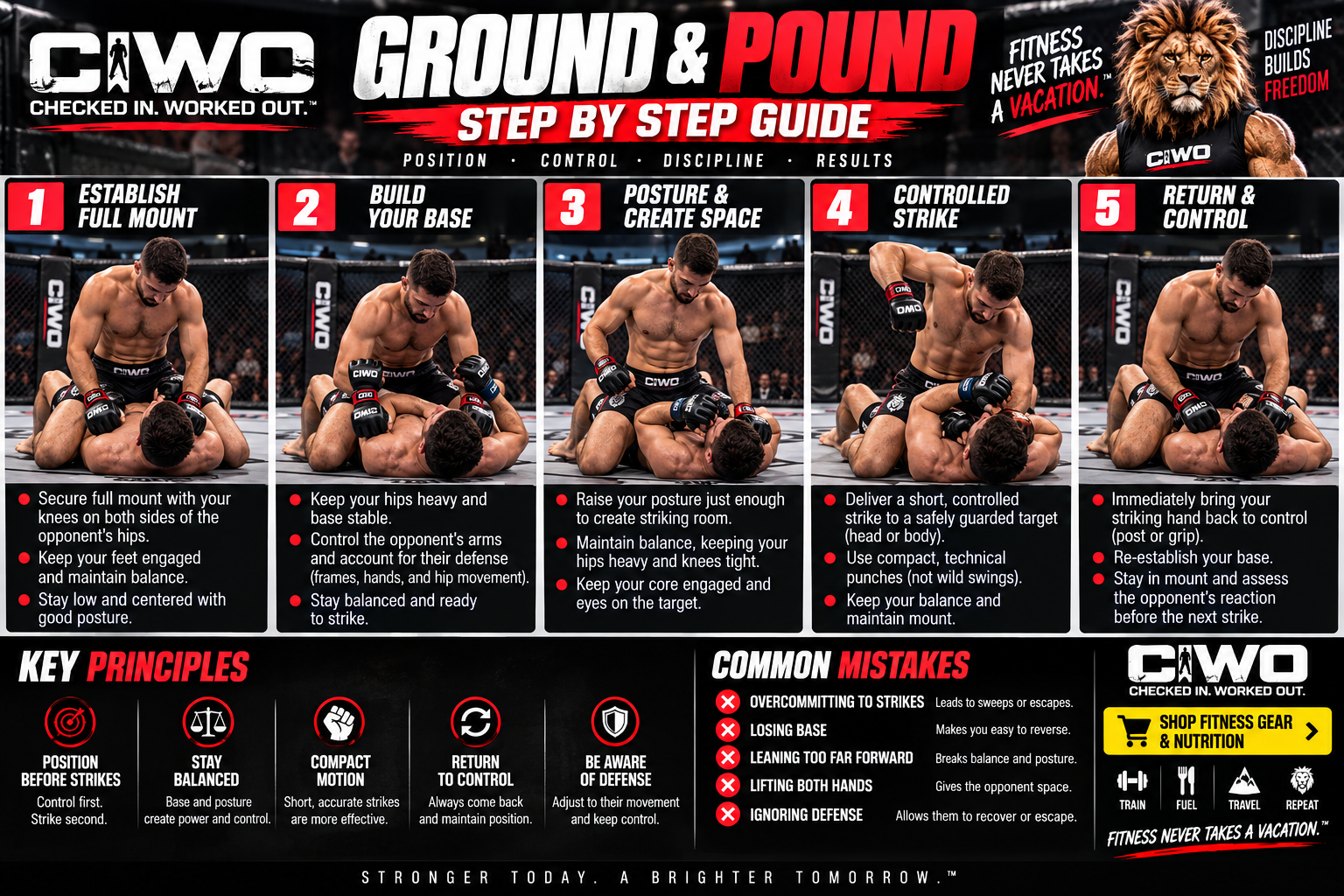

Ground and pound is a core MMA striking skill that combines positional control on the ground with compact, controlled strikes. Effective ground and pound is not simply about throwing punches from the top position: the fighter must first establish balance, understand the opponent’s defensive movement, create safe striking space, and return to control after every attack.
What Is Ground and Pound?
Ground and pound describes striking from a dominant ground position in mixed martial arts. From positions such as full mount, a fighter can use punches while maintaining positional control. Good technique prioritizes position, balance and accuracy instead of uncontrolled swinging.
Ground and Pound: Step-by-Step
1. Establish Full Mount
Secure the mount with your knees positioned on both sides of your training partner’s hips. Keep a stable base and stay centered. Before thinking about striking, make sure you can maintain the position as your partner moves.
2. Build Your Base
Keep your hips controlled and use your hands, knees and body position to maintain balance. Pay attention to framing, bridging and hip movement from the person underneath you. A strong base makes it harder to be swept or reversed.
3. Posture and Create Space
Raise your posture only enough to create room for a controlled strike while keeping your center of gravity stable. Keep your core engaged and avoid leaning so far forward or backward that you sacrifice the mount.
4. Deliver a Controlled Strike
In supervised MMA training, practice compact punching mechanics against pads or other appropriate training equipment. Short straight punches and compact downward motions generally require less wind-up than large swings and make it easier to preserve balance. Accuracy, control and position come before power.
5. Return to Control
Bring the striking hand back immediately and re-establish your base. Assess your partner’s movement before beginning another controlled repetition. The sequence is position, strike and return to control—not a continuous loss of posture in pursuit of punches.
Key Ground-and-Pound Principles
- Position before strikes: maintain control before creating offense.
- Stay balanced: your base determines whether you can strike without being reversed.
- Use compact motion: avoid unnecessary wind-up.
- Return to control: recover your hand and posture after each repetition.
- Respect the defense: adjust when your training partner frames, bridges or changes position.
Common Mistakes
Common errors include overcommitting to strikes, losing the mount while reaching, leaning too far forward, lifting both hands away from your base at the wrong time, ignoring defensive movement, and prioritizing power over control.
Training Ground and Pound Safely
Ground-and-pound practice should be performed in an appropriate MMA training environment with qualified coaching, agreed intensity and suitable protective equipment. Beginners should learn positional control and striking mechanics separately before combining them. Use pads or controlled partner drills rather than trying to reproduce full-force competition strikes during routine practice. Stop immediately if a partner is hurt or cannot intelligently defend.
Ground and Pound FAQ
Is ground and pound only performed from full mount?
No. MMA fighters can strike from several top positions. Full mount is used in this guide because it clearly demonstrates the relationship between positional control, posture and striking.
Should beginners focus on punching power?
No. Beginners benefit more from learning balance, posture, control and clean mechanics. Power should never come at the expense of safe training or positional stability.
Why return to control after a strike?
Every strike can temporarily change your balance and create an opportunity for the opponent to escape or reverse position. Recovering your posture helps you remain in control and prepares you for the opponent’s response.
Train the position. Control the movement. Build the striking skill. Explore more CIWO MMA striking tutorials to continue developing your stand-up and ground striking fundamentals.