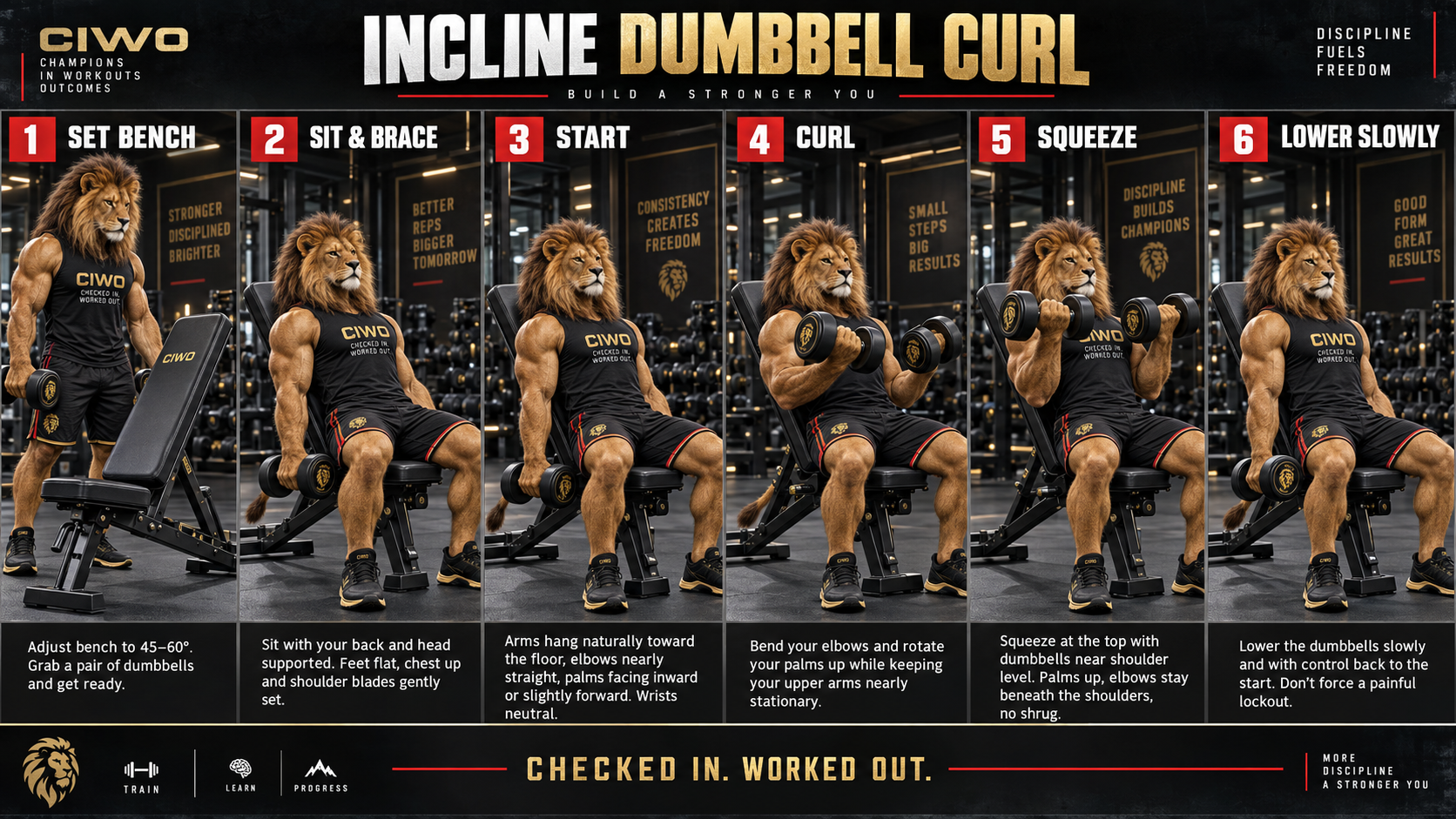

The Incline Dumbbell Curl is a seated arm exercise performed against an inclined bench. Allowing the arms to hang slightly behind the torso places the biceps—especially the long head—in a lengthened starting position and makes strict technique especially important.
This step-by-step guide covers bench setup, posture, arm position, curling mechanics, breathing, programming and common mistakes. Begin with lighter dumbbells than you would normally use for standing curls and prioritize a smooth, pain-free range of motion.
Exercise Overview
- Primary muscles: Biceps brachii
- Secondary muscles: Brachialis and brachioradialis
- Movement: Elbow flexion with forearm supination
- Equipment: Adjustable incline bench and two dumbbells
- Suggested bench angle: Approximately 45–60 degrees
- Level: Beginner to intermediate
Benefits of the Incline Dumbbell Curl
- Trains the biceps from a lengthened starting position.
- Reduces the opportunity to create momentum with the hips or torso.
- Allows each arm to work independently.
- Can help reveal and address side-to-side strength differences.
- Builds controlled elbow-flexion strength that complements rows and pull-ups.
- Requires only dumbbells and an adjustable bench.
How to Perform the Incline Dumbbell Curl
- Set the bench: Adjust the backrest to approximately 45–60 degrees. Choose a light pair of dumbbells and place them where you can pick them up safely.
- Sit and brace: Sit with your back and head supported, feet planted and shoulder blades gently drawn down and back.
- Establish the start: Let both arms hang naturally toward the floor with palms facing inward or slightly forward. Keep the shoulders relaxed and wrists neutral.
- Begin the curl: Exhale and bend the elbows. Rotate the palms upward as the dumbbells rise while keeping the upper arms nearly still.
- Contract at the top: Curl through the largest comfortable range without allowing the elbows to travel far forward or the shoulders to round.
- Lower slowly: Inhale and return the dumbbells over 2–3 seconds. Maintain control until the elbows are nearly straight without forcing them into a painful lockout.
- Reset and repeat: Reestablish your posture, keep the arms hanging beneath the shoulders and begin the next repetition without swinging.
Key Form Checklist
- Keep your back and head supported by the bench.
- Plant both feet and keep the ribs controlled.
- Let the arms hang naturally instead of forcing them excessively behind the body.
- Keep the upper arms mostly stationary.
- Rotate the palms upward during the curl without twisting the wrists.
- Avoid shrugging the shoulders toward the ears.
- Lower the dumbbells slowly through a comfortable range.
- Use the same controlled path on every repetition.
Tempo and Breathing
- Exhale while curling the dumbbells upward for approximately 1–2 seconds.
- Pause briefly at the top without letting the elbows drift forward.
- Inhale while lowering for approximately 2–3 seconds.
- Pause momentarily in the controlled starting position before the next repetition.
Suggested Sets and Repetitions
- Learning the movement: 2–3 sets of 10–15 repetitions
- Muscle building: 3–4 sets of 8–12 repetitions
- Muscular endurance: 2–3 sets of 15–20 repetitions
- Rest: 60–90 seconds between sets
Select a weight that lets you keep the shoulders stable and control the complete lowering phase. Add weight only after you can complete the target repetitions without swinging, shortening the range or moving the elbows forward.
Common Mistakes and Fixes
- Using too much weight: Reduce the load until every repetition can be performed without swinging.
- Elbows drifting forward: Keep the upper arms hanging beneath the shoulders and stop the curl before the shoulders take over.
- Shoulders rolling forward: Keep the shoulder blades gently set against the bench.
- Lifting the head or back: Maintain contact with the bench throughout the set.
- Dropping the dumbbells: Control the lowering phase for 2–3 seconds.
- Bending the wrists: Keep the knuckles aligned with the forearms.
- Forcing excessive arm extension: Use a comfortable bottom position and stop if the front of the shoulder or elbow feels strained.
- Uneven repetitions: Match the range and tempo on both sides, or use alternating repetitions with deliberate control.
Variations and Alternatives
- Alternating incline dumbbell curl
- Neutral-grip incline hammer curl
- Single-arm incline dumbbell curl
- Standing dumbbell curl
- Preacher curl
- Cable curl
- EZ-bar curl
Safety Notes
Inspect the bench and dumbbells before training, confirm that the backrest is locked and keep the floor around the bench clear. Begin with a conservative angle and light resistance. Do not force the arms far behind the torso or aggressively lock the elbows at the bottom. Stop if you feel sharp pain, numbness or unusual discomfort in the shoulders, elbows, wrists, neck or back. Choose a pain-free alternative and consult a qualified healthcare or fitness professional when needed.
Frequently Asked Questions
What bench angle should I use?
A backrest angle of approximately 45–60 degrees works well for many lifters. A lower angle increases the shoulder-extension demand, so begin higher and adjust only if the movement remains comfortable.
Should I curl both dumbbells together?
You can curl both arms simultaneously or alternate sides. Simultaneous repetitions are efficient, while alternating repetitions can make it easier to focus on one arm at a time.
Should my arms be completely straight at the bottom?
Lower until the elbows are nearly straight while maintaining muscular control. Do not force a hard lockout or stretch beyond a comfortable range.
Why do I feel the exercise in the front of my shoulders?
The bench may be too low, the arms may be forced too far behind the body or the weight may be too heavy. Raise the bench, reduce the load and use a comfortable arm position. Stop if discomfort persists.
Bottom Line
The Incline Dumbbell Curl is most effective when you use a stable bench setup, keep the upper arms quiet and control both the curl and the lowering phase. Let strict form—not the size of the dumbbells—determine the load.
Shop CIWO Weight-Training Gear
Looking for dumbbells, adjustable benches and weight-training accessories? Visit the Checked In. Worked Out. Shop to explore fitness gear for home, gym and travel workouts.
Affiliate disclosure: Some shop links may be affiliate links. CIWO may earn a commission from qualifying purchases at no additional cost to you.
Exercise disclaimer: This content is for general educational purposes and is not medical advice. Exercise carries risk. Use appropriate equipment and technique, work within your abilities and consult a qualified professional when needed.
Fitness Never Takes a Vacation.™