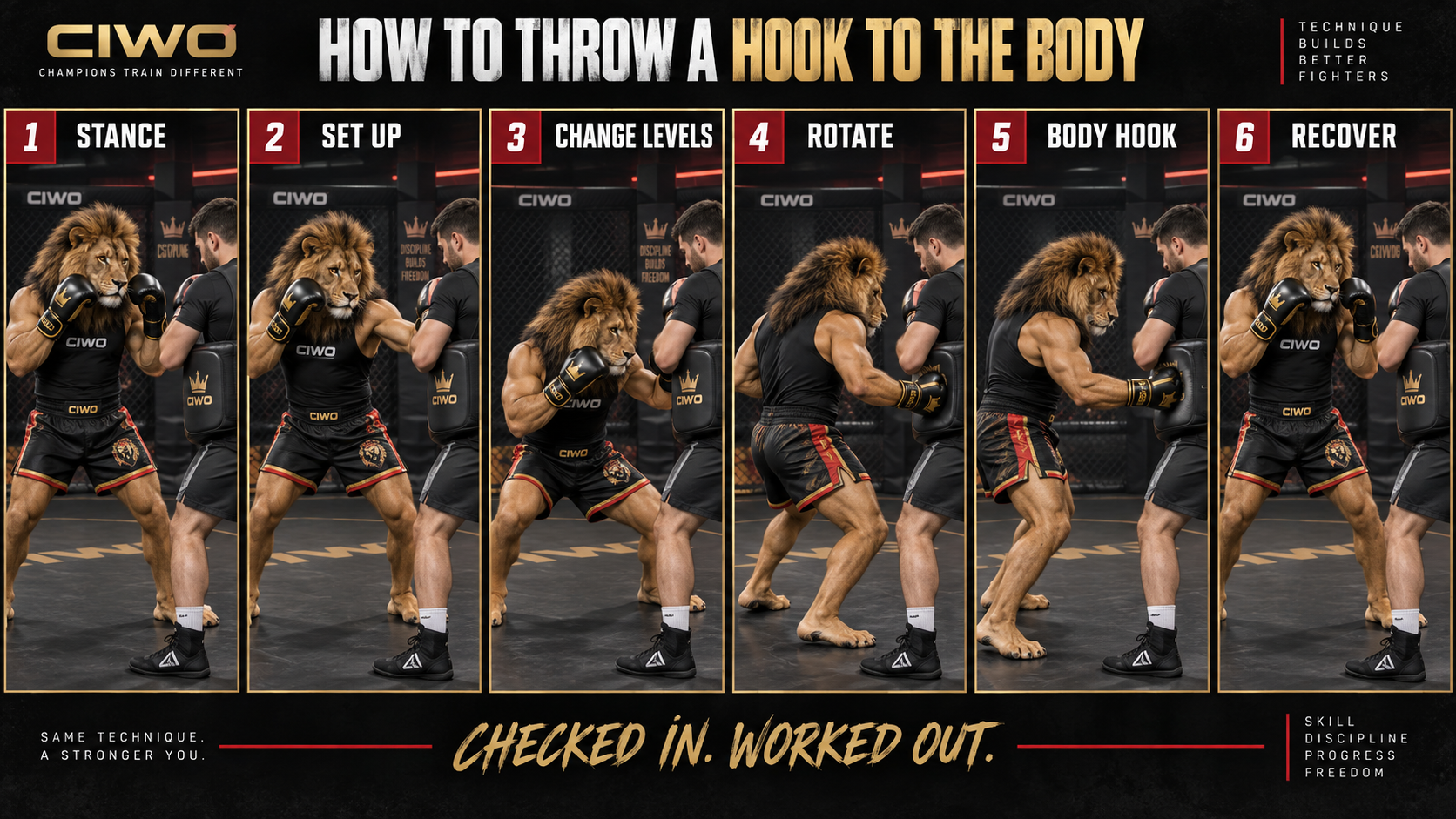

The hook to the body is a compact power punch aimed below an opponent’s guard. In MMA, it can punish a high guard, interrupt forward pressure and create openings for punches, kicks or takedowns.
The strike may be thrown with the lead or rear hand. The exact angle changes with stance and range, but the essentials remain the same: stay balanced, change levels with the legs, rotate through the floor, keep the elbow bent and return immediately to a protected stance.
Technique Overview
- Strike: Lead- or rear-hand hook to the body
- Primary targets: Legal body targets such as the ribs and torso
- Best range: Close to mid-range
- Primary mechanics: Level change, hip rotation and a compact bent-arm arc
- Primary weapons: First two knuckles inside properly fitted gloves
- Level: Beginner to intermediate
Why Use a Body Hook?
- Attacks underneath a high guard.
- Encourages the opponent to lower an elbow, creating head-level openings.
- Can disrupt breathing, posture and forward pressure.
- Combines naturally with jabs, crosses, uppercuts, kicks and level-change feints.
- Works from either side and can be adapted to orthodox or southpaw stance.
How to Throw a Hook to the Body
- Start in stance: Keep your feet under you, knees soft, chin tucked and both hands protecting your face.
- Enter behind a setup: Use a jab, feint, slip or combination to occupy the opponent’s guard. Do not reach from outside punching range.
- Change levels: Bend slightly through the knees and hips while keeping your spine controlled and eyes on the opponent. Avoid folding forward at the waist.
- Rotate from the floor: Turn the foot, knee, hip and torso on the punching side as one connected unit. Keep the opposite hand at your cheek.
- Drive a compact arc: Keep the elbow bent and sweep the fist horizontally or slightly upward into a legal body target. Keep the wrist straight and avoid an exaggerated windup.
- Make controlled contact: Strike through the target without overextending, letting the legs and torso create the force.
- Recover immediately: Retract the hand along a short path, bring your posture back under you and reset your guard and stance before continuing the combination.
Lead Hook vs. Rear Hook to the Body
Lead-Hand Body Hook
The lead hook usually travels a shorter distance and can follow a jab, slip or lead-hand feint. Keep it compact, rotate the lead hip and recover quickly so the rear hand remains available for defense or a follow-up cross.
Rear-Hand Body Hook
The rear hook can carry more rotational force but may expose you if it becomes wide. Set it up, turn the rear hip without crossing your feet and keep the lead hand protecting your face throughout the strike.
Key Form Checklist
- Lower your level with the knees and hips—not by dropping your face toward the target.
- Keep your chin tucked and eyes up.
- Maintain a bent elbow and straight wrist at impact.
- Keep the non-punching hand at the cheek.
- Rotate the foot, hip and torso together.
- Stay balanced enough to defend, angle out or continue the combination.
- Return the hand directly to guard after every punch.
Common Mistakes and Fixes
- Reaching for the body: Step into safe range behind a setup instead of leaning your head forward.
- Dropping the punching hand first: Keep the motion compact so the punch is harder to read.
- Swinging too wide: Shorten the arc and keep the elbow bent.
- Using only the arm: Initiate force from the floor and connect the foot, hip and torso.
- Dropping the opposite hand: Glue the non-punching glove to your cheek.
- Looking at the target: Keep your eyes on the opponent and disguise the body attack.
- Remaining low after contact: Recover your posture and guard immediately.
- Overcommitting: Finish balanced enough to defend counters or change position.
Useful Setups and Combinations
- Jab → body hook → cross
- Jab → cross → lead hook to the body
- High hook → body hook
- Slip outside → body hook → angle out
- Level-change feint → body hook → head hook
- Body jab → body hook → exit
Training Drills
- Shadowboxing: 3 rounds of 2 minutes, emphasizing level change and fast recovery.
- Heavy bag: 3–5 sets of 8 controlled body hooks per side.
- Focus mitts: Practice the strike inside short combinations with a qualified coach or partner.
- Defense drill: Throw the body hook, return to guard and immediately angle away from the imagined counter.
Begin slowly enough to keep the same balance, guard and wrist position on every repetition. Add speed and power only after the mechanics remain consistent.
Safety and Sparring Notes
Learn this strike under qualified supervision and use properly fitted gloves, hand wraps and appropriate protective equipment. Agree on intensity and legal target areas before partner drills or sparring. Never practice full-power body shots on an unprotected partner. Avoid prohibited areas, stop immediately for sharp pain, dizziness, breathing difficulty or unusual symptoms, and seek appropriate medical care when needed.
Frequently Asked Questions
Should the body hook travel horizontally or upward?
Either can work. The angle depends on your position, the target and the opponent’s guard. Keep the arc compact and the wrist aligned rather than forcing one exact angle.
Do I have to use a specific hand?
No. The hook to the body can be thrown with either the lead or rear hand from orthodox or southpaw stance. Practice both sides so you can select the right tool for the opening.
How low should I change levels?
Only as low as needed to reach the target while keeping your posture, vision and balance. A small knee bend is usually more useful than a deep crouch.
Why do I lose balance when throwing it?
You may be reaching, rotating beyond your stance or placing too much weight over the front foot. Reduce the power, shorten the punch and practice finishing in a position from which you can move immediately.
Bottom Line
An effective body hook is short, disguised and balanced. Change levels with your legs, rotate as one unit, protect your face and recover immediately. Clean technique creates the opening for power.
Shop CIWO Training Gear
Looking for gloves, hand wraps, training accessories and fitness gear? Visit the Checked In. Worked Out. Shop for equipment that supports training at home, in the gym and on the go.
Affiliate disclosure: Some shop links may be affiliate links. CIWO may earn a commission from qualifying purchases at no additional cost to you.
Training disclaimer: This content is for general educational purposes and is not medical advice. Combat-sport training carries risk. Train under qualified supervision, use appropriate protective equipment and work within your abilities.
Fitness Never Takes a Vacation.™