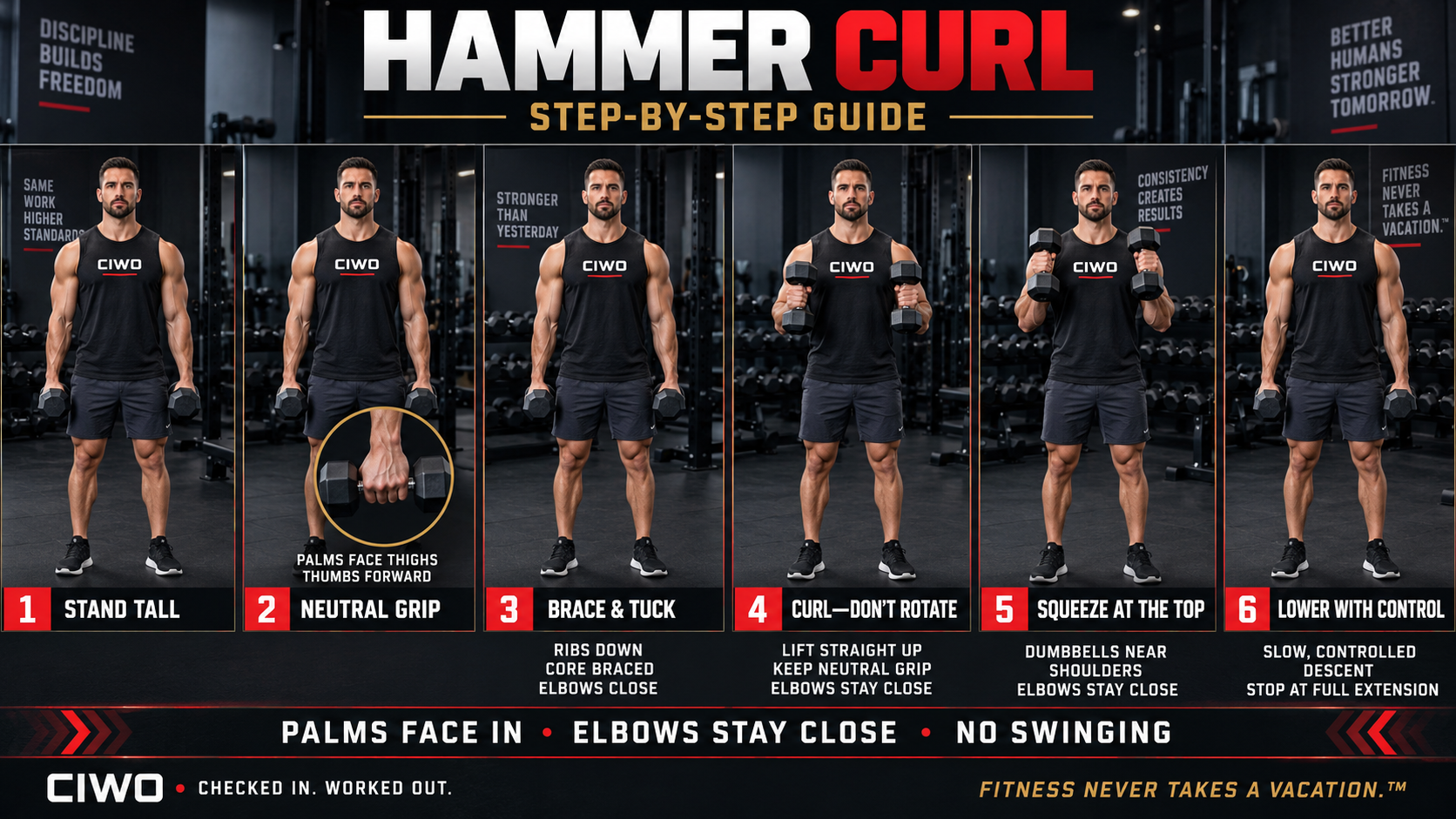

The Hammer Curl is a dumbbell arm exercise performed with a neutral grip—your palms face inward throughout the repetition. This position trains the elbow flexors while placing strong emphasis on the brachialis and brachioradialis alongside the biceps brachii.
Hammer curls are simple to learn, but effective execution depends on keeping the upper arms stable, wrists straight and torso quiet. Use a manageable weight and make the elbow—not momentum—the center of the movement.
Exercise Overview
- Primary muscles: Brachialis, brachioradialis and biceps brachii
- Movement: Elbow flexion
- Equipment: Two matching dumbbells
- Grip: Neutral, with palms facing inward
- Level: Beginner to advanced
Muscles Worked
- Brachialis: Lies beneath the biceps and contributes strongly to elbow flexion.
- Brachioradialis: A forearm muscle that assists elbow flexion, especially with a neutral grip.
- Biceps brachii: Assists in bending the elbow even though the hands remain neutral.
- Stabilizers: Forearm and grip muscles, shoulders, upper back and core help maintain position.
Benefits of Hammer Curls
- Builds the upper arms and forearms with one straightforward movement.
- Strengthens elbow flexion and gripping support for rows, pull-ups and everyday lifting.
- The neutral grip may feel more comfortable than a fully palms-up curl for some people.
- Works well with bilateral, alternating, seated and cable variations.
- Requires minimal equipment and can be performed at home, in a gym or while traveling.
Equipment and Setup
- Select two equal dumbbells light enough to control without swinging.
- Stand with your feet approximately hip- to shoulder-width apart and knees softly unlocked.
- Hold the dumbbells beside your thighs with palms facing inward and thumbs pointing forward.
- Stack the wrists straight over the handles and close the hands securely around each dumbbell.
- Stand tall with the chest comfortable, ribs down, shoulders relaxed and core braced.
- Keep the elbows close to the sides of your torso.
How to Perform the Hammer Curl
- Stand tall: Begin with the dumbbells at your sides, arms extended without forcing the elbows backward.
- Set the grip: Keep both palms facing inward. Do not rotate the hands into a traditional palms-up curl.
- Brace and tuck: Keep the torso still, shoulder blades gently set and elbows near the ribs.
- Curl the weights: Exhale and bend the elbows, bringing the dumbbells upward while the upper arms remain mostly vertical.
- Squeeze at the top: Stop when the forearms approach the upper arms or just before the elbows begin drifting forward. Pause briefly without shrugging.
- Lower with control: Inhale and return the dumbbells over approximately 2–3 seconds until the arms are fully extended under control.
Key Form Checklist
- Keep the palms facing inward from start to finish.
- Maintain straight, neutral wrists rather than bending them toward the shoulders.
- Keep the elbows close to the torso without pinning them painfully inward.
- Move at the elbows while minimizing shoulder and torso movement.
- Keep the ribs down and avoid leaning backward as the dumbbells rise.
- Lower the weight as deliberately as you lift it.
- Stop the set when consistent form begins to break down.
Tempo and Breathing
- Lift: Exhale and curl for approximately 1–2 seconds.
- Top: Pause briefly while maintaining tension.
- Lower: Inhale and descend for approximately 2–3 seconds.
- Reset: Allow the arms to extend under control before beginning the next repetition.
Suggested Sets and Repetitions
- Technique beginner: 2–3 sets of 10–15 repetitions with a light load
- Muscle building: 3–4 sets of 8–12 controlled repetitions
- Muscular endurance: 2–3 sets of 15–20 repetitions
- Rest: approximately 60–90 seconds between sets
Use a weight that leaves you able to complete each repetition without swinging, rotating the wrists or driving the elbows forward. Increase the load gradually after you can complete the upper end of your target range with repeatable form.
Common Mistakes and Fixes
- Swinging the torso: Reduce the weight, brace the core and pause between repetitions.
- Leaning backward: Keep the ribs stacked over the pelvis and avoid turning the curl into a full-body lift.
- Rotating the palms upward: Keep the thumbs pointing forward and palms facing one another.
- Allowing elbows to travel forward: Stop the curl slightly lower and keep the upper arms vertical.
- Bending the wrists: Keep the knuckles aligned with the forearms.
- Shrugging the shoulders: Relax the shoulders away from the ears and use less weight.
- Dropping the dumbbells: Control the lowering phase rather than letting gravity take over.
- Rushing repetitions: Slow the tempo and focus on a consistent path.
Variations and Alternatives
- Alternating hammer curl: Curl one dumbbell at a time.
- Seated hammer curl: Sit upright to reduce lower-body involvement.
- Incline hammer curl: Use an incline bench for a longer starting position.
- Cross-body hammer curl: Curl each dumbbell toward the opposite side of the chest.
- Rope cable hammer curl: Use a rope attachment for continuous cable resistance.
- Single-arm hammer curl: Train one side at a time and use the free hand for balance.
When to Add Hammer Curls
Hammer curls usually fit well after larger pulling exercises such as rows or pulldowns, or alongside another biceps exercise near the end of an upper-body or arm workout. Avoid adding more volume than your elbows and forearms can recover from.
Safety Notes
Inspect the dumbbells and surrounding floor before starting. Use a stable stance, keep the weights clear of your legs and lower them without dropping. Stop if you experience sharp pain, numbness, tingling or unusual discomfort in the hands, wrists, elbows or shoulders. Choose a comfortable variation and consult a qualified healthcare or fitness professional when appropriate.
Frequently Asked Questions
Should hammer curls be performed together or one arm at a time?
Both methods are effective. Bilateral curls save time, while alternating curls may make it easier to focus on one arm and keep the torso stable.
How high should I curl the dumbbells?
Curl until the forearms approach the upper arms or until going higher would cause the elbows to drift forward or the shoulders to shrug. The exact top position depends on your proportions and mobility.
Are hammer curls better than traditional curls?
Neither is universally better. Hammer curls emphasize the brachialis and brachioradialis with a neutral grip, while palms-up curls place the biceps in a different position. Many programs use both.
Why do I feel hammer curls mostly in my forearms?
The brachioradialis is expected to contribute strongly. Excessive grip tension, bent wrists or too much weight can make forearm fatigue dominate, so keep the wrists neutral and adjust the load if needed.
Bottom Line
The Hammer Curl is an effective arm exercise when you maintain a neutral grip, keep the elbows close, avoid swinging and control both halves of every repetition.
Further Reading
- American Council on Exercise: Exercise Library
- American College of Sports Medicine: Resistance Training Guidelines Update
Shop CIWO Fitness Gear
Looking for dumbbells, weight-training accessories and home-gym equipment? Visit the Checked In. Worked Out. Shop to explore fitness gear for training at home, in the gym and on the go.
Affiliate disclosure: Some shop links may be affiliate links. CIWO may earn a commission from qualifying purchases at no additional cost to you.
Exercise disclaimer: This content is for general educational purposes and is not medical advice. Exercise carries risk. Use appropriate equipment and technique, work within your abilities and consult a qualified professional when needed.
Fitness Never Takes a Vacation.™