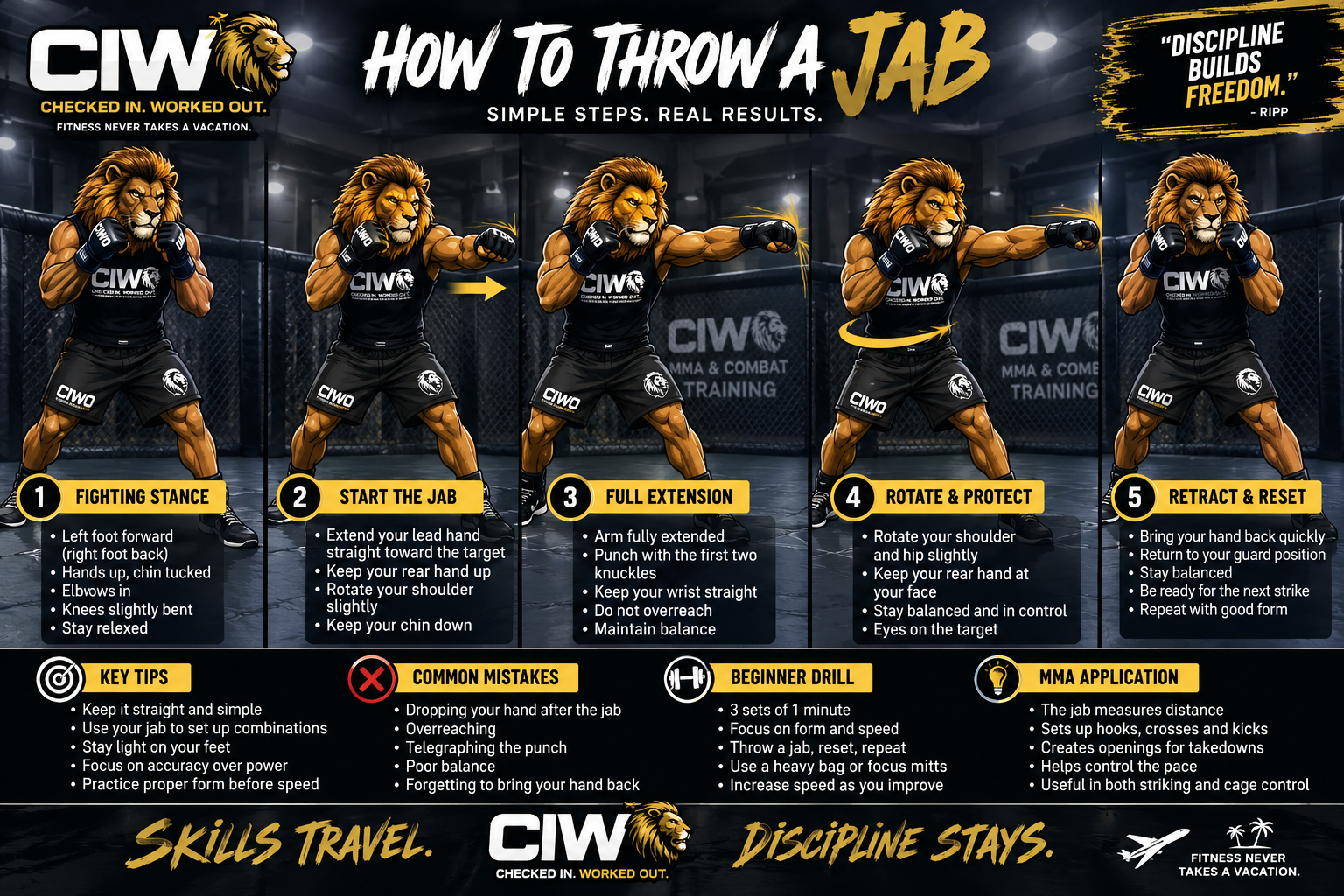

The jab is one of the most important punches in MMA and combat-sport striking. It can help establish range, interrupt an opponent’s rhythm, set up combinations and create openings for other techniques. A good jab is fast, balanced and returns immediately to a protective guard.
What Is a Jab?
A jab is a straight punch thrown with the lead hand. For an orthodox stance, the left hand is normally the lead hand. For a southpaw stance, the right hand is normally the lead hand. Unlike a power-focused rear-hand cross, the jab usually emphasizes speed, timing, accuracy and efficient recovery.
Starting Position
- Begin in a balanced fighting stance with your feet about shoulder-width apart.
- Keep your knees slightly bent and your weight balanced so you can move in any direction.
- Keep your lead hand near your cheek and your rear hand protecting the opposite side of your face.
- Keep your chin slightly tucked and look forward rather than down.
- Keep your elbows relatively close to your body instead of flaring them outward.
How to Throw a Jab: Step by Step
1. Start From Your Guard
Stay relaxed in your stance. Avoid loading the punch by pulling your lead hand backward first. That extra motion can make the jab slower and easier to read.
2. Extend the Lead Hand Straight Forward
Drive the lead fist toward the target along a direct path. Think about sending the fist straight out rather than swinging it in an arc. Keep the opposite hand at your face to maintain your guard.
3. Rotate the Fist Naturally
As the arm extends, allow the fist and forearm to rotate naturally so the knuckles are oriented appropriately at the end of the punch. Do not exaggerate the rotation or force the shoulder into an uncomfortable position.
4. Let the Lead Shoulder Protect the Chin
A slight rise of the lead shoulder can help protect the lead side of your chin while the jab is extended. Keep your head controlled and avoid lifting your chin as you punch.
5. Stay Balanced
The jab should not pull your upper body far beyond your base. You may use a small step with the lead foot when closing distance, but your stance should remain stable enough to defend, move or continue a combination immediately afterward.
6. Snap the Hand Back to Guard
Retract the lead hand along the same direct path and return it to your cheek. The recovery is part of the technique. Do not leave the arm extended after the punch.
Key Coaching Cues
- Straight out, straight back.
- Stay relaxed: unnecessary tension can slow the punch.
- Keep the rear hand home: do not drop the opposite hand while jabbing.
- Chin down, eyes up: maintain awareness while protecting your head.
- Recover quickly: finish every jab back in a useful fighting stance.
Common Jab Mistakes
- Pulling the hand backward before throwing the punch.
- Dropping the rear hand while the jab is extended.
- Flaring the lead elbow excessively.
- Leaning too far forward and losing balance.
- Raising the chin during the punch.
- Pushing the jab slowly instead of extending and recovering efficiently.
- Leaving the lead hand extended instead of returning to guard.
Beginner Jab Drill
- Take your normal fighting stance in front of a mirror or with a qualified coach.
- Throw one controlled jab and immediately return to guard.
- Check your balance, rear-hand position and chin position after every repetition.
- Once the motion is consistent, practice the jab while taking a small controlled step.
- Progress to light shadowboxing or controlled pad work before increasing speed or contact.
Using the Jab in MMA
The jab is useful for more than landing a single punch. It can help measure distance, disguise an entry, begin combinations, create reactions and support movement. In MMA, stance and distance can change because kicks, clinch work and takedowns are also possible, so the jab should be practiced together with balanced footwork and defensive awareness.
Safety & Training Tips
- Learn striking mechanics from a qualified combat-sport coach whenever possible.
- Use appropriate hand wraps and gloves for bag or pad work.
- Keep contact controlled during partner drills and follow your gym’s rules.
- Build speed and power gradually after technique is consistent.
- Stop training if you experience significant hand, wrist, elbow or shoulder pain.
Shop CIWO Fitness & Training Picks
Looking for training gear, fitness equipment, recovery tools and accessories? Visit the Checked In. Worked Out. Shop and explore products selected to support your workouts wherever life takes you.
Affiliate disclosure: Some shop links may be affiliate links. CIWO may earn a commission from qualifying purchases at no additional cost to you.
The CIWO Takeaway
A dependable jab begins with a balanced stance, travels directly to the target and returns immediately to guard. Master the movement slowly before chasing speed or power. Strong fundamentals make later combinations and more advanced striking easier to learn.
Fitness never takes a vacation.