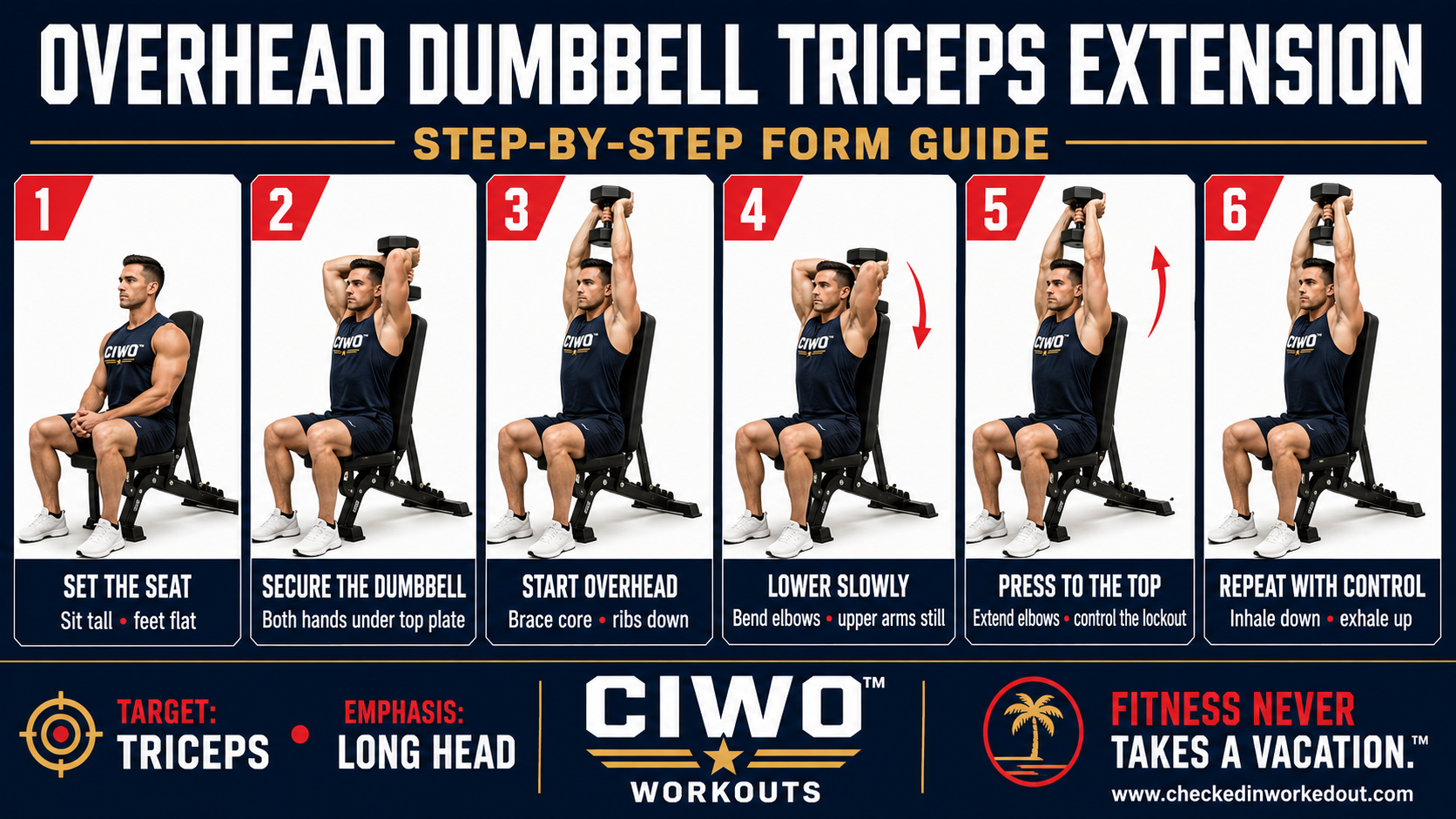

The Overhead Dumbbell Triceps Extension is an isolation exercise that trains elbow extension while placing the arms overhead. This position gives the long head of the triceps a strong training stimulus and makes the movement a useful addition to upper-body and arm workouts.
This guide demonstrates the seated, two-hand version with one dumbbell. A back-supported bench can make it easier to keep the torso stable while you learn the movement.
Exercise Overview
- Primary muscle: Triceps brachii
- Emphasis: Long head of the triceps
- Movement: Elbow extension
- Equipment: One dumbbell and a stable bench
- Level: Beginner to advanced
Muscles Worked
- Primary: All three heads of the triceps brachii—the long, lateral and medial heads
- Assisting: Anconeus during elbow extension
- Stabilizing: Shoulders, upper back, forearms and core
Equipment and Setup
- Choose a dumbbell you can control without arching your back or letting your elbows flare.
- Sit on a stable bench, preferably with back support, and place both feet flat on the floor.
- Hold the dumbbell vertically and securely cup the inside of the upper plate with both hands.
- Carefully bring the dumbbell overhead with your arms extended.
- Brace your core, keep your ribs down and position your upper arms near your ears.
How to Perform the Overhead Dumbbell Triceps Extension
- Set the seat: Sit tall with your head, upper back and hips supported when possible. Keep your feet planted.
- Secure the dumbbell: Cup the upper plate with both hands and maintain a firm, balanced grip.
- Start overhead: Extend your arms above your head. Keep your wrists neutral, core braced and ribs from flaring.
- Lower slowly: Inhale as you bend your elbows and guide the dumbbell behind your head. Keep the upper arms mostly still and close to your ears.
- Use a comfortable depth: Lower until you feel a controlled triceps stretch without shoulder or elbow pain. Do not force extra range.
- Press to the top: Exhale as you extend your elbows and raise the dumbbell. Finish with straight arms without aggressively snapping the joints into lockout.
- Repeat with control: Keep tension on the triceps and use the same steady path on every repetition.
Key Form Checklist
- Keep the dumbbell grip secure before moving it overhead.
- Brace your midsection and avoid arching your lower back.
- Keep your ribs stacked over your hips.
- Point your elbows generally forward and keep them near your head.
- Move mainly through the elbows while the upper arms stay stable.
- Lower and lift the dumbbell smoothly—never bounce it behind your head.
- Use only a pain-free range of motion.
Tempo and Breathing
- Inhale while lowering the dumbbell for about 2–3 seconds.
- Pause briefly in a comfortable stretched position.
- Exhale while extending the elbows for about 1–2 seconds.
- Avoid holding your breath through the entire repetition.
Suggested Sets and Repetitions
- Beginner: 2–3 sets of 10–15 repetitions
- Muscle building: 3–4 sets of 8–12 repetitions
- Muscular endurance: 2–3 sets of 15–20 repetitions
- Rest: 45–90 seconds between sets
Begin with a light-to-moderate weight. Increase the load only after you can complete every repetition with a stable torso, controlled elbows and secure grip. Small weight increases are usually enough for this isolation movement.
Common Mistakes and Fixes
- Arching the lower back: Reduce the weight, brace the core and keep the ribs down.
- Elbows flaring wide: Bring them closer to your head without forcing an uncomfortable position.
- Upper arms drifting: Keep them mostly vertical while the forearms move.
- Using too much weight: Choose a load that does not change your posture or tempo.
- Dropping too deep: Stop at the deepest pain-free position you can control.
- Bending the wrists: Keep the hands and forearms aligned.
- Rushing the return: Lower the dumbbell slowly to maintain tension and protect your position.
Seated vs. Standing
The seated version offers more external support and can make torso control easier. The standing version requires more core and lower-body stabilization. Whichever version you choose, keep the spine neutral and avoid turning the movement into a full-body lift.
Variations and Alternatives
- Single-arm overhead dumbbell triceps extension
- Standing two-hand overhead dumbbell extension
- Overhead cable triceps extension
- Resistance-band overhead triceps extension
- Lying dumbbell triceps extension
- Close-grip push-up
Safety Notes
Check the dumbbell before lifting and keep the area behind you clear. Do not perform the exercise with a loose grip or a weight you cannot place overhead safely. Stop if you feel sharp pain, numbness or unusual discomfort in the shoulders, elbows, wrists or neck. If overhead positions are uncomfortable or you have an existing injury, use a pain-free alternative and consult a qualified healthcare or fitness professional.
Frequently Asked Questions
How low should the dumbbell go?
Lower it only as far as you can maintain control and feel a comfortable triceps stretch. Your shoulder mobility and arm position will determine the appropriate depth.
Should my elbows stay completely together?
Keep them generally forward and near your head, but do not force them into a painful position. A small amount of natural movement is acceptable.
Why do I feel it in my shoulders?
The load may be too heavy, your ribs may be flaring or the overhead position may not suit your current mobility. Reduce the load and range, improve your torso position or choose a cable pushdown variation.
When should I use this exercise?
It works well after compound presses in an upper-body workout or alongside another triceps movement during an arm session.
Bottom Line
The Overhead Dumbbell Triceps Extension is most effective when the dumbbell stays controlled, the torso remains stable and the elbows perform the movement. Start lighter than you think you need, master the path and progress gradually.
Sources and Further Reading
- American Council on Exercise: Triceps Extension
- American College of Sports Medicine: Resistance Training Guidelines Update
Shop CIWO Fitness Gear
Looking for dumbbells, benches, resistance bands and workout accessories? Visit the Checked In. Worked Out. Shop to explore fitness products selected to support training at home, in the gym and on the go.
Affiliate disclosure: Some shop links may be affiliate links. CIWO may earn a commission from qualifying purchases at no additional cost to you.
Exercise disclaimer: This content is for general educational purposes and is not medical advice. Exercise carries risk. Use appropriate equipment and technique, work within your abilities and consult a qualified professional when needed.
Fitness Never Takes a Vacation.™